Compliance-safety
Swimming Pool Fence Requirements: California Compliance Guide [2026]
Complete guide to California swimming pool fence requirements under HSC 115922. Learn height requirements, gate specifications, safety features, inspection requirements, and compliance tips for pool barriers.
![Swimming Pool Fence Requirements: California Compliance Guide [2026]](/_next/image?url=%2Fresources%2Fswimming-pool-fence-requirements-hero.webp&w=3840&q=75)
12 min
California swimming pool fence requirements are among the strictest in the nation, designed to prevent child drowning incidents. Under the California Swimming Pool Safety Act (Health and Safety Code § 115922), all new or remodeled pools must have proper barriers meeting specific height, gap, and gate requirements. This comprehensive guide explains everything pool owners, builders, and inspectors need to know about pool fence compliance in California for 2026.
Whether you're installing a new pool, remodeling an existing one, or simply ensuring ongoing compliance, understanding these requirements can prevent costly citations, insurance issues, and—most importantly—tragic accidents.
Quick Reference: California Pool Fence Requirements
| Requirement | Specification |
|---|---|
| Minimum Fence Height | 60 inches (5 feet) from exterior side |
| Maximum Ground Clearance | 2 inches or less |
| Maximum Gap Size | 4 inches diameter or less |
| Gate Requirements | Self-closing and self-latching |
| Latch Height | 54 inches minimum above ground |
| Gate Direction | Opens outward away from pool |
| Safety Features Required | Minimum 2 of 7 approved features |
| Inspection | Required before final approval |
| Applies To | New pools and remodels requiring permits (post-2007) |
Understanding California's Swimming Pool Safety Act (HSC 115922)
The California Swimming Pool Safety Act, also known as the AB 1020 Drowning Prevention Act, establishes minimum safety standards for residential swimming pools and spas.
When Do These Requirements Apply?
California pool fence requirements apply to:
- All new pool construction requiring building permits
- Pool remodeling projects that require permits
- Pools built or substantially remodeled after 2007
Important grandfathering provision: If your pool was built before 2007 and hasn't undergone major renovation, you're not required to upgrade to current standards. However, you must maintain existing barriers in working condition.
The Two-Layer Protection Requirement
California law requires two separate layers of drowning prevention protection:
- A physical barrier (fence) around the pool area
- At least two of seven approved safety features (detailed below)
This redundant system ensures multiple safeguards are in place to prevent unsupervised child access to pool areas.
Pool Fence Height Requirements in California
Minimum Height: 60 Inches (5 Feet)
California mandates a minimum barrier height of 60 inches (5 feet), measured from the ground level on the side of the barrier facing away from the pool (the exterior side).
This is higher than the 48-inch minimum required by many other states and the International Building Code (IBC), reflecting California's stricter safety standards.
Why Height Matters
The 60-inch requirement is based on child development research:
- Average 5-year-old height: 42-44 inches
- Average 6-year-old height: 45-47 inches
- 60-inch barrier prevents most children under 7 from climbing over
Professional tip: Many pool professionals recommend 72-inch (6-foot) fences for extra security, especially in neighborhoods with older children who may attempt to climb fences.
Measuring Fence Height Correctly
Common measurement mistakes during inspections:
❌ Incorrect: Measuring from pool deck or interior side
✅ Correct: Measuring from finished ground level on exterior (away from pool)
❌ Incorrect: Measuring to top of fence post caps
✅ Correct: Measuring to top of actual barrier surface
If your property has sloping terrain, the fence must meet the 60-inch minimum at all points, measured from the exterior ground level at each location.
Ground Clearance and Gap Requirements
Maximum 2-Inch Ground Clearance
The vertical space between the ground and the bottom of your fence cannot exceed 2 inches. This prevents small children from crawling underneath the barrier.
Common compliance issues:
- Uneven terrain creating gaps in some areas
- Ground erosion over time increasing clearance
- Fence posts settling and raising the fence bottom
- Landscaping changes (adding mulch, removing soil) affecting clearance
Maximum 4-Inch Gap Diameter
All gaps, openings, or spaces in your pool fence must not allow passage of a sphere 4 inches in diameter or larger.
This applies to:
- Spacing between vertical fence pickets or bars
- Spacing between horizontal fence rails
- Gaps in chain-link fencing
- Spaces in lattice or decorative fencing
- Openings in gates
Testing compliance: Inspectors often use a 4-inch ball or template to verify gap compliance. If a 4-inch object can pass through any opening, the fence fails inspection.
Special Rules for Chain Link and Mesh Fencing
For chain-link fences used as pool barriers:
- Maximum mesh size: 1¾ inches (significantly smaller than 4-inch rule)
- Mesh must be installed to prevent climbing (no horizontal rails accessible from exterior)
For removable mesh pool fencing (counted as one of the seven safety features):
- Must meet ASTM International F2286 standard
- Professional installation typically required
- Annual inspection recommended to verify mesh integrity
Pool Gate Requirements: Self-Closing and Self-Latching
All gates providing access to the pool area must meet specific operational requirements under California law.
Self-Closing Gate Requirements
"Self-closing" means the gate automatically closes without human assistance after being opened.
Required specifications:
- Gate must close from any open position (not just fully open)
- Closing mechanism must function consistently and reliably
- Gate must close completely to engage the latch
- Closing speed should be moderate (not slam violently)
Acceptable self-closing mechanisms:
- Spring-loaded hinges (most common for residential pools)
- Hydraulic gate closers (commercial-grade applications)
- Gravity-based systems (on properly sloped installations)
- Magnetic closing systems (when code-compliant)
Annual maintenance requirement: Self-closing mechanisms degrade over time. Hinges weaken, hydraulic closers lose fluid, springs stretch. Pool owners should test gates monthly and service mechanisms annually.
Self-Latching Gate Requirements
"Self-latching" means the gate latch automatically engages when the gate closes, without requiring manual latching.
Required specifications:
- Latch must engage automatically when gate fully closes
- Latch must secure the gate without gaps exceeding 1/2 inch
- Latch must resist opening without deliberate release
- Release mechanism must be out of children's reach (see height requirements)
Latch Height Requirements: The 54-Inch Rule
California pool fence regulations specify two options for latch placement:
Option 1: Latch release 54+ inches above ground (most common)
- Release mechanism positioned at least 54 inches from ground level
- Can be accessed from both sides of gate
- Simplest compliance method for most residential installations
Option 2: Latch release below 54 inches (requires additional safety features)
- Release must be on the pool side (not accessible from exterior)
- Release must be at least 3 inches below the top of the gate
- No openings greater than 1/2 inch within 18 inches of release mechanism
- Prevents children from reaching through fence to access latch
Why 54 inches? The average 7-year-old can reach approximately 52-53 inches high. The 54-inch minimum places latches just beyond reach of most children under 8.
Gate Opening Direction
Gates must open outward, away from the pool area, not toward it.
Safety reasoning:
- Prevents children from pushing gate open from pool side
- Easier for adults to exit pool area in emergency
- Reduces risk of gate swinging open from pool activity
- Allows gate to close properly even if partially obstructed
Common Gate Compliance Failures
During pool safety inspections, these are the most frequently cited gate violations:
- Worn self-closing hinges - Gate doesn't fully close on its own
- Latch too low - Release mechanism below 54 inches without proper safeguards
- Gap too large - Gate and frame gap exceeds 1/2 inch when latched
- Wrong swing direction - Gate opens toward pool instead of away
- Latch doesn't engage - Gate closes but latch doesn't automatically engage
- Manual slide bolt - Additional non-self-latching lock prevents self-closing function
- Degraded materials - Rust, corrosion, or damage prevents proper operation
Documentation tip: When conducting pool inspections, use digital inspection software to photograph gate operation, latch height, and closing mechanism. This provides timestamped compliance records for homeowners and liability protection for pool service professionals.
The 7 Drowning Prevention Safety Features
Beyond the physical barrier (fence), California HSC 115922 requires pools to have at least 2 of the following 7 approved safety features:
1. Total Pool Enclosure (Isolation Barrier)
A barrier that completely isolates the pool from the home and yard, creating a separate enclosed area for the pool only.
Specifications:
- Pool must have no direct access from the house
- Enclosure must meet all fence height, gap, and gate requirements
- Provides highest level of protection by requiring deliberate action to access pool
Most effective but least common: Only ~15% of California pools use isolation barriers due to space constraints and reduced yard accessibility.
2. Removable Mesh Fencing
ASTM F2286-compliant mesh pool fencing that can be installed and removed as needed.
Specifications:
- Must meet ASTM International F2286 standard
- Typically 4-5 feet tall with self-latching gates
- Professional installation required for code compliance
- Can be used in combination with property fence
Cost: $10-$20 per linear foot ($1,500-$3,000 for typical residential pool)
Advantage: Can be removed for adult gatherings, reinstalled when children present
3. Safety Pool Cover (ASTM F1346-91 Compliant)
A manually or power-operated pool cover that meets ASTM Standard F1346-91 specifications.
Requirements:
- Must support weight of two adults and one child (ASTM testing)
- Must be motorized or manual crank operation
- Must completely cover pool water surface
- Should be deployed when pool not supervised
Cost: $1,200-$2,500 (manual) or $8,000-$15,000+ (automatic motorized)
Limitation: Only effective when properly deployed. Many drowning incidents occur when covers aren't used consistently.
4. Exit Alarms on Pool Access Doors
A continuous audible alarm on any door providing direct access from the home to the pool area.
Specifications:
- Must sound when door is opened
- Minimum 85-decibel alarm volume
- Must have manual deactivation (for adults exiting)
- Should have battery backup
Cost: $50-$300 per door depending on sophistication
Compliance note: Alarm must be maintained in working order. Dead batteries or disconnected alarms don't satisfy the requirement.
5. Self-Closing, Self-Latching Door Device (54+ Inches High)
A self-closing, self-latching device on doors providing pool access, with release mechanism at least 54 inches above the floor.
Requirements:
- Applies to doors from house to pool area
- Same 54-inch height rule as gates
- Device must prevent door from being left ajar
- Must automatically latch when door closes
Common installations: Hydraulic door closers with high-mounted release handles
Cost: $100-$400 per door
6. Pool Water Entry Alarm (ASTM F2208 Standard)
An alarm that sounds when it detects accidental or unauthorized water entry, meeting ASTM International F2208 standard.
Specifications:
- Detects water disturbance/waves from entry
- Minimum 85-decibel alarm at 10 feet
- Remote receiver capability (hear alarm inside home)
- Should differentiate between wind/debris and actual entry
Cost: $150-$400 for quality systems
Maintenance: Requires battery changes and occasional recalibration. False alarms (from wind, falling leaves) sometimes lead homeowners to disconnect them, creating compliance and safety issues.
7. Other Approved Safety Devices
California building officials may approve other drowning prevention devices that provide equivalent or superior protection.
Examples sometimes approved:
- Advanced perimeter monitoring systems
- Combination safety solutions
- Emerging technologies meeting equivalent safety standards
Important: Always verify with your local building department before counting alternative devices for compliance.
Choosing Your Two Required Safety Features
Most California pool owners select these common combinations:
Most Common: Property Fence + Door Alarms
- ✅ Property fence (meets 60-inch, self-closing gate requirements)
- ✅ Exit alarms on doors to pool area
- Cost: $3,000-$7,000 (fence) + $100-$500 (alarms)
- Advantage: Lowest cost, minimal ongoing maintenance
Best Protection: Isolation Barrier + Safety Cover
- ✅ Isolation fence (separate pool enclosure)
- ✅ ASTM-compliant safety cover
- Cost: $5,000-$10,000 (isolation fence) + $1,200-$15,000 (cover)
- Advantage: Maximum protection, insurance discounts often available
High-Safety Budget Option: Mesh Fence + Water Alarm
- ✅ Property fence (60-inch with compliant gates)
- ✅ Removable mesh fence (secondary barrier around pool)
- ✅ Water entry alarm (ASTM F2208)
- Features: 3 of 7 safety features (exceeds requirement)
- Cost: $5,000-$10,000 total
- Advantage: Redundant protection, suitable for families with young children
Professional recommendation: If you have children under 5, consider implementing 3-4 safety features instead of the minimum 2. The incremental cost is modest compared to the additional protection.
Pool Fence Inspection Requirements
Building Code Inspection (New Construction/Remodeling)
Before final approval of permitted pool construction or remodeling, local building code officials must inspect all drowning prevention safety features required by HSC 115922.
Inspector verifies:
- Fence height meets 60-inch minimum
- Ground clearance doesn't exceed 2 inches
- Gaps don't exceed 4-inch diameter
- Gates are self-closing and self-latching
- Latch release meets 54-inch requirement
- Two approved safety features are properly installed
- All components meet referenced ASTM standards
Timeline: Inspections typically occur during final building inspection before pool can be filled and used.
Ongoing Compliance Verification
While California doesn't require periodic re-inspection of existing pools (unless remodeling), pool owners should conduct regular safety checks:
Monthly inspection checklist:
- Test gate self-closing function
- Test gate self-latching function
- Check ground clearance (erosion, settling issues)
- Verify latch height hasn't changed
- Test alarms if installed (batteries, function)
- Inspect fence for damage, gaps, or deterioration
Annual professional inspection: Many insurance companies require annual pool safety inspections, often combined with pool equipment inspections.
Documenting Compliance with Digital Tools
Pool service professionals and safety inspectors increasingly use digital pool inspection software to document barrier compliance:
Digital documentation benefits:
- Timestamped photos of fence, gates, and safety features
- GPS-tagged locations verifying inspection occurred on-site
- Compliance checklists ensuring all requirements verified
- Historical records showing maintenance over time
- Instant report generation for homeowners and insurance
- Legal protection for inspectors documenting pre-existing conditions
PoolVerify compliance features: Our California-compliant inspection platform includes built-in checklists for HSC 115922 barrier requirements, automated measurements using photo tools, and instant compliance reports formatted for insurance and municipal requirements.
Common Pool Fence Compliance Mistakes
Mistake #1: Measuring Height from Wrong Side
Problem: Measuring fence height from pool deck or interior side instead of exterior ground level
Why it matters: Ground may slope, creating lower effective height on exterior
Solution: Always measure from finished grade on side facing away from pool
Mistake #2: Decorative Elements Creating Climbing Aids
Problem: Horizontal rails, crossbars, or decorative elements positioned where children can use them to climb
Code requirement: Horizontal members on exterior side must be spaced at least 45 inches apart, or fence must be smooth/unclimbable
Solution: Position decorative horizontal elements on pool side, not exterior
Mistake #3: Assuming Property Fence = Pool Compliance
Problem: Existing property fence doesn't meet pool-specific requirements
Common gaps:
- Height only 48 inches (legal for property, not pool)
- Gates without self-closing mechanisms
- Gates without self-latching mechanisms
- Latch release too low
- Ground clearance too large
Solution: Upgrade property fence to pool code or install separate pool barrier
Mistake #4: Using Manual Slide Bolts or Padlocks
Problem: Adding manual slide bolts or padlocks for "extra security"
Why it's non-compliant: Prevents gate from being truly "self-latching" since it requires manual securing
Exception: Keyed locks above the latch are acceptable if they don't interfere with self-closing/latching function
Solution: Remove manual securing devices; rely on code-compliant self-latching mechanisms
Mistake #5: Neglecting Maintenance
Problem: Gates and latches degrade over time, becoming non-functional
Common failures:
- Springs weaken on self-closing hinges
- Hydraulic closers leak fluid
- Latches corrode and stick
- Wood warps preventing proper closure
- Hinges rust and seize
Solution: Monthly testing and annual professional servicing of all self-closing/latching mechanisms
Mistake #6: Fence Doesn't Enclose Entire Pool Area
Problem: Fence only covers three sides, with house serving as fourth barrier—but house has multiple unlocked doors/windows providing pool access
Code requirement: If house forms part of barrier, ALL doors and windows must have approved safety features (alarms or self-closing/latching devices with high releases)
Solution: Either extend fence to create isolation barrier, or install compliant devices on ALL house openings to pool
Mistake #7: Gaps Under/Around Gates
Problem: Gates that meet latch and height requirements but have gaps when closed
Code violations:
- Gap between gate and latch post exceeds 1/2 inch
- Gap between gate bottom and ground exceeds 2 inches
- Gap between gate and hinge post allows 4+ inch sphere passage
Solution: Adjust gate hangs, add gap seals, or install pool-side kick plates
Mistake #8: Assuming Compliance Transfers from Previous Owner
Problem: Buying home with pool and assuming existing barriers meet current code
Reality:
- Older pools may not meet current requirements (grandfathered)
- Previous owners may have made non-compliant modifications
- Deterioration may have created new violations
Solution: Conduct thorough pool safety inspection when purchasing home with pool, document current condition, budget for upgrades if needed
Pool Fence Material Options and Costs
Removable Mesh Pool Fencing
Specifications:
- Semi-permanent fabric mesh on poles inserted into deck sleeves
- ASTM F2286-compliant products available
- Height: 4-5 feet (meets 60-inch when properly installed)
Pros:
- Removable when not needed
- Doesn't obstruct pool view
- Professional installation available
- Counts as one of seven safety features
Cons:
- Requires annual inspection
- Can sag or tear over time
- Needs professional reinstallation after removal
Cost: $10-$20 per linear foot ($1,500-$3,000 for 150-foot perimeter)
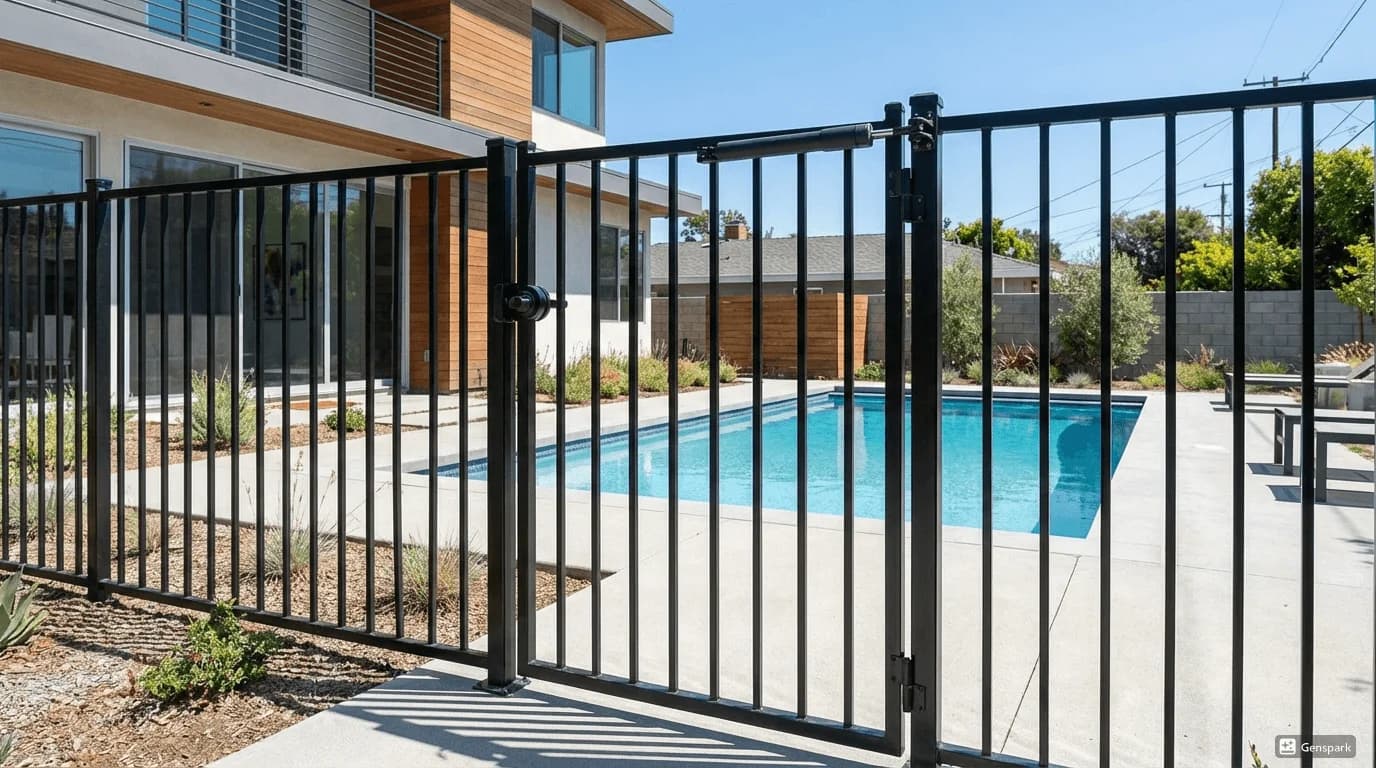
Wrought Iron or Aluminum Fencing
Specifications:
- Vertical picket design prevents climbing
- Powder-coated for corrosion resistance
- Self-closing/latching gates available
Pros:
- Elegant appearance
- Very durable (20+ year lifespan)
- Low maintenance
- Excellent visibility through fence
Cons:
- Higher upfront cost
- Can rust if coating damaged
- Difficult to DIY install
Cost: $25-$50 per linear foot ($3,750-$7,500 for 150-foot perimeter)
Glass Panel Fencing
Specifications:
- Tempered glass panels in metal or wood frames
- Frameless options available (glass-to-glass clamps)
- Height typically 60-72 inches
Pros:
- Unobstructed pool view
- Modern aesthetic
- Wind barrier (pool stays warmer)
- Easy to clean
Cons:
- Most expensive option
- Requires regular cleaning (water spots, fingerprints)
- Glass can chip or crack
- Professional installation required
Cost: $150-$300 per linear foot ($22,500-$45,000 for 150-foot perimeter)
Vinyl or PVC Fencing
Specifications:
- Vinyl panels with aluminum reinforcement
- Various styles (privacy, semi-privacy, picket)
- Height options from 48-96 inches
Pros:
- Never needs painting
- Resistant to moisture and corrosion
- Moderate cost
- DIY-friendly installation
Cons:
- Can become brittle in extreme heat
- Limited color options
- May not meet pool code (check gap requirements)
- Some HOAs restrict vinyl fencing
Cost: $20-$40 per linear foot ($3,000-$6,000 for 150-foot perimeter)
Wood Fencing
Specifications:
- Cedar, redwood, or pressure-treated lumber
- Vertical picket or solid privacy designs
- Requires regular maintenance
Pros:
- Natural appearance
- Can be customized easily
- DIY installation possible
- Moderate initial cost
Cons:
- Requires annual sealing/staining
- Can warp, rot, or split
- 10-15 year typical lifespan
- Privacy designs may violate visibility requirements in some jurisdictions
Cost: $15-$35 per linear foot ($2,250-$5,250 for 150-foot perimeter)
Chain Link Fencing
Specifications:
- Galvanized or vinyl-coated steel mesh
- Maximum mesh size: 1¾ inches for pool barriers
- Height: 60+ inches for pool code compliance
Pros:
- Lowest cost option
- Very durable
- Minimal maintenance
- Meets code when properly installed
Cons:
- Industrial appearance
- Provides minimal privacy
- Can rust (galvanized) or fade (vinyl-coated)
- Many HOAs prohibit chain link
Cost: $8-$18 per linear foot ($1,200-$2,700 for 150-foot perimeter)
Self-Closing Gate Hardware: Options and Costs
Regardless of fence material, all pool gates must have code-compliant self-closing and self-latching hardware.
Spring-Loaded Hinges
Type: Coil or leaf springs integrated into hinges
Cost: $30-$80 per gate (DIY) or $100-$200 (installed)
Pros: Simple, affordable, no maintenance
Cons: Springs weaken over 3-5 years, need replacement
Hydraulic Gate Closers
Type: Fluid-dampened closing mechanism (like commercial door closers)
Cost: $80-$200 per gate (DIY) or $200-$400 (installed)
Pros: Adjustable closing speed, durable (10+ years), smooth operation
Cons: Higher cost, can leak over time
TruClose Hinges (Tension-Based)
Type: Adjustable tension mechanism with no springs
Cost: $100-$150 per pair (DIY) or $200-$300 (installed)
Pros: Highly durable, weather-resistant, adjustable tension, 10+ year lifespan
Cons: Higher upfront cost
Magna-Latch Systems
Type: Magnetic latching with mechanical backup
Cost: $150-$300 per gate (complete system)
Pros: Extremely reliable, meets all code requirements, self-aligning
Cons: Premium pricing
Professional recommendation: For California pool compliance, invest in hydraulic closers or TruClose systems rather than cheap spring hinges. The $100-200 premium provides years of reliable operation and avoids compliance failures from weakened springs.
How PoolVerify Helps with Fence Compliance
Whether you're a pool service professional, safety inspector, or property manager, PoolVerify's California-compliant inspection platform streamlines pool barrier documentation:
Built-In Barrier Compliance Checklists
Our digital inspection platform includes pre-loaded checklists for HSC 115922 requirements:
- Fence height measurement prompts (with photo verification)
- Ground clearance verification
- Gap size documentation
- Gate self-closing function testing
- Gate self-latching function testing
- Latch height measurement
- Safety feature identification and verification
Photo Documentation with Measurements
PoolVerify's photo tools allow inspectors to:
- Capture fence height measurements with on-screen rulers
- Document gate operation with before/after photos
- Photograph latch mechanisms and heights
- Record any compliance issues discovered
- Create visual evidence of barrier condition
All photos are GPS-tagged and timestamped for legal defensibility.
Instant Compliance Reports
Generate professional compliance reports in seconds:
- PDF format for email distribution
- Branded with your company logo and information
- Formatted for insurance requirements
- Includes all photos and measurements
- Compliant with California BPC §7195 and HSC §115922
Historical Tracking for Ongoing Compliance
Track barrier condition over time:
- Compare current inspection to previous visits
- Identify deterioration trends
- Schedule preventive maintenance before compliance failures
- Demonstrate diligent maintenance to insurance companies
Mobile-First Design for Field Inspections
Conduct inspections entirely from your smartphone or tablet:
- No laptop or clipboard needed
- Works offline (syncs when internet available)
- Faster inspections (complete barrier compliance in 5-10 minutes)
- Reduce paperwork and manual data entry
Try PoolVerify's barrier compliance tools: Start your 14-day free trial and see how digital inspections streamline California pool fence compliance documentation.
Pool Fence Compliance by California County
While HSC 115922 establishes statewide minimum requirements, some California counties and cities have additional regulations:
Los Angeles County
Additional requirements:
- Some municipalities require annual pool safety inspections
- Specific enclosure requirements for above-ground pools
- Additional alarm requirements in some jurisdictions
Verify with: LA County Department of Public Health, local building department
San Diego County
Additional requirements:
- Coastal Zone properties may have height restrictions (consult Coastal Commission)
- Some HOAs impose stricter standards than state code
Verify with: San Diego County Building Official, local planning department
Orange County
Additional requirements:
- Some cities require pool barrier inspections during property transfers
- Stricter gap requirements in some municipalities
Verify with: Orange County Building Division, city building departments
Sacramento County
Additional requirements:
- Historical districts may restrict fence materials/appearance
- Some cities require permits for pool barrier installation
Verify with: Sacramento County Planning and Environmental Review
Alameda County
Additional requirements:
- Berkeley and Oakland have additional notification requirements
- Some jurisdictions require landlord inspections of rental properties with pools
Verify with: Local building official, city planning department
Important: Always consult your local building department before installing or modifying pool barriers. Municipal codes may exceed state minimum requirements.
Penalties for Non-Compliance
Building Code Violations
Failure to comply with California pool barrier requirements can result in:
- Stop-work orders during construction
- Certificate of occupancy denial for new homes
- Fines ranging from $500-$5,000+ per violation
- Mandatory correction before pool can be legally used
Liability Exposure
Non-compliant barriers create severe liability if a drowning incident occurs:
- Civil liability for injuries or deaths
- Insurance claim denials (most policies require code compliance)
- Criminal charges (in cases of gross negligence)
- Property liens from civil judgments
Insurance Consequences
Many homeowners insurance policies:
- Require annual pool safety inspections
- May deny coverage for non-compliant barriers
- Increase premiums for pools without proper safety features
- Require specific safety features for coverage
Real case example: A 2023 Los Angeles Superior Court case resulted in a $2.8 million judgment against a homeowner whose non-compliant fence (48-inch height, no self-latching gate) failed to prevent a neighbor child from drowning. The insurance company denied coverage citing willful non-compliance with known safety codes.
Pool Fence Compliance Checklist
Use this comprehensive checklist when installing or inspecting California pool barriers:
Physical Barrier Specifications
- [ ] Fence height minimum 60 inches (exterior side measurement)
- [ ] Ground clearance maximum 2 inches or less
- [ ] All gaps maximum 4-inch diameter or smaller
- [ ] No climbable horizontal members on exterior (or 45+ inches apart)
- [ ] Barrier completely encloses pool area
- [ ] No access to pool without passing through compliant gate
Gate Requirements
- [ ] All gates are self-closing from any position
- [ ] All gates are self-latching automatically
- [ ] Gates open outward (away from pool)
- [ ] Latch release 54+ inches above ground, OR
- [ ] Latch release on pool side, 3+ inches below gate top, with no gaps >½ inch within 18 inches
- [ ] Gate closes completely with no gaps exceeding ½ inch
- [ ] Self-closing mechanism functions properly (test multiple times)
- [ ] Latch engages every time gate closes
Safety Features (Minimum 2 Required)
- [ ] Feature #1 identified: _______________________
- [ ] Feature #1 meets applicable ASTM standard
- [ ] Feature #1 properly installed and functional
- [ ] Feature #2 identified: _______________________
- [ ] Feature #2 meets applicable ASTM standard
- [ ] Feature #2 properly installed and functional
Documentation
- [ ] Photos of fence from multiple angles
- [ ] Photos of all gates (closed and latched)
- [ ] Photos of latch mechanisms and heights
- [ ] Photos of safety features
- [ ] Measurements recorded for fence height
- [ ] Measurements recorded for ground clearance
- [ ] Measurements recorded for latch heights
- [ ] Compliance inspection report completed
Maintenance Schedule
- [ ] Monthly gate testing schedule established
- [ ] Annual professional inspection scheduled
- [ ] Alarm testing schedule (if applicable)
- [ ] Safety cover maintenance plan (if applicable)
Download printable PDF checklist: PoolVerify Barrier Compliance Checklist
Frequently Asked Questions
What is the minimum height for a pool fence in California?
California law requires pool barriers to be a minimum of 60 inches (5 feet) tall, measured from the exterior side facing away from the pool. This requirement is mandated under the California Swimming Pool Safety Act (HSC 115922).
Do pool gates need to be self-closing and self-latching in California?
Yes, all pool gates in California must be self-closing and self-latching. The latch release mechanism must be located at least 54 inches above ground level, or if lower than 54 inches, positioned on the pool side at least 3 inches below the gate top with no openings greater than 1/2 inch within 18 inches of the mechanism.
What are the 7 drowning prevention safety features required by California law?
California HSC 115922 requires pools to have at least 2 of these 7 features: (1) Total pool enclosure isolating from home, (2) Removable mesh fencing meeting ASTM F2286, (3) Safety pool cover meeting ASTM F1346-91, (4) Exit alarm on doors to pool area, (5) Self-closing door device with release 54+ inches high, (6) Water entry alarm meeting ASTM F2208, or (7) Other approved safety devices.
Does my existing pool need to comply with current California fence requirements?
If your pool was built before 2007 and hasn't undergone major remodeling requiring permits, you're not required to upgrade to current standards. However, you must maintain existing fences and gates in working order. Any new construction or substantial remodeling triggers compliance with current HSC 115922 requirements.
How much does a compliant pool fence cost in California?
A code-compliant pool fence in California typically costs $1,500-$8,000 depending on size and material. Mesh fencing costs $10-$20 per linear foot ($1,500-$3,000 for average pool), while wrought iron or aluminum costs $25-$50 per linear foot ($3,750-$7,500). Self-closing, self-latching gates add $150-$500 per gate.
Who inspects pool fences for compliance in California?
Local building code officials inspect pool fences before final approval of permitted construction or remodeling work. The inspector verifies all drowning prevention safety features required by HSC 115922 are properly installed. For routine compliance documentation, many pool service professionals use digital inspection software like PoolVerify to photograph and document barrier conditions.
What are the maximum gap requirements for California pool fences?
California pool fence regulations require maximum vertical clearance from the ground to the bottom of the fence of 2 inches or less. Additionally, gaps in the fence should not allow passage of any object more than 4 inches in diameter to prevent small children from squeezing through.
Can I use my property fence as a pool barrier in California?
Yes, your property fence can serve as the required pool barrier if it meets all California requirements: minimum 60-inch height, maximum 2-inch ground clearance, no gaps larger than 4 inches, and access gates with self-closing, self-latching mechanisms. Many homeowners still install an additional pool-specific barrier for extra safety, which counts as one of the two required drowning prevention features.
Related Resources
- Pool Inspection: Complete Guide [2026] - Comprehensive pool inspection overview including barrier checks
- Pool Inspection Checklist for Professionals - Detailed inspection checklist including fence compliance items
- California Pool Safety Requirements: Complete 2026 Guide - All California pool safety regulations explained
- Pool Gate Safety: Self-Closing and Self-Latching Requirements - Deep dive into gate compliance
- Digital Pool Inspection Software Features - How PoolVerify streamlines barrier compliance documentation
- California Pool Compliance Documentation - BPC §7195 and HSC §115922 compliance tools
Conclusion
Swimming pool fence requirements in California are designed to prevent child drowning incidents through multiple layers of protection. By understanding and implementing HSC 115922 requirements—60-inch minimum fence height, self-closing/self-latching gates, proper ground clearance and gap specifications, and at least two approved safety features—pool owners create safer environments while maintaining legal compliance.
Whether you're installing a new pool, remodeling an existing one, or conducting routine safety inspections, proper barrier compliance protects children, reduces liability exposure, and satisfies insurance requirements.
For pool service professionals and safety inspectors, PoolVerify's digital inspection platform provides the fastest, most thorough way to document pool barrier compliance with built-in HSC 115922 checklists, photo measurement tools, and instant professional reporting.
Ready to streamline your pool barrier inspections? Start your 14-day free trial of PoolVerify and experience how digital tools make California pool fence compliance documentation faster, more thorough, and legally defensible.
Sources
- California Pool Fence Laws & Requirements in 2026
- Swimming Pool Safety Act - California Legislative Information
- California Code, Health and Safety Code - HSC § 115922
- Understanding California Pool Laws: Codes, Fence Regulations
- Pool Code Safety and Compliance - Gate Hardware Center
- Do Pool Gates Need to be Self-Closing? - Life Saver Pool Fence
- The Guide to Pool Fence Building Requirements in California
- California Residential Pool Safety Codes
Last updated: January 31, 2026
Frequently Asked Questions
What is the minimum height for a pool fence in California?
California law requires pool barriers to be a minimum of 60 inches (5 feet) tall, measured from the exterior side facing away from the pool. This requirement is mandated under the California Swimming Pool Safety Act (HSC 115922) and is stricter than the 48-inch minimum required by most other states.
Do pool gates need to be self-closing and self-latching in California?
Yes, all pool gates in California must be self-closing and self-latching. The latch release mechanism must be located at least 54 inches above ground level, or if lower, positioned on the pool side at least 3 inches below the gate top with no openings greater than half an inch within 18 inches.
What are the 7 drowning prevention safety features required by California law?
California HSC 115922 requires pools to have at least two of these seven features: total pool enclosure, removable mesh fencing meeting ASTM F2286, safety pool cover meeting ASTM F1346-91, exit alarms on pool access doors, self-closing door devices with 54-inch release, water entry alarms meeting ASTM F2208, or other approved devices.
How much does a compliant pool fence cost in California?
A code-compliant pool fence in California typically costs $1,500 to $8,000 depending on size and material. Mesh fencing costs $10-$20 per linear foot, while wrought iron or aluminum costs $25-$50 per linear foot. Self-closing and self-latching gates add $150-$500 per gate to the total.
Can I use my property fence as a pool barrier in California?
Yes, your property fence can serve as the required pool barrier if it meets all California requirements: minimum 60-inch height, maximum 2-inch ground clearance, no gaps larger than 4 inches, and access gates with self-closing and self-latching mechanisms. Many homeowners install an additional pool-specific barrier for extra safety.
Related Articles
Pool-compliance
California Pool Barrier Requirements: Complete 2026 Compliance Guide
Complete guide to California pool barrier requirements for 2026. Learn BPC §7195 and HSC §115922 specifications for height, spacing, gates, and materials.

Pool-compliance
Pool Fence Height Requirements: State-by-State Guide [2026]
Complete state-by-state comparison of pool fence height requirements in 2026. Learn minimum heights, measurement methods, and compliance guidelines for all 50 states.
Pool-compliance
Pool Enclosure Requirements: California Guide
Complete California pool enclosure requirements guide covering types, specifications, when required vs fence, height, materials, gaps, permits, and inspections.