Pool-safety
Pool Safety Requirements: Complete California List
Complete list of all California pool safety requirements including barriers, gates, latches, alarms, covers, drains, when they apply, and enforcement.
11 min read
California maintains the most comprehensive pool safety requirements in the United States, with detailed regulations governing every aspect of pool safety from barrier construction to drain cover standards. These requirements, established under multiple California codes, work together to prevent the approximately 350 annual child drowning deaths nationwide.
Understanding exactly what California requires for pool safety is essential for pool owners, contractors, inspectors, and anyone involved in residential swimming pools. This complete guide lists every required safety feature, explains when requirements apply, and clarifies enforcement procedures. Professional inspectors using California-specific inspection software like PoolVerify ensure no required safety features are overlooked.
Table of Contents
- Complete list of California pool safety requirements
- Required safety features checklist
- Barrier requirements detailed
- Gate and latch requirements
- Alarm requirements
- Cover requirements
- Drain safety requirements
- When safety requirements apply
- Enforcement and penalties
- Frequently asked questions
Complete list of California pool safety requirements
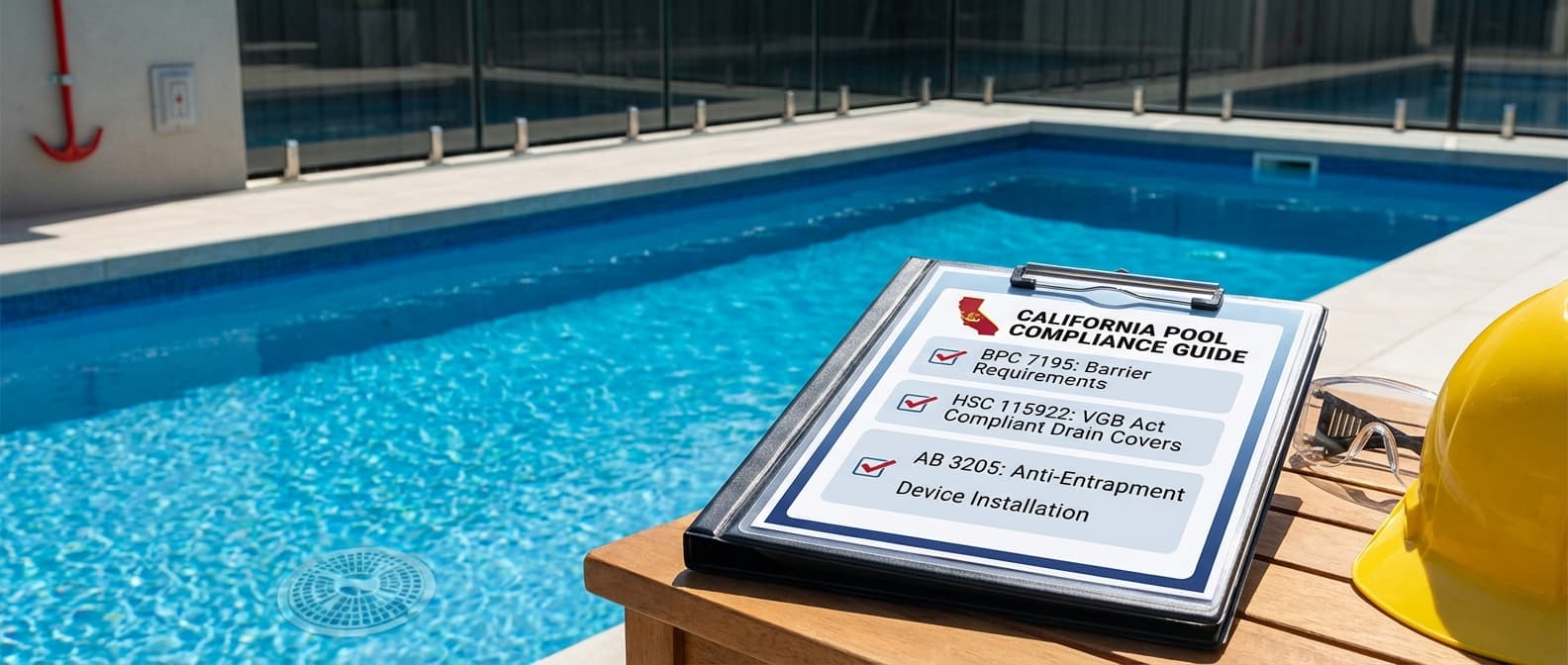
California pool safety requirements stem primarily from three legal sources: Health and Safety Code §115922 (drowning prevention features for new pools), Business and Professions Code §7195 (inspection requirements for property transfers), and California Building Code Chapter 31 (construction standards). These laws create layered requirements ensuring comprehensive pool safety.
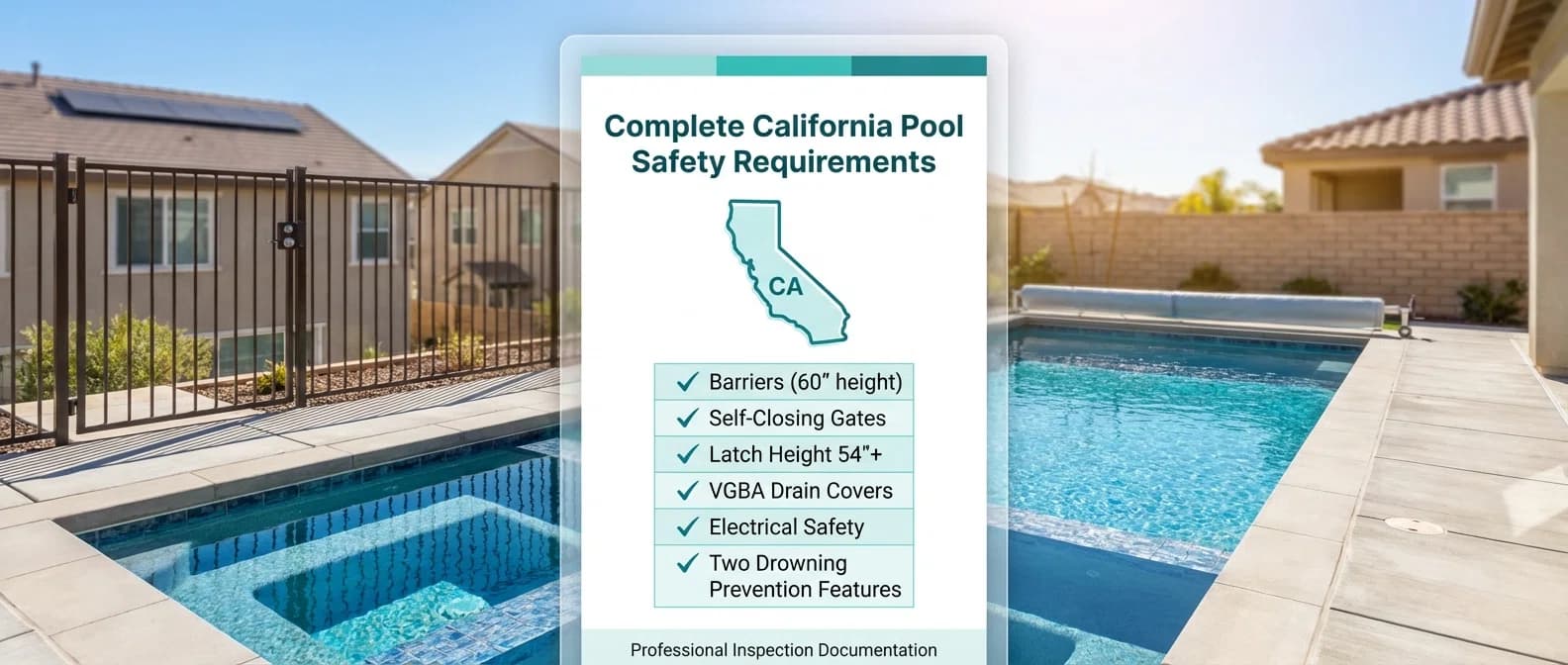
All private single-family home pools must have at least two of seven approved drowning prevention safety features when constructed or substantially remodeled. Additionally, all pools regardless of age must meet barrier construction standards, have VGBA-compliant drain covers, and satisfy electrical safety requirements.
Primary safety requirement categories
California organizes pool safety requirements into distinct categories, each addressing specific drowning hazards:
Physical Barriers: Enclosures, fences, and walls preventing unauthorized pool access
Access Control: Self-closing gates and self-latching mechanisms preventing entry
Detection Systems: Alarms alerting to pool access or surface disturbance
Physical Protection: Safety covers providing barriers over pool water surface
Entrapment Prevention: Drain covers and anti-entrapment systems preventing suction injuries
Electrical Safety: GFCI protection and bonding preventing electrical shock
Water Quality: Chemical handling and water treatment standards
Understanding how these categories interact creates comprehensive safety coverage addressing multiple potential hazards simultaneously.

California pool safety requirements organized by category and hazard type
Ensure complete safety feature compliance
PoolVerify's inspection platform includes comprehensive California safety requirement checklists with photo documentation and instant reporting.
Required safety features checklist
This comprehensive checklist covers all California pool safety requirements. Use it to verify existing pool compliance or plan new pool installations.
Mandatory for all pools (regardless of installation date)
- [ ] Barrier enclosure: Minimum 60-inch height completely surrounding pool
- [ ] VGBA-compliant drain covers: ANSI/APSP-16 certified covers on all suction outlets
- [ ] Anti-entrapment system: Multiple drains, SVRS, or gravity drainage
- [ ] Electrical GFCI protection: All pool electrical equipment and nearby outlets
- [ ] Equipotential bonding: All metal pool components bonded together
- [ ] Maximum 2-inch ground clearance: Between barrier bottom and grade
- [ ] Maximum 4-inch spacing: Between vertical barrier components
- [ ] Self-closing gates: Gates automatically close from any position
- [ ] Self-latching gates: Latches automatically engage when gate closes
- [ ] Latch height minimum 54 inches: Measured from pool side of gate
Required for new pools (post-2018 construction/remodels)
- [ ] Two of seven drowning prevention features: Minimum requirement under HSC §115922
- [ ] Approved feature compliance: Each feature meets specific ASTM or ANSI standards
- [ ] Proper labeling: Required labels/stamps on covers, alarms, drain covers
- [ ] Building permit compliance: Installation matches approved permit plans
- [ ] Final inspection approval: Building department sign-off on safety features
Recommended but not legally required
- [ ] CPR instructions posted: Emergency response guidance visible poolside
- [ ] Emergency contact information: Rescue service phone numbers accessible
- [ ] Pool rules signage: Clear safety rules posted for all users
- [ ] Rescue equipment: Shepherd's hook, life ring, or throw rope available
- [ ] First aid kit: Waterproof kit with basic emergency supplies
This checklist aligns with California pool compliance requirements and forms the foundation for BPC §7195 inspections.

Complete California pool safety requirements checklist with all mandatory features
Barrier requirements detailed
Pool barriers form the primary defense preventing unsupervised child access to pool areas. California's barrier requirements, detailed in California Building Code Section 3109, establish precise construction specifications all pool enclosures must meet.
Barrier height specifications
All pool barriers must be minimum 60 inches (5 feet) tall measured from grade on the side facing away from the pool. This measurement must be maintained at all points around the pool perimeter, including sloped terrain.
Grade is defined as the finished ground surface, not original grade. If ground is built up adjacent to the barrier exterior, height is measured from that elevated surface. Walking surfaces like patios or decks adjacent to barriers establish the measurement point.
Barriers on sloped terrain must meet the 60-inch minimum at the highest point within 3 feet of the barrier's exterior side. This prevents situations where sloping creates low points enabling children to climb over.
Barrier spacing and gap requirements
Horizontal and vertical spacing between barrier components cannot exceed 4 inches at any point. This prevents children from squeezing through fence pickets, rails, or other barrier elements.
Chain link fencing must have maximum 1.75-inch mesh size with maximum 4-inch diamond diagonal measurement. Mesh fencing must conform to ASTM F2286 specifications for removable pool barriers if used as a drowning prevention feature.
Ground clearance between the barrier bottom and grade cannot exceed 2 inches. This prevents children from crawling underneath barriers. Solid barriers built directly on grade can have slightly larger expansion joint gaps if engineered to prevent passage.
Barrier surface requirements
The pool side surface of barriers must be free of handholds, footholds, or other features enabling climbing by children under age 5. Horizontal components like rails or decorative elements on the pool side create climbing hazards.
If horizontal members are present on the pool side, they must be spaced minimum 45 inches apart. When horizontal spacing is less than 45 inches, vertical picket spacing must be maximum 1.75 inches to prevent climbing.
Chain link fabric must be installed with minimal slack and no sagging that could facilitate climbing. Decorative fence toppers must not create handholds accessible to children.

Pool barrier construction showing height, spacing, and surface requirements
Using building walls as barriers
Dwelling walls can serve as part of the pool barrier perimeter, but doors and windows providing pool access must meet specific requirements. Every door providing direct pool access must have one of these features:
- Pool alarm meeting ASTM F2208 standards (surface disturbance alarm)
- Exit alarm on the door with deactivation control 54+ inches above floor
- Self-closing, self-latching door with release mechanism 54+ inches high
Windows with sills less than 60 inches above adjacent walking surfaces must have window guards preventing openings large enough for child passage, or the windows must be designed to prevent opening.
Complete barrier specifications are detailed in our California pool barrier requirements guide and swimming pool fence requirements.
Gate and latch requirements
Self-closing and self-latching gates are critical components of pool barriers that must function properly every time. California pool gate requirements establish specific performance standards ensuring gates provide reliable access control.
Self-closing mechanism requirements
Every gate in a pool barrier must be self-closing, meaning it automatically closes completely from any open position without manual assistance. Gates must close from a full 90-degree open position or greater.
Closing mechanisms include hydraulic gate closers, spring-loaded hinges, gravity-based systems with weighted arms, and tension springs. Whatever mechanism is used, it must function consistently without adjustment or maintenance.
Closing speed must be appropriate—not so fast that it creates a pinch or strike hazard, but fast enough to ensure reliable closure before a child could access the pool area. Most closers complete closure in 15-30 seconds from full open position.
Self-latching mechanism requirements
Gates must be self-latching, automatically engaging the latch when the gate closes without manual operation. Simply closing the gate should fully engage the latch mechanism, securing the gate in the closed position.
Latches must securely hold gates closed against normal opening attempts. Loose, damaged, or improperly adjusted latches that don't fully engage fail to meet requirements even if they're self-latching mechanisms.
The latch release mechanism must be located minimum 54 inches above grade measured from the pool side of the gate. This height prevents young children from reaching and operating the release.
Latch placement options
California allows two latch placement configurations:
High Placement (Preferred): Latch release positioned on the exterior (non-pool) side of the gate, minimum 54 inches above grade. This configuration allows convenient adult access while preventing child operation.
Pool-Side Placement: If the latch release is less than 54 inches from the gate top, it must be positioned on the pool side of the gate, at least 3 inches below the gate top. This forces children to reach over the gate top to access the latch, requiring coordination beyond most young children's capability.
Gate swing direction
Gates must swing outward away from the pool area. This prevents accidental inward gate opening from pool side and ensures gates don't swing into pool areas where they could strike swimmers.
Outward swing also creates a barrier during the opening process, giving adults time to observe the pool area before the gate fully opens and provides access.

Self-closing gate mechanism showing latch height and swing direction requirements
Detailed gate and latch specifications are covered in our pool gate latch requirements and self-closing pool gate guide.
Verify all gate and latch requirements with PoolVerify
Document self-closing and self-latching functionality with video capture and photo evidence in your inspection reports.
Alarm requirements
Pool alarms and exit alarms provide detection systems alerting adults when pool access occurs or surface disturbance indicates someone entered the water. While not required for all existing pools, they're common drowning prevention features under HSC §115922.
Pool surface alarms (ASTM F2208)
Pool alarms detect surface water disturbance indicating someone or something entered the pool. ASTM F2208 establishes performance standards for these devices:
Detection Requirement: Alarm must sound within 30 seconds of surface disturbance equivalent to a child entering the water (approximately 18-pound weight displacement).
Alarm Volume: Audible alarm must be minimum 85 decibels at 10 feet from alarm location, loud enough to be heard inside the dwelling.
False Alarm Resistance: Alarms must distinguish between entry disturbance and normal conditions like wind, rain, or pool equipment operation.
Power Source: Battery-operated alarms must have low-battery warning indicators. Wired alarms should have battery backup preventing power-outage failure.
Reset Mechanism: Alarms must have manual reset capability allowing pool use but preventing extended deactivation. Some models automatically reset after preset time periods.
Exit alarm requirements
Exit alarms install on doors providing direct pool access from dwellings. These alarms sound when doors open, alerting adults that someone accessed the pool area.
Audible Alarm: Must be loud enough to be heard throughout the dwelling, typically 85+ decibels at 10 feet.
Deactivation Control: Manual deactivation mechanism must be positioned 54+ inches above floor on the dwelling side of the door.
Single-Opening Alarm: Alarm must sound for a single door opening, not only when doors remain open.
Deactivation Time: Temporarily deactivation typically allows 15-30 seconds for passing through door before automatic re-arming.
Exit alarms are one of the seven drowning prevention features under HSC §115922 and are commonly used when dwelling walls form part of the pool barrier.
Pool alarm maintenance
Alarms require regular testing and maintenance to remain functional. Monthly testing ensures batteries haven't failed and sensors properly detect water disturbance.
Annual battery replacement (even without low-battery warnings) ensures reliable operation. Check manufacturer specifications for specific maintenance requirements and replacement intervals.

Pool alarm system showing surface alarm and exit alarm installation locations
Complete alarm requirements are detailed in our pool alarm requirements California guide.
Cover requirements
Safety pool covers provide physical barriers preventing water access when pools aren't in use. Not all pool covers meet California safety requirements—only covers meeting specific ASTM standards qualify as drowning prevention features.
ASTM F1346 safety cover standards
ASTM F1346 establishes performance standards for safety pool covers used as drowning prevention features. These covers must:
Support Minimum 485 Pounds: Covers must support weight of two adults and one child (485 pounds) on a 2x2 foot area, preventing anyone from falling through the cover into water below.
Automatic Drainage: Surface water from rain or melting snow must drain automatically preventing water accumulation on cover surface (which creates drowning hazards).
Secure Attachment: Covers must anchor securely to deck or coping preventing removal or displacement by children. Anchors must remain secure with minimal maintenance.
Complete Coverage: When installed, covers must completely span the pool water surface with no gaps large enough for child access.
Labeling: Covers must include permanent labeling indicating ASTM F1346 compliance and installation instructions.
Types of safety covers
Solid Safety Covers: Typically vinyl material in custom pool shapes with deck-mounted anchors. Water drains through automatic cover pumps or mesh panels. Common for winter pool closure.
Mesh Safety Covers: Woven fabric allows water drainage while supporting weight. Lighter than solid covers and easier to remove/install. Popular for seasonal coverage.
Automatic Safety Covers: Track-mounted motorized covers extending and retracting with button operation. Most expensive option but offers convenience encouraging regular use.
Not all automatic covers meet ASTM F1346 standards—verify certification before relying on automatic covers as drowning prevention features.
Non-compliant covers
These common pool covers do NOT meet California safety requirements and cannot serve as drowning prevention features:
Solar Covers: Bubble-style covers providing heat retention but no weight support
Winter Tarps: Basic weighted covers without structural support capability
Floating Covers: Covers resting on water surface without deck attachment
Leaf Nets: Mesh nets designed to catch debris, not support weight
Using non-compliant covers creates false security and doesn't satisfy HSC §115922 requirements.

Safety pool cover installation showing ASTM F1346 compliant cover with anchors
Drain safety requirements
Pool drain safety prevents suction entrapment, a serious hazard addressed by federal Virginia Graeme Baker Pool and Spa Safety Act (VGBA) regulations incorporated into California requirements through HSC §115922.
VGBA-compliant drain cover requirements
All swimming pool and spa suction outlets must be covered with drain covers meeting ANSI/APSP-16 performance standards. Drain covers must:
Match Sump Configuration: Covers must be designed for the specific sump size, shape, and flow rate. Mismatched covers can create dangerous suction.
ANSI/APSP-16 Certification: Covers must display the ANSI/APSP-16 stamp indicating certification and manufacture date.
Secure Fastening: All screws or fasteners must be intact and properly tightened. Missing screws allow covers to dislodge under suction.
Undamaged Condition: Cracks, breaks, missing pieces, or excessive fading indicating UV degradation make covers non-compliant.
Recent Manufacture: Covers should be replaced every 5 years even without visible damage, as UV exposure degrades structural integrity.
Anti-entrapment systems
In addition to VGBA-compliant covers, pools must have anti-entrapment systems preventing body entrapment on single drain outlets. California accepts multiple system types:
Multiple Main Drains: Two or more main drains separated by minimum 3 feet linear distance. If one drain is blocked (by entrapment), water flow continues through other drains reducing suction at the blocked drain.
Gravity Drainage: System design where water returns to filter through unpowered gravity flow rather than pump suction. No suction equals no entrapment hazard.
Automatic Pump Shut-Off: Suction Vacuum Release System (SVRS) that detects flow blockage and automatically shuts off pumps within 2 seconds, eliminating suction before entrapment can occur.
Other Engineered Systems: Approved anti-entrapment devices meeting ASME/ANSI A112.19.17 standards.
At least one anti-entrapment system must be present in addition to VGBA-compliant drain covers.

VGBA compliant drain cover showing ANSI APSP-16 certification stamp
Complete drain safety requirements are detailed in our pool drain cover requirements guide.
Document all drain safety features accurately
PoolVerify helps inspectors photograph drain cover stamps, verify compliance dates, and document anti-entrapment systems in detail.
When safety requirements apply
Understanding when various California pool safety requirements apply clarifies which standards must be met for different pool situations.
New pool construction (post-2018)
Swimming pools and spas constructed after January 1, 2018 (when HSC §115922 took effect) must comply with all requirements:
- Minimum two of seven drowning prevention safety features
- All barrier construction standards (60-inch height, spacing, etc.)
- VGBA-compliant drain covers with anti-entrapment systems
- Electrical safety requirements (GFCI, bonding)
- Plumbing code compliance
- Building permit approval with final inspections
Building permits submitted after this date trigger full HSC §115922 compliance requirements for drowning prevention features.
Substantial pool remodels
"Substantial remodel" of existing pools triggers HSC §115922 requirements for drowning prevention features. California defines substantial remodel as:
- Pool replastering or resurfacing
- Pool equipment replacement (pumps, heaters, filters)
- Structural modifications to pool shell
- Improvements valued at 50%+ of pool replacement cost
Minor repairs like tile replacement, equipment repairs, or cosmetic improvements generally don't trigger drowning prevention feature requirements, though existing barriers and drain covers must remain compliant.
Property transfers
Whenever property with a swimming pool or spa changes ownership, BPC §7195 requires pool safety inspections documenting which drowning prevention features are present. Property transfers include:
- Traditional home sales
- Foreclosures and bank sales
- Estate transfers and inheritances
- Quitclaim deeds and family transfers
- Trust transfers involving ownership change
The inspection doesn't require adding features to pools built before HSC §115922, but documents the pool's current safety status for buyer disclosure.
Existing pools (pre-2018)
Pools constructed before January 1, 2018 are generally grandfathered under prior codes and don't require addition of drowning prevention features unless substantial remodeling occurs. However, these mandatory requirements apply regardless of pool age:
- VGBA-compliant drain covers (required since 2008)
- Electrical GFCI protection and bonding
- Barrier height and spacing standards (if barriers exist)
- Self-closing and self-latching gates
Even grandfathered pools must maintain basic safety standards, though they may not require the full "two of seven" drowning prevention features.

Timeline showing when different California pool safety requirements took effect
Enforcement and penalties
California pool safety requirements are enforced through multiple mechanisms involving different government agencies and legal frameworks.
Building department enforcement
Local building departments enforce California Building Code, Electrical Code, and Plumbing Code requirements through:
Permit Review: Building permit applications for new pools or substantial remodels must demonstrate compliance with all applicable codes before permit issuance.
Construction Inspections: Staged inspections during construction verify proper installation of barriers, electrical systems, plumbing, and safety features.
Final Inspections: Final building inspection confirms all safety features are present and functional before permit closure.
Complaint Response: Building departments investigate code violation complaints and issue correction orders for non-compliant conditions.
Real estate transaction enforcement
BPC §7195 creates enforcement through required disclosure during property sales:
Mandatory Inspections: Sellers must provide pool safety inspection reports to buyers documenting safety feature status.
Disclosure Liability: Sellers who fail to provide required inspections or knowingly misrepresent pool safety conditions face potential lawsuit liability.
Transaction Delays: Escrow companies may delay closing until pool safety inspection reports are provided and reviewed.
Buyer Recission: Material pool safety deficiencies not properly disclosed may give buyers grounds to cancel purchase agreements.
Violation penalties and fines
Penalties for pool safety code violations vary by violation type and jurisdiction:
Building Code Violations: Typical fines $100-$500 per violation per day until corrected. Serious violations may result in pool closure orders.
Unpermitted Construction: Pools built without required permits face retroactive permit requirements, often at double standard permit fees, plus correction of all code deficiencies.
VGBA Violations: Federal VGBA violations can result in pool closure orders and fines. California incorporated VGBA requirements into HSC §115922.
Electrical Violations: Serious electrical code violations may result in immediate power disconnection until corrections are completed and inspected.
Liability for drowning incidents
The most serious consequence of pool safety non-compliance is liability if drowning incidents occur:
Civil Liability: Pool owners may face civil lawsuits for wrongful death or injury if non-compliant safety features contributed to drowning incidents.
Negligence Claims: Failure to maintain required safety features or allowing known code violations to exist can establish negligence in liability cases.
Insurance Issues: Homeowner insurance may deny coverage for incidents involving pools with known code violations or missing required safety features.
Criminal Charges: In extreme cases involving gross negligence or repeated violations after warnings, pool owners may face criminal charges if drownings occur.
Maintaining compliance protects both safety and legal liability. Professional pool safety inspections identify issues before they create enforcement or liability problems.

Code enforcement process showing inspection, violation notice, correction, and re-inspection
Frequently asked questions
What pool safety features are required in California?
All California pools must have barriers (60-inch minimum height), self-closing/self-latching gates, VGBA-compliant drain covers, and electrical safety features (GFCI protection and bonding). Pools built or substantially remodeled after January 2018 must also have at least two of seven drowning prevention features including enclosures, mesh fencing, safety covers, alarms, or compliant doors.
Do existing pools need to be upgraded to current standards?
Pools built before 2018 are generally grandfathered under prior codes and don't require drowning prevention feature additions unless substantial remodeling occurs. However, all pools regardless of age must have VGBA-compliant drain covers (since 2008), proper electrical safety, and compliant barriers if barriers exist. Basic safety standards apply to all pools.
How often do pools need safety inspections in California?
Professional pool safety inspections are required during property transfers under BPC §7195. Otherwise, no mandatory inspection schedule exists for residential pools. However, pool owners should perform monthly safety checks during swimming season, and professional inspections every 2-3 years are recommended to identify compliance issues before property sales.
Can I get fined for not having proper pool safety features?
Yes. Building departments can issue citations and fines for code violations, typically $100-$500 per violation per day until corrected. More serious consequences include pool closure orders, retroactive permit requirements, and potential liability if drowning incidents occur. Unpermitted pools face the strictest penalties including demolition orders in extreme cases.
What's the most commonly missing pool safety feature?
VGBA-compliant drain covers are frequently non-compliant due to age (covers degrade over 5-7 years), missing screws, cracks, or mismatched covers that don't fit sump configurations. The second most common deficiency is malfunctioning self-closing or self-latching gate mechanisms that haven't been properly maintained. Regular pool safety inspections identify these issues.
Conclusion
California pool safety requirements create comprehensive protection against drowning hazards through layered requirements covering barriers, gates, alarms, covers, drains, and electrical safety. Understanding exactly which requirements apply to your pool situation—whether new construction, remodel, existing pool, or property transfer—ensures compliance and prevents enforcement issues.
Pool owners should perform regular safety checks using a comprehensive pool safety checklist, and schedule professional inspections every 2-3 years even when not selling property. Proactive compliance prevents code violations, protects children, and avoids liability exposure.
Professional pool inspectors can streamline California pool safety compliance verification with PoolVerify's specialized inspection platform. Complete comprehensive BPC §7195 inspections in 15 minutes with pre-built California checklists, integrated photo documentation of all safety features, and instant PDF reports meeting all legal disclosure requirements. Start your free 14-day trial today.
Related posts
Frequently Asked Questions
What pool safety features are required in California?
All California pools must have barriers (60-inch minimum height), self-closing and self-latching gates, VGBA-compliant drain covers, and electrical safety features including GFCI protection and bonding. Pools built or remodeled after January 2018 must also have at least two of seven drowning prevention features.
Do existing pools need to be upgraded to current safety standards?
Pools built before 2018 are generally grandfathered and do not require drowning prevention feature additions unless substantial remodeling occurs. However, all pools regardless of age must have VGBA-compliant drain covers, proper electrical safety, and compliant barriers if barriers exist.
How often do pools need safety inspections in California?
Professional pool safety inspections are required during property transfers under BPC §7195. No mandatory inspection schedule exists for residential pools otherwise. Pool owners should perform monthly safety checks during swimming season, and professional inspections every two to three years are recommended.
Can I get fined for not having proper pool safety features?
Yes. Building departments can issue citations and fines for code violations, typically $100-$500 per violation per day until corrected. More serious consequences include pool closure orders, retroactive permit requirements, and potential civil and criminal liability if drowning incidents occur.
What is the most commonly missing pool safety feature?
VGBA-compliant drain covers are frequently non-compliant due to age, missing screws, cracks, or mismatched covers. The second most common deficiency is malfunctioning self-closing or self-latching gate mechanisms that have not been properly maintained over time.
Related Articles
Pool-compliance
California Pool Laws: Complete 2026 Compliance Guide
Complete guide to California pool laws including BPC §7195, HSC §115922, AB 3205, and SB 552. Learn requirements for new construction, existing pools, rental properties, enforcement, and penalties.
Pool-compliance
California BPC §7195: Complete Pool Inspection Guide for Home Inspectors & Property Owners
Complete guide to California Business & Professions Code §7195 pool inspection requirements for property transfers. Learn inspection procedures, reporting requirements, penalties, training, and compliance for 2026.
Pool-compliance
Pool Compliance California: Complete Requirements Guide
Complete California pool compliance guide covering BPC §7195, HSC §115922, Title 24 requirements, and AB 3205. Stay compliant with 2026 regulations.