Pool-compliance
Pool Compliance California: Complete Requirements Guide
Complete California pool compliance guide covering BPC §7195, HSC §115922, Title 24 requirements, and AB 3205. Stay compliant with 2026 regulations.
12 min read
Navigating California pool compliance requirements can be overwhelming. Multiple code sections, changing regulations, and strict safety standards create a complex compliance landscape for homeowners, pool builders, and inspectors.
This comprehensive guide consolidates everything you need to know about California pool compliance in 2026—from mandatory safety features to property transfer requirements, from new construction standards to Title 24 energy efficiency rules.
Whether you're buying a home with a pool, building a new pool, or conducting compliance inspections, this guide provides the complete roadmap to California pool regulatory requirements.
Table of Contents
- California Pool Compliance Overview
- Key California Pool Laws and Codes
- BPC §7195: Property Transfer Requirements
- HSC §115922: Seven Required Safety Features
- AB 3205: Swimming Pool Safety Act
- Title 24: Energy Efficiency Requirements (2026)
- Barrier and Fence Compliance
- Gate Requirements
- Electrical Compliance
- When Compliance is Required
- Who Can Perform Compliance Inspections
- Penalties for Non-Compliance
- How to Achieve and Maintain Compliance
- Frequently Asked Questions
California Pool Compliance Overview
California has some of the most stringent pool safety and compliance regulations in the United States. These requirements exist to prevent drowning accidents, protect children, and ensure energy efficiency.
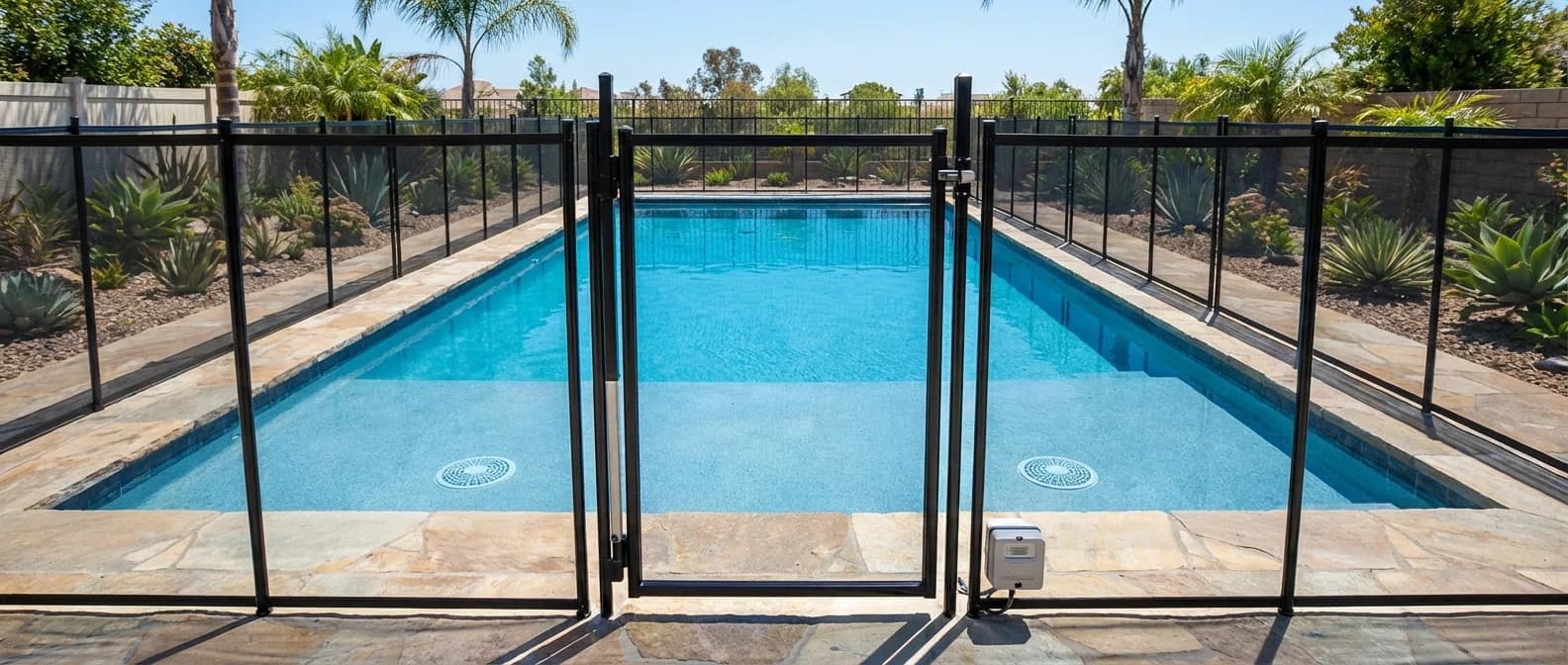
Beautiful California residential pool with compliant 60-inch safety fence, self-closing gates, pool alarm, and compliant safety features
Why California Pool Compliance Matters
Safety: California averages 70-80 childhood drowning deaths annually. Compliance requirements dramatically reduce these tragedies.
Legal liability: Non-compliant pools create legal exposure for homeowners and property owners.
Property sales: Compliance certification is mandatory for most residential property transfers involving pools.
Fines and penalties: Non-compliance can result in substantial fines, code enforcement actions, and denied building permits.
Insurance: Some insurance companies require pool safety compliance for coverage.
Compliance applies to:
- Residential swimming pools (in-ground and above-ground)
- Residential spas and hot tubs
- Pools at single-family homes
- Pools at multifamily properties
- Condominiums with pools
- Vacation rentals with pools
Commercial pools follow different regulations under California Title 22 and local health department codes.
Key California Pool Laws and Codes
California pool compliance involves multiple code sections and regulations:
1. Business and Professions Code §7195 (BPC §7195)

Infographic of California seven drowning prevention safety features
Applies to: Property transfers (sales, exchanges, real property transfers)
Requires: Written inspection report identifying which drowning prevention safety features the pool possesses
Effective: Amended most recently in 2024 with enhanced requirements
Key requirement: Must specify if pool has fewer than two safety features
2. Health and Safety Code §115922 (HSC §115922)
Applies to: New construction and remodels after January 1, 2007
Requires: Pools must have at least two of seven approved drowning prevention safety features
Effective: Swimming Pool Safety Act requirements
Enforcement: Local building departments verify compliance before issuing permits
3. AB 3205: Swimming Pool Safety Act

California AB 3205 seven drowning prevention features with detailed specifications
Signed: 2017 (effective January 1, 2018)
Purpose: Strengthened previous pool safety requirements
Key change: Updated requirements for residential pools during property transfers
Scope: All residential swimming pools and spas (including hot tubs)
Swimming Pool Safety Act details
4. Title 24, Part 6: Energy Efficiency Standards
Major update: January 1, 2026 new requirements
Focus: Energy efficiency for pool heating and equipment
Impact: Shifts industry toward renewable energy and away from gas heating
Applies to: New pool construction and major remodels adding heating systems
California Title 24 pool requirements
5. Local Ordinances
Many California cities and counties have additional requirements beyond state minimums:
- Los Angeles: Enhanced fence requirements in some areas
- San Diego: Specific alarm requirements
- San Francisco: Additional barrier standards
- Orange County: Five-foot pool clearance requirements
Always verify local requirements with your city or county building department.

Infographic showing hierarchy of California pool laws from state codes to local ordinances with BPC, HSC, AB 3205, and Title 24
BPC §7195: Property Transfer Requirements
Business and Professions Code §7195 establishes mandatory pool inspection requirements when transferring real property with swimming pools or spas.
When BPC §7195 Applies
The law requires pool compliance inspections in connection with:
- Sale of residential property with pool or spa
- Exchange of real property
- Transfer of real property ownership
- Refinancing (some lenders require compliance verification)
Inspection Requirements
A qualified inspector must conduct a noninvasive physical examination identifying:
- Which of the seven HSC §115922 drowning prevention safety features are present
- Whether each present feature is in good repair
- Whether each feature is operable as designed
- Whether features are appropriately labeled (where applicable)
Written Report Mandates
The inspection report must:
- List all seven safety features
- Indicate which features are present/absent
- Note compliance status of present features
- Specifically state if the pool has fewer than two safety features
- Include inspector certification and license information
Important Clarification
BPC §7195 inspections do NOT require:
- Determination of ASTM or ASME specification compliance
- Invasive testing or destructive examination
- Certification that pool "passes" or "fails"
- Repair or correction of deficiencies (only identification)
The inspector identifies what's present and operational—not whether it meets exact technical specifications.
Compliance Timeline
For property sales:
- Inspection typically ordered during escrow period
- Report delivered to buyer before close of escrow
- Some municipalities require filing with building department
- Typical turnaround: 3-7 business days from inspection to report
Streamline BPC §7195 compliance inspections
PoolVerify's California-specific inspection platform includes pre-built BPC §7195 templates with all seven required safety features. Complete inspections in 15-25 minutes and generate professional compliance reports instantly.
HSC §115922: Seven Required Safety Features
Health and Safety Code §115922 defines the seven approved drowning prevention safety features that pools may use to achieve compliance. Pools built or substantially remodeled after January 1, 2007 must have at least two of these seven features.
The Seven Approved Safety Features
1. Enclosure Meeting ASTM F1908
An enclosure (fence or barrier) that isolates the pool from access to the home and meets ASTM International F1908 standard specifications.
Requirements:
- Minimum 60 inches (5 feet) in height
- Self-closing, self-latching gate
- Latch release 54 inches from ground minimum
- No gaps larger than 4 inches
- Ground clearance maximum 2 inches
Most common compliance method: Traditional pool fencing with compliant gates.
2. Approved Safety Cover Meeting ASTM F1346
A removable mesh safety cover or automatic safety cover meeting ASTM F1346 standards.
Requirements:
- Completely covers pool water surface
- Meets ASTM F1346 performance specifications
- Properly installed and functional
- Can support weight according to specifications
Note: Winter tarps and solar covers do NOT qualify.
3. Exit Alarms on Doors/Windows
Alarms on all doors and windows providing direct access to pool area.
Requirements:
- Audible alarm at minimum 85 decibels
- Alarm sounds when door or window opens
- Alarm resets automatically when closed
- Battery backup (if powered)
- Complies with manufacturer specifications
Best for: Pools where home has direct access to pool area (no isolation fence).
4. Self-Closing, Self-Latching Door Device with 54" Release
A self-closing, self-latching device on doors providing direct pool access, with latch release at least 54 inches above threshold.
Requirements:
- Door automatically closes from any open position
- Latch automatically engages when door closes
- Latch release positioned 54 inches minimum from threshold
- Door opens away from pool
Common on: Sliding glass doors, French doors opening to pool areas.
5. Pool Alarm Meeting ASTM F2208
An alarm detecting water surface disturbance meeting ASTM F2208 standards.
Requirements:
- Detects entry into pool water
- Sounds alarm at minimum 85 decibels
- Meets ASTM F2208 performance specifications
- Battery backup
- Can be temporarily deactivated for swimming (with auto-reset)
Types: Surface wave detection alarms, subsurface disturbance alarms.
6. Removable Mesh Fencing Meeting ASTM F2286
Removable mesh pool fencing meeting ASTM F2286 standards, completely surrounding pool.
Requirements:
- Minimum 48 inches in height (some jurisdictions require 60 inches)
- Meets ASTM F2286 mesh fence specifications
- Self-closing, self-latching gate
- Completely encloses pool area
Popular option: Temporary fencing for pools at homes with small children.
7. Other Approved Devices or Structures
Any other means of protection approved by the local building official that equals or exceeds performance standards.
Examples:
- Automatic pool covers (not manually operated)
- Combination systems approved locally
- Innovative barrier systems meeting safety standards
Important: Must receive local building department approval before relying on this option.
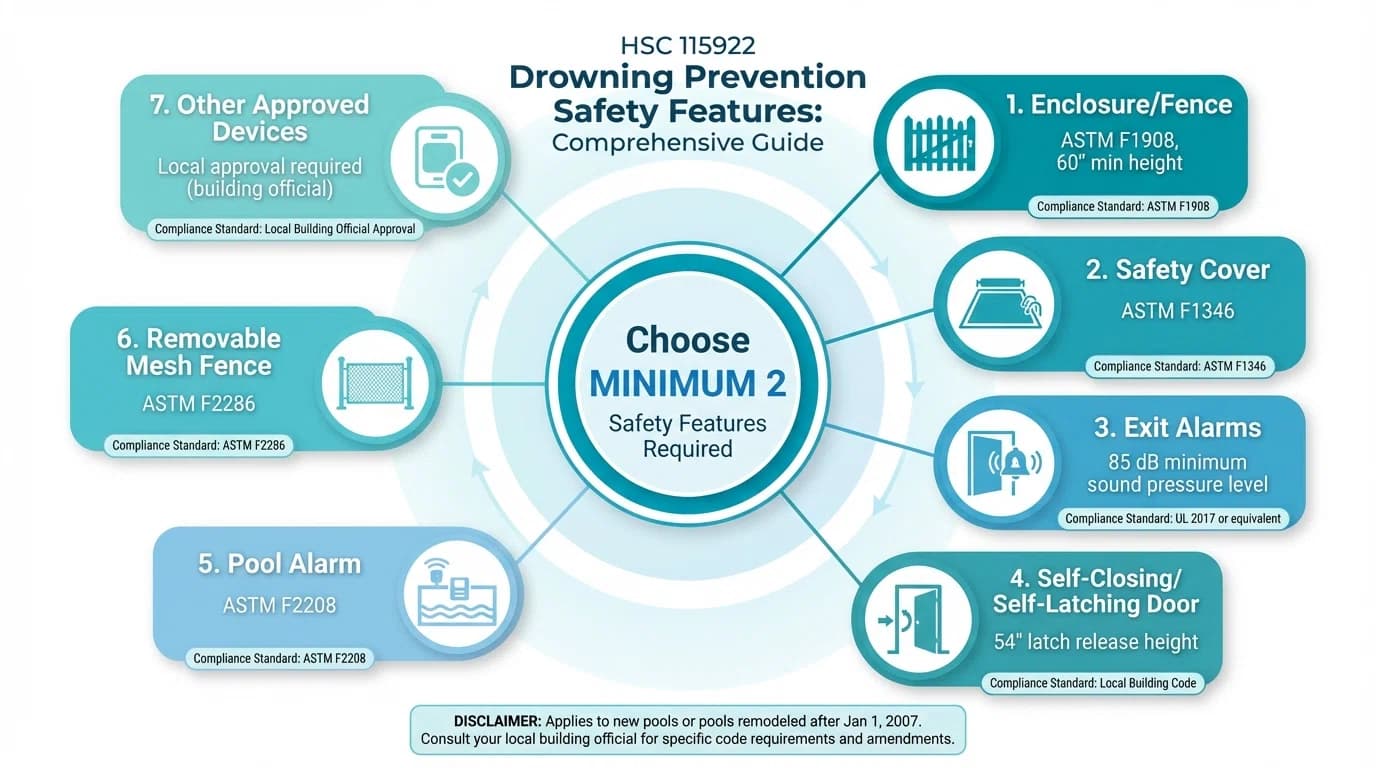
Visual diagram showing all seven HSC 115922 drowning prevention safety features with icons and compliance requirements for each
Most Common Compliance Combinations
Combination 1: Fence + Pool Alarm (70% of pools)
- 60-inch isolation fence with compliant gates
- Plus ASTM F2208 pool alarm
Combination 2: Fence + Exit Alarms (20% of pools)
- Isolation fence around pool
- Plus exit alarms on all doors/windows with pool access
Combination 3: Fence + Safety Cover (5% of pools)
- Barrier fence
- Plus ASTM F1346 safety cover
Combination 4: Exit Alarms + Self-Closing Doors + Pool Alarm (5% of pools)
- Multiple features for pools with direct home access
- No isolation fence
Most homeowners choose fence-based combinations for reliability and lower maintenance.
AB 3205: Swimming Pool Safety Act
Assembly Bill 3205, signed in 2017 and effective January 1, 2018, strengthened California's Swimming Pool Safety Act under HSC §115920-115929.
What AB 3205 Changed
Previous law: Required one of seven safety features
AB 3205 requirement: Requires at least two of seven safety features for pools built or remodeled after 2007
Additional clarification: Extended requirements explicitly to spas and hot tubs
Enhanced enforcement: Strengthened inspection and reporting requirements for property transfers
Who Must Comply with AB 3205
Mandatory compliance:
- All new residential pools (construction after 2007)
- Pools with substantial remodels adding or replacing heating equipment (after 2007)
- Properties selling or transferring with pools (inspection required)
Grandfathered pools:
- Pools built before 2007 may have fewer than two features
- But property transfer inspections must still document what features exist
- Upgrading older pools to two features is recommended but not always mandatory
AB 3205 and Property Transfers
When selling a home with a pool:
- Inspection required: Must hire qualified inspector
- Report generated: Inspector documents which safety features present
- Disclosure to buyer: Seller provides report to buyer
- Municipal filing: Some jurisdictions require filing with building department
- Close of escrow: Compliance documentation completed before transfer
Important: The inspection identifies features—it doesn't mandate upgrades for pre-2007 pools, though upgrades are strongly recommended for safety.
Title 24: Energy Efficiency Requirements (2026)
California Title 24, Part 6 includes building energy efficiency standards that significantly impact pool construction and heating systems. Major changes took effect January 1, 2026.
2026 Title 24 Changes for Pools
According to industry analysis and compliance guides, the 2026 requirements represent a fundamental shift toward renewable pool heating.
Primary Heating Source Requirements
For new pools or major remodels (adding/replacing heating systems):
Required: Must use one of these as primary heat source:
- Heat pump (sized per JA16.3 standards), OR
- Solar thermal system (60% coverage residential, 65% nonresidential)
Prohibited as primary source: Gas-fired heaters cannot serve as sole or primary heating
Allowed as backup: Gas heaters may serve as backup/supplemental heat only
Mandatory Pool Cover Requirement
Any outdoor pool or spa equipped with gas heater OR heat pump must have:
- Pool cover meeting specifications
- Reduces heat loss
- Improves energy efficiency
Covers required for: All heated outdoor pools (new construction)
Demand Response Requirements
New pool control systems must:
- Be capable of demand response communication
- Allow grid communication for energy optimization
- Respond to peak demand periods
- Enable load shifting during high-use electricity times
Purpose: Integrate pool heating with grid management, reduce peak demand
Enforcement and Compliance
Building permits: All new pool construction and major remodels require Title 24 compliance verification
Plan review: Building departments verify heating system specifications meet 2026 standards
Inspection: Field verification of installed equipment before certificate of occupancy
Documentation: CF1R forms (Certificate of Compliance) required demonstrating compliance
Impact on Pool Owners and Builders
Cost implications:
- Heat pumps: $3,000-7,000 installation
- Solar thermal: $3,000-8,000 installation
- Pool covers: $500-3,000 depending on type
- Higher upfront costs, lower operating costs
Energy savings:
- Heat pumps use 50-80% less energy than gas heaters
- Solar thermal provides nearly free heating (after installation)
- Pool covers reduce heat loss by 70-90%
Environmental benefits:
- Significant reduction in natural gas consumption
- Lower greenhouse gas emissions
- Supports California carbon neutrality goals

Diagram showing Title 24 2026 compliant pool heating system options including heat pump, solar thermal, and backup gas heater configurations
Barrier and Fence Compliance
Pool barriers and fencing represent the most common safety compliance method in California. Understanding detailed requirements ensures proper installation and compliance.
Height Requirements
California standard: Minimum 60 inches (5 feet) measured from exterior grade
Measurement point: From ground level on exterior (away from pool) side to top of fence
Critical: Many other states require only 48 inches—California is stricter
Above-ground pools: Same 60-inch requirement applies if pool wall is less than 48 inches high or has permanent access ladder
Gap and Spacing Requirements
Vertical spacing: Maximum 4-inch gap between vertical fence elements
Test: 4-inch diameter sphere must not pass through
Ground clearance: Maximum 2-inch gap between bottom of fence and ground
Exception: Maximum 4-inch gap allowed if ground is solid surface (concrete, pavers) on exterior side
Horizontal members: If fence has horizontal rails, must be:
- On pool side only (no climbing assistance from exterior), OR
- Spaced less than 45 inches apart with minimum 4-inch separation between horizontal members
Material Options
Acceptable barrier materials:
- Wrought iron or aluminum fencing
- Vinyl or PVC privacy fencing
- Wood fencing (solid or picket style)
- Glass panel barriers
- Removable mesh fencing (ASTM F2286)
- Masonry or concrete walls
- Home walls (if no direct access doors/windows)
Material must:
- Withstand normal weathering
- Maintain structural integrity
- Provide continuous barrier when gates closed
Climbable Objects
48-inch rule: No objects creating handholds or footholds within 48 inches horizontally of fence exterior
Prohibited near fence:
- Trees or large shrubs
- Playground equipment
- Furniture (benches, planters)
- Decorative features
- Air conditioning units
- Pool equipment (if provides climbing assistance)
Purpose: Prevents children from using objects to climb over barrier
For more details, see our guide on California pool barrier requirements.
Gate Requirements
Self-closing, self-latching gates are mandatory for California pool compliance. Gates are often the weakest point in barrier systems, so proper installation and maintenance is critical.
Self-Closing Mechanism
Requirement: Gate must automatically close from any open position
Test positions:
- Fully open (90 degrees)
- Half open (45 degrees)
- Minimum California test: 12 inches from post
Mechanism types:
- Spring-loaded hinges ($30-80)
- Hydraulic closers ($80-200)
- TruClose-style hinges ($100-150)
- Magnetic systems ($150-300)
All positions: Gate must close completely and latch automatically
Self-Latching Mechanism
Requirement: Latch must automatically engage when gate reaches closed position
Types:
- Gravity latches (close and latch by gravity)
- Spring-loaded latches
- Magnetic catch systems
- Combination closer/latch mechanisms
No manual latching: Residents cannot be required to manually engage latch
Latch Release Height
California requirement: Latch release must be minimum 54 inches from ground
Measurement: From ground on exterior side to latch release mechanism
Purpose: Keeps release mechanism beyond reach of young children (typically 36-48 inches tall)
Exception: Latch release may be on pool side of gate if positioned 54 inches minimum from ground or positioned 3 inches below top of gate on pool side (and gate is 60 inches minimum)
Gate Opening Direction
Requirement: Gate must open away from pool (outward)
Reason: Prevents children from pushing through gate into pool area
Enforcement: Building inspectors verify opening direction during final inspections
Pedestrian vs Vehicle Gates
Pedestrian gates: All requirements apply—self-closing, self-latching, 54-inch latch height
Vehicle/RV gates: May have different standards if:
- Manually operated only
- Not used for routine pedestrian access
- Alternative pedestrian gate exists with proper mechanisms
Verify locally: Some jurisdictions require all gates to be self-closing
For detailed gate requirements, see our guide on pool gate latch requirements.
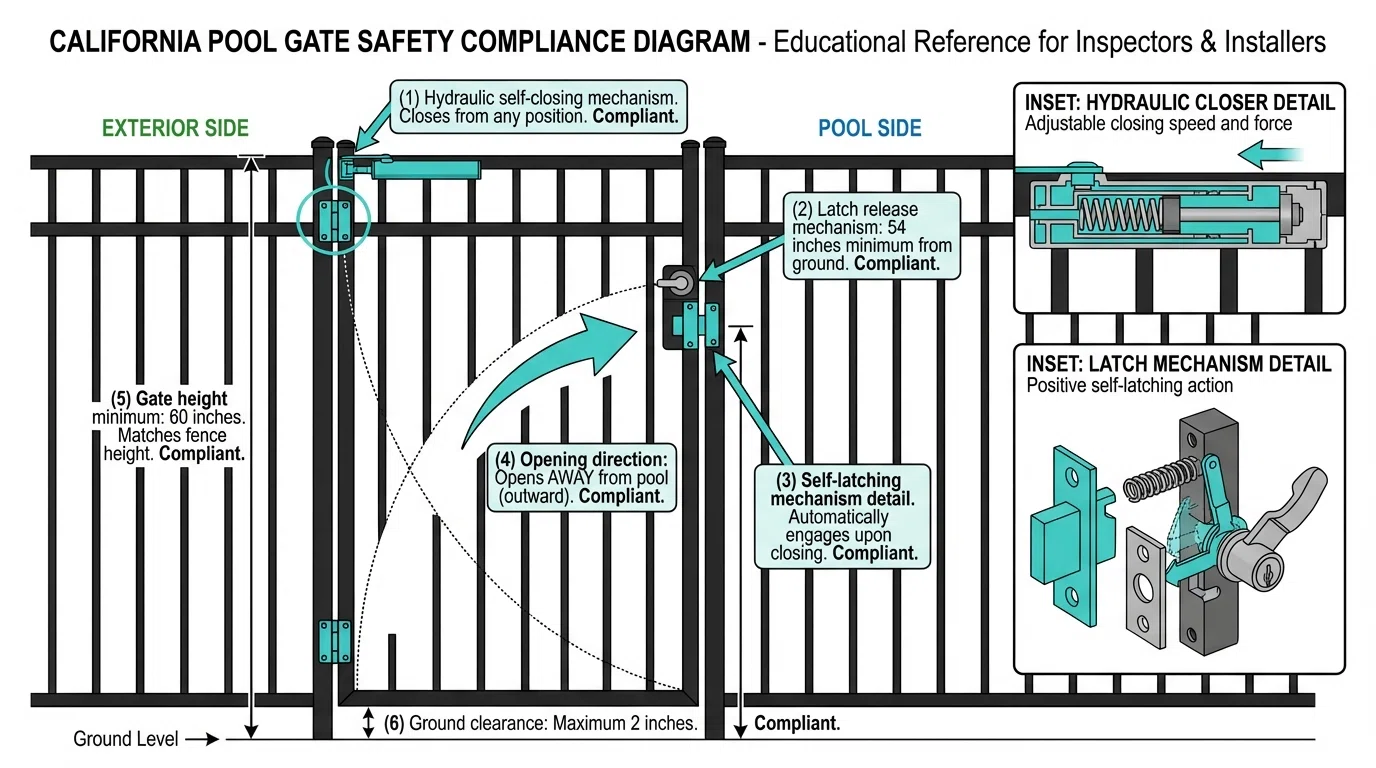
Technical diagram showing compliant pool gate with self-closing mechanism, self-latching hardware, 54-inch latch height, and outward opening direction
Electrical Compliance
Pool electrical systems must comply with California Electrical Code (Title 24, Part 3) and National Electrical Code (NEC) Article 680.
GFCI Protection Requirements
All 120-volt circuits serving pool equipment must have Ground Fault Circuit Interrupter (GFCI) protection.
Required GFCI protection for:
- Pool pump motors
- Pool lighting (underwater and deck)
- Heaters and heat pumps
- Automatic pool covers
- Water features and fountains
- Any electrical outlet within 20 feet of pool
Test frequency: Monthly GFCI testing recommended
Bonding Requirements
Equipotential bonding required for all metallic components:
- Pool structure (reinforcing steel)
- Perimeter surfaces (deck reinforcement)
- Metallic equipment (pumps, filters, heaters)
- Metal fencing and railings
- Water features
- Diving boards and slides
Bonding conductor: Minimum 8 AWG copper
Purpose: Eliminates voltage gradients, prevents electric shock
Grounding Requirements
Equipment grounding required for all pool electrical equipment
Grounding methods:
- Equipment grounding conductor in circuit
- Metallic conduit system (where permitted)
- Connection to grounding electrode system
Clearance Requirements
Overhead power lines: Minimum clearances from pool water:
- 750 volts or less: 22.5 feet
- Over 750 volts: Consult NEC 680.8
Electrical outlets: No outlets within 5 feet of pool edge (except GFCI-protected, specific use)
Switches and controls: Minimum 5 feet from pool edge
Underwater Lighting
Low-voltage preferred: 12-volt systems safer than 120-volt
Required:
- GFCI protection (120-volt systems)
- Proper wet-niche installation
- Bonding to equipotential grid
- Watertight conduit seals
Retrofitting older pools: Replacing 120V with low-voltage LED recommended
For detailed electrical requirements, see the California Pool Association's electrical guide.
When Compliance is Required
Understanding when California pool compliance verification is mandatory helps homeowners and pool professionals plan accordingly.
Property Transfer (Sale or Exchange)
Mandatory: BPC §7195 compliance inspection required when:
- Selling residential property with pool or spa
- Exchanging real property with pool
- Transferring property ownership with pool
Timeline: Typically during escrow period, before close
Responsibility: Usually seller's obligation (negotiable in purchase agreement)
New Pool Construction
Mandatory: Full compliance with all applicable codes required, including:
- HSC §115922 (minimum two of seven safety features)
- Title 24 energy efficiency (2026 standards)
- Barrier and gate requirements
- Electrical code compliance
- Local ordinances
Verification: Building department plan review and inspection
Final approval: Certificate of occupancy requires compliance verification
Substantial Remodel or Addition
Triggers compliance requirements:
- Adding or replacing pool heating system (Title 24 applies)
- Expanding pool footprint significantly
- Adding spa to existing pool
- Replacing pool shell or major structural work
Local determination: Building department determines if remodel is "substantial"
Partial compliance: Sometimes limited to modified systems only (consult locally)
Refinancing
Some lenders require pool safety compliance verification
Title company discretion: May request compliance documentation
Not universal: Not all refinances trigger requirement
Municipal Inspections
Periodic inspections: Some jurisdictions conduct random pool safety compliance checks
Complaint-driven: Code enforcement may inspect following neighbor complaints
Vacation rentals: Additional safety inspections may be required
Voluntary Compliance
Highly recommended even when not required:
- Prevents drowning accidents
- Reduces liability exposure
- Increases property value
- Provides peace of mind
Proactive inspections: Homeowners can request voluntary compliance assessments
Who Can Perform Compliance Inspections
California law specifies which professionals may conduct pool safety compliance inspections for BPC §7195 property transfer requirements.
Qualified Inspector Categories
1. Licensed Home Inspectors (HI License)
California-licensed home inspectors certified under BPC §7195 provisions
Scope: Can perform complete pool safety compliance inspections
License verification: California DCA License Search
2. Licensed General Contractors (B License)
General building contractors (B license) may conduct pool inspections
Requirement: Active California contractor's license
Scope: Full pool safety assessment capability
3. Licensed Pool Contractors (C-53 License)
Swimming pool contractors holding C-53 specialty license
Expertise: Pool-specific knowledge and construction experience
Scope: Complete pool compliance inspections
4. Other Qualified Professionals
As defined by local ordinances or BPC §7195:
- Licensed structural engineers (for structural assessments)
- Licensed architects (for design compliance)
- Other professionals approved by local building officials
Inspector Responsibilities
Qualified inspectors must:
- Conduct noninvasive physical examination
- Identify which seven safety features are present
- Assess whether present features are in good repair
- Determine if features are operable as designed
- Document findings in written report
- Sign and certify report
- Provide license number on report
Inspectors are not required to:
- Determine ASTM/ASME specification compliance
- Perform destructive testing
- Certify pool "passes" or "fails"
- Guarantee safety or compliance
- Mandate specific repairs
Choosing an Inspector
Specialized pool inspectors often provide:
- Deeper pool-specific knowledge
- Faster inspection turnaround
- Digital reporting with photos
- Clear compliance recommendations
Digital inspection platforms like PoolVerify help inspectors:
- Complete BPC §7195 inspections in 15-25 minutes
- Generate professional compliance reports instantly
- Document all seven safety features systematically
- Provide branded PDF reports to clients immediately
Streamline your pool compliance inspections
PoolVerify helps licensed inspectors complete California BPC §7195 assessments faster with pre-built compliance templates, instant photo documentation, and professional PDF reports.
Penalties for Non-Compliance
Failing to comply with California pool safety laws can result in serious consequences.
Fines and Citations
Code violation fines: $100-500 per violation (varies by jurisdiction)
Daily penalties: Some municipalities assess daily fines until compliance achieved
Building department stop-work orders: Construction halted until compliance demonstrated
Legal Liability
Personal injury lawsuits: Non-compliant pools create significant liability exposure
Negligence claims: Failure to comply with safety laws strengthens plaintiff cases
Homeowner liability: Can be held responsible for injuries resulting from non-compliant features
Property owner responsibility: Rental property owners liable for tenant/guest injuries
Property Sale Complications
Delayed closings: Non-compliance discoveries can delay escrow
Purchase price reductions: Buyers may demand credits for compliance upgrades
Sale cancellations: Some buyers refuse to proceed with non-compliant pools
Disclosure requirements: Must disclose known non-compliance to buyers
Insurance Issues
Coverage denial: Some insurers deny claims involving non-compliant pools
Policy cancellation: Discovered non-compliance may trigger policy cancellation
Higher premiums: Non-compliant pools may increase insurance costs
Building Department Enforcement
Certificate of occupancy denial: New construction cannot close without compliance
Permit revocation: Permits pulled for non-compliant work
Required corrections: Must upgrade to compliant standards before approval
Criminal Liability (Extreme Cases)
Gross negligence: Egregious non-compliance contributing to drowning may result in criminal charges
Rental property violations: Repeated violations at rental properties can result in prosecution
Rare but possible: Most enforcement is civil, but criminal liability exists in severe cases
Cost of Bringing Non-Compliant Pool to Compliance
Typical upgrade costs:
- New compliant fence: $3,000-10,000
- Gate upgrades: $200-500 per gate
- Pool alarm: $200-500
- Exit alarms: $50-150 per door
- Safety cover: $2,000-15,000
Total compliance cost: $1,000-15,000 depending on existing conditions and required upgrades
Compare to penalties: Proactive compliance is always less expensive than fines, lawsuits, or sale complications
How to Achieve and Maintain Compliance
Ensuring your California pool meets all compliance requirements involves systematic assessment and ongoing maintenance.
Step 1: Understand Applicable Requirements
Determine:
- Pool construction date (pre- or post-2007)
- Whether property transfer is occurring
- New construction or remodel scope
- Local jurisdiction requirements
Research:
- Check city/county building department website
- Review HOA requirements (if applicable)
- Consult local pool compliance guides
Step 2: Conduct Compliance Assessment
Hire qualified inspector to assess:
- Which of seven safety features are present
- Whether features are functional and in good repair
- Barrier and gate compliance
- Electrical system compliance
- Any deficiencies requiring correction
DIY pre-inspection:
- Use our pool safety inspection checklist
- Test gate self-closing and latching mechanisms
- Measure fence height and gaps
- Check alarm functionality
Step 3: Address Deficiencies
Prioritize safety-critical items:
- Non-functional gates (immediate hazard)
- Barrier gaps or height deficiencies
- Inoperable alarms or safety features
- Electrical hazards
Get professional quotes for required upgrades
Complete repairs before inspection or property transfer
Step 4: Schedule Professional Inspection
For property transfers:
- Hire licensed inspector (HI, B, or C-53 license)
- Schedule during escrow period
- Allow 3-7 business days for report
For new construction:
- Schedule building department final inspection
- Ensure all features operational before inspection
- Have compliance documentation ready
Step 5: Obtain Compliance Documentation
Required documents:
- Written inspection report (BPC §7195)
- Certificate of compliance (if required locally)
- Photos of compliant features
- Warranty documentation for equipment
Record retention: Keep compliance records for at least 7 years
Step 6: Maintain Ongoing Compliance
Regular maintenance:
- Test gate self-closing quarterly
- Replace worn gate hardware promptly
- Test alarms monthly (battery and functionality)
- Inspect fence for damage or gaps
- Maintain pool cover (if applicable)
- Test GFCI protection monthly
Annual assessment:
- Comprehensive safety feature check
- Professional inspection every 2-3 years recommended
- Update compliance documentation if modifications made
Step 7: Stay Current with Changing Requirements
Monitor updates:
- California legislation affecting pools
- Local ordinance changes
- New Title 24 requirements
- Industry best practices
Resources:
- California Department of Public Health pool requirements page
- Local building department websites
- Pool industry associations

Flowchart showing 7-step process to achieve and maintain California pool compliance from assessment through ongoing maintenance
Using Digital Tools for Compliance Management
Pool compliance software like PoolVerify helps:
Inspectors:
- Complete BPC §7195 inspections systematically
- Generate compliant reports with required elements
- Document safety features with photos
- Maintain inspection history and records
Homeowners:
- Track compliance status
- Schedule maintenance reminders
- Store compliance documentation
- Prepare for property transfers
Pool professionals:
- Streamline compliance verification
- Provide professional documentation to clients
- Ensure no required features are overlooked
Frequently Asked Questions
Do all California pools need to be compliant?
All California residential pools must meet basic barrier requirements. Pools built or substantially remodeled after January 1, 2007 must have at least two of the seven HSC §115922 drowning prevention safety features. Property transfers require BPC §7195 compliance inspections documenting which features are present.
What are the 7 required pool safety features in California?
California HSC §115922 defines seven approved safety features: (1) Enclosure meeting ASTM F1908, (2) Safety cover meeting ASTM F1346, (3) Exit alarms on doors/windows, (4) Self-closing self-latching doors with 54" release height, (5) Pool alarm meeting ASTM F2208, (6) Removable mesh fencing meeting ASTM F2286, and (7) Other approved devices meeting local standards. Pools need at least two features (for construction after 2007).
How tall does a pool fence need to be in California?
California requires pool barriers to be minimum 60 inches (5 feet) tall, measured from the exterior grade level to the top of the fence. This is higher than the 48-inch national standard and applies to both in-ground and above-ground pools.
Who can perform a pool compliance inspection in California?
Qualified inspectors include licensed home inspectors (HI license), licensed general contractors (B license), licensed pool contractors (C-53 license), and other professionals defined by local ordinances. The inspector must provide a written report certifying the compliance assessment.
How much does it cost to bring a pool into compliance?
Costs vary based on existing conditions and required upgrades. Typical expenses: compliant fencing ($3,000-10,000), gate hardware upgrades ($200-500 per gate), pool alarms ($200-500), exit alarms ($50-150 per door), safety covers ($2,000-15,000). Most pools can achieve compliance for $1,000-5,000 if basic barriers exist.
What happens if I sell my house without pool compliance?
Selling a California home with a pool requires a BPC §7195 compliance inspection. Failure to provide this documentation can delay or derail the sale, result in buyer credits or price reductions, create legal liability, or cause the buyer to cancel the purchase agreement. Most escrow companies and title companies require compliance documentation.
Do I need a pool compliance inspection if my pool was built before 2007?
Yes, property transfers require BPC §7195 inspections regardless of pool age. However, pools built before 2007 may be grandfathered and not required to have two safety features. The inspection must still document which features are present and whether the pool has fewer than two features.
Conclusion: California Pool Compliance Made Simple
California pool compliance requirements are comprehensive, but they serve critical safety purposes. Understanding BPC §7195 property transfer requirements, HSC §115922 safety features, AB 3205 mandates, and Title 24 energy standards ensures your pool meets all legal obligations.
Key compliance takeaways:
- Minimum two of seven safety features required (pools built/remodeled after 2007)
- Property transfers require BPC §7195 inspection by qualified inspector
- 60-inch barrier height minimum (stricter than other states)
- Self-closing, self-latching gates with 54-inch latch release
- Title 24 2026 requirements mandate renewable heating for new pools
- Ongoing maintenance essential to maintain compliance
Stay compliant by conducting regular safety assessments, maintaining all safety features, and hiring qualified inspectors for property transfers.
Professional inspectors: Streamline compliance documentation with PoolVerify's California-specific inspection platform—complete BPC §7195 inspections in 15-25 minutes with pre-built templates and instant professional reports.
Simplify California pool compliance inspections
PoolVerify provides everything inspectors need for BPC §7195 compliance: pre-loaded safety feature checklists, photo documentation, instant PDF reports, and California-specific compliance language.
Related Posts
- California AB 3205 Pool Inspection Requirements
- California Pool Barrier Requirements
- Pool Safety Inspection Checklist
- Pool Inspection Requirements for Home Sales in California
- Pool Gate Latch Requirements
Sources:
Frequently Asked Questions
Do all California pools need to be compliant?
All California residential pools must meet basic barrier requirements. Pools built or substantially remodeled after January 1, 2007 must have at least two of seven HSC §115922 drowning prevention safety features. Property transfers require BPC §7195 compliance inspections documenting which features are present.
What are the 7 required pool safety features in California?
HSC §115922 defines seven approved features: (1) enclosure meeting ASTM F1908, (2) safety cover meeting ASTM F1346, (3) exit alarms on doors and windows, (4) self-closing self-latching doors with 54-inch release, (5) pool alarm meeting ASTM F2208, (6) removable mesh fencing meeting ASTM F2286, and (7) other locally approved devices.
How tall does a pool fence need to be in California?
California requires pool barriers to be minimum 60 inches (5 feet) tall, measured from the exterior grade level to the top of the fence. This is stricter than the 48-inch national standard and applies to both in-ground and above-ground pools with self-closing, self-latching gates required.
Who can perform a pool compliance inspection in California?
Qualified inspectors include licensed home inspectors (HI license), licensed general contractors (B license), licensed pool contractors (C-53 license), and other professionals defined by local ordinances. The inspector must provide a written report certifying which drowning prevention safety features are present.
What happens if I sell my house without pool compliance?
Selling a California home with a pool requires a BPC §7195 compliance inspection. Failure to provide documentation can delay or derail the sale, result in buyer credits or price reductions, create legal liability, or cause the buyer to cancel the purchase agreement entirely.
Related Articles
Pool-compliance
California Pool Laws: Complete 2026 Compliance Guide
Complete guide to California pool laws including BPC §7195, HSC §115922, AB 3205, and SB 552. Learn requirements for new construction, existing pools, rental properties, enforcement, and penalties.
Pool-compliance
How to Ensure Your Pool Meets California Regulations
Step-by-step guide to ensuring your California pool meets BPC §7195 and HSC §115922 regulations. DIY self-assessment, hiring inspectors, and fixing violations.
Pool-safety
Pool Safety Requirements: Complete California List
Complete list of all California pool safety requirements including barriers, gates, latches, alarms, covers, drains, when they apply, and enforcement.