Pool-compliance
How to Ensure Your Pool Meets California Regulations
Step-by-step guide to ensuring your California pool meets BPC §7195 and HSC §115922 regulations. DIY self-assessment, hiring inspectors, and fixing violations.
14 min read
To ensure your pool meets California regulations, you need at least two of the seven drowning prevention safety features listed under HSC §115922, with all features in good working order. California law — specifically BPC §7195 and HSC §115922 — requires pool safety inspections during property transfers and mandates specific barrier, gate, alarm, and drain safety standards for all residential pools and spas.
California has over 1.3 million residential swimming pools (California Energy Commission), and every one of them must comply with state safety regulations. Whether you're selling a home, buying a property with a pool, or simply want to make sure your backyard pool is safe and legal, understanding these requirements is essential.
This guide walks you through a practical, step-by-step process to verify your pool's compliance — from conducting a DIY self-assessment to hiring a qualified inspector and fixing any issues found. Professional inspectors using California-specific inspection software like PoolVerify can streamline the entire compliance verification process on any device.
Table of contents
- Understanding California pool safety laws
- The seven drowning prevention safety features
- Step-by-step pool compliance self-assessment
- When a professional pool inspection is required
- How to hire a qualified pool inspector in California
- Common compliance issues and how to fix them
- Cost of achieving pool compliance in California
- How to maintain ongoing compliance
- Frequently asked questions
Understanding California pool safety laws
California enforces pool safety through two primary statutes: BPC §7195 and HSC §115922. Together, these laws establish what safety features your pool must have, when inspections are required, and what happens if you don't comply.
BPC §7195: property transfer inspections
Business and Professions Code §7195 requires a pool safety inspection whenever a residential property with a swimming pool or spa is transferred through sale, exchange, lease with option to purchase, or installment land sales contract. The inspection must identify which of the seven drowning prevention safety features the pool has and whether they are in good repair and operable.
The inspection report must specifically state if the pool has fewer than two of the seven safety features — a critical compliance threshold.
HSC §115922: mandatory safety features
Health and Safety Code §115922 defines the seven drowning prevention safety features that every California residential pool or spa must have at least two of. This law applies to all residential pools — not just those being sold.
| Law | What It Covers | When It Applies |
|---|---|---|
| BPC §7195 | Inspection requirements during property transfers | Sales, exchanges, lease-purchase agreements |
| HSC §115922 | Seven required drowning prevention safety features | All residential pools and spas in California |
| AB 3205 | Enhanced pool safety standards for new construction | Pools built or remodeled after January 1, 2018 |
For a comprehensive breakdown of all California pool statutes, see our complete California pool laws guide.
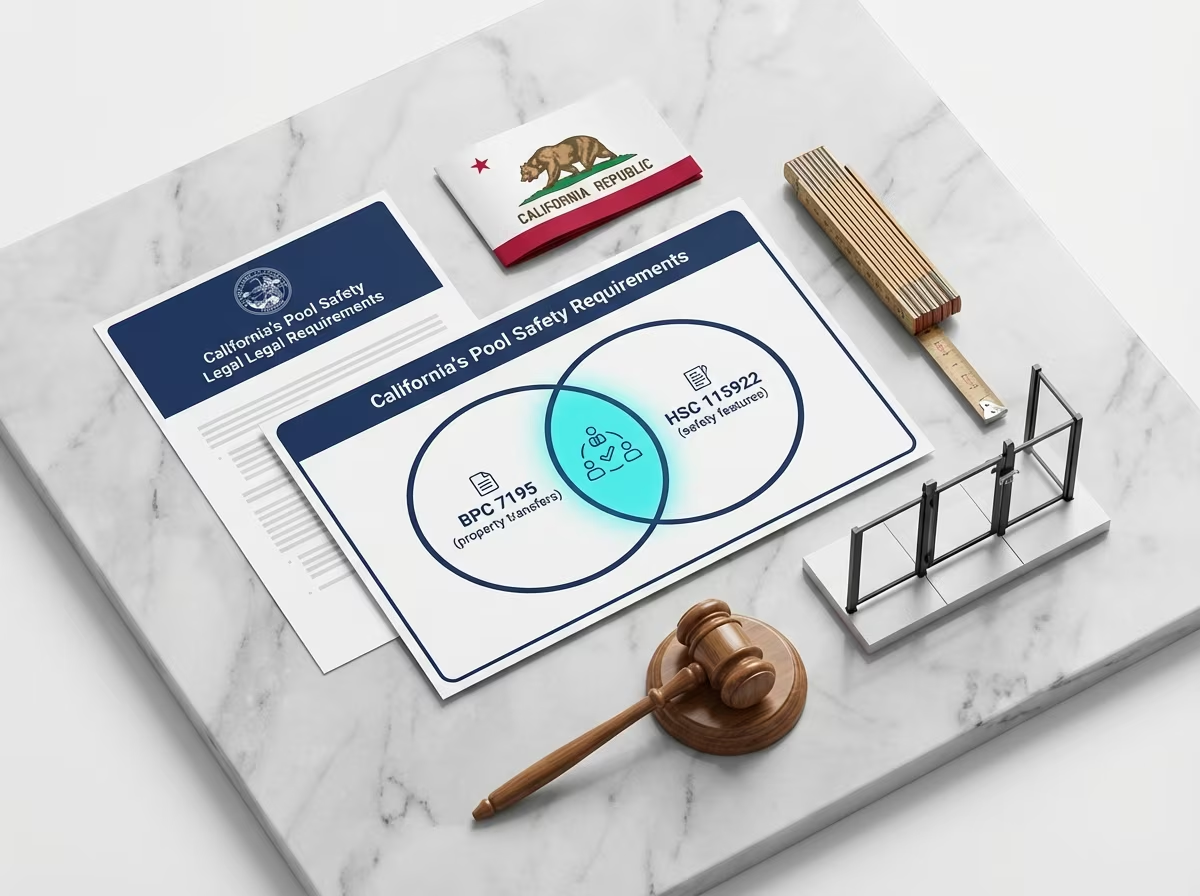
California pool safety law framework showing BPC 7195 and HSC 115922 requirements
The seven drowning prevention safety features
HSC §115922 lists seven specific drowning prevention safety features, and your pool must have at least two of them. According to the Consumer Product Safety Commission (CPSC), drowning is the leading cause of unintentional death for children ages 1–4, making these features critical for child safety.
Here are the seven features California law recognizes:
- Pool isolation fence — An enclosure that meets the California Building Code standards (minimum 60 inches high, no more than 4-inch gaps between vertical members, self-closing and self-latching gate)
- Approved safety pool cover — A motorized or manual cover meeting ASTM F1346 standards that prevents access to the water
- Exit alarms on doors — Alarms on all doors providing direct access to the pool area that sound when opened
- Self-closing, self-latching devices on doors — Hardware on doors leading to the pool area that ensures they close and latch automatically
- Pool alarm — A device installed in the pool that detects unauthorized entry into the water and sounds an alarm
- Removable mesh fencing — A mesh barrier at least 48 inches high that meets ASTM F2286 standards
- Other means of protection — Additional safety measures approved by the local building department, if they provide equivalent protection
The American Academy of Pediatrics emphasizes that a pool isolation fence is the most studied and effective drowning prevention measure for preventing unsupervised child access to pools. California law requires inspectors to include this statement in every inspection report (BPC §7195).
For detailed specifications on each safety feature, see our pool safety requirements guide and pool barrier complete guide.
Step-by-step pool compliance self-assessment
You can perform a preliminary compliance check on your own pool before hiring a professional inspector. This DIY self-assessment helps you identify obvious issues and understand what an inspector will look for.
Step 1: count your safety features
Walk around your pool and identify how many of the seven drowning prevention features you have installed. Remember — you need at least two. Common combinations include:
- Pool isolation fence + exit alarms on doors
- Pool isolation fence + self-closing/self-latching doors
- Pool alarm + approved safety pool cover
- Removable mesh fencing + exit alarms
Step 2: inspect your pool barriers
If you have a pool fence or enclosure, verify these measurements:
- Height: Minimum 60 inches from the exterior side
- Gap spacing: No more than 4 inches between vertical members
- Ground clearance: No more than 2 inches between the bottom of the fence and the ground
- Climbability: No horizontal rails or footholds that children could use to climb
Our California pool barrier requirements guide covers all barrier specifications in detail.
Step 3: test gates and latches
Every gate providing access to the pool area must:
- Self-close from any open position (test by opening the gate 6 inches, 12 inches, and fully — it should close on its own each time)
- Self-latch automatically when the gate closes
- Open outward away from the pool
- Have the latch at least 54 inches from the ground (if the release mechanism is on the pool side)
For more on gate requirements, see our pool gate requirements guide.
Step 4: check alarms and covers
If you rely on alarms or covers as safety features:
- Door alarms: Test each alarm — they should produce an audible sound of at least 50 decibels when any door leading directly to the pool area is opened
- Pool alarms: Verify the alarm activates when the water surface is disturbed (test per manufacturer instructions)
- Safety covers: Check for tears, sagging, or broken anchors — the cover must support the weight of a child without collapsing
Step 5: verify drain safety
HSC §115922 and the federal Virginia Graeme Baker Act require compliant suction outlet covers:
- All drain covers must be ASME/ANSI A112.19.8 certified
- Covers must not be cracked, broken, or missing
- Single main drains must have a safety vacuum release system (SVRS), suction-limiting vent system, or gravity drainage system
For detailed drain safety information, see our suction entrapment prevention guide.
Ready to streamline your California pool safety inspections?
PoolVerify helps inspectors complete BPC §7195 inspections on any device with built-in California compliance checklists and instant PDF report generation.
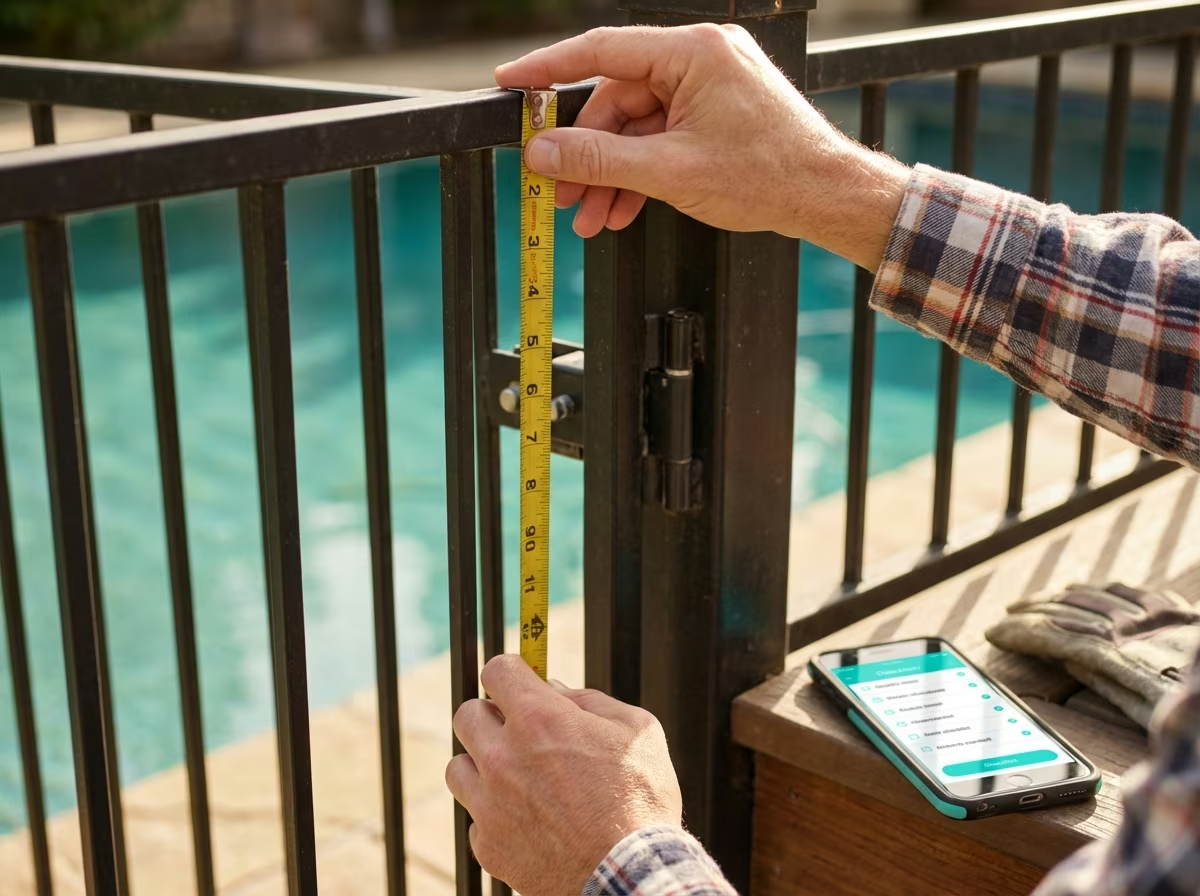
Homeowner conducting pool safety self-assessment checking fence height and gate latches
When a professional pool inspection is required
California law mandates a professional pool safety inspection during every residential property transfer involving a pool or spa. Under BPC §7195, the inspection must be performed before the close of escrow.
Professional inspections are required in these situations:
- Selling a home with a pool or spa — The seller or buyer must arrange an inspection
- Buying a home with a pool or spa — The inspection report must be included in transfer disclosures
- Lease with option to purchase — Same requirements as a standard sale
- Exchange or installment land sales contracts — Covered under the transfer definition
Professional inspections are also strongly recommended when:
- You've made modifications to your pool, fence, or safety equipment
- Your pool was built before 2007 (when AB 3205 requirements took effect)
- You've purchased a home and want to verify the previous owner's compliance claims
- Your local building department requires an inspection for a permit or code enforcement case
For a complete guide on inspections during home sales, see our pool inspection requirements for home sales.
How to hire a qualified pool inspector in California
In California, pool safety inspections for property transfers must be performed by a licensed home inspector or a qualified professional with equivalent expertise. Choosing the right inspector ensures your compliance assessment is thorough and legally valid.
Who can perform pool inspections
Under BPC §7195, the following professionals can perform pool safety inspections:
- Licensed home inspectors (California Business and Professions Code Chapter 9.3)
- Licensed general contractors (Class B or C-53 pool contractors)
- Certified pool/spa inspectors (CPO, CPI, or equivalent certification)
- Licensed pest control operators (who also perform property inspections)
What to look for in a pool inspector
When hiring a pool inspector, verify:
- California-specific expertise — They should know BPC §7195 and HSC §115922 requirements specifically, not just general home inspection standards
- Proper licensing — Ask for their license number and verify it through the California Contractors State License Board or relevant licensing authority
- Digital reporting — Inspectors using professional tools like PoolVerify generate detailed PDF reports with photo documentation and digital signatures, making compliance verification faster and more reliable
- Insurance and bonding — Verify they carry errors and omissions (E&O) insurance
What the inspection report must include
BPC §7195 requires the inspection report to include:
- Which of the seven drowning prevention safety features the pool has
- Whether those features are in good repair and operable as designed
- Whether the pool has fewer than two safety features
- A written statement about pool isolation fencing being the most effective safety measure (per the American Academy of Pediatrics)
For information about pool inspection costs in California, typical prices range from $150–$350 depending on pool complexity and location.
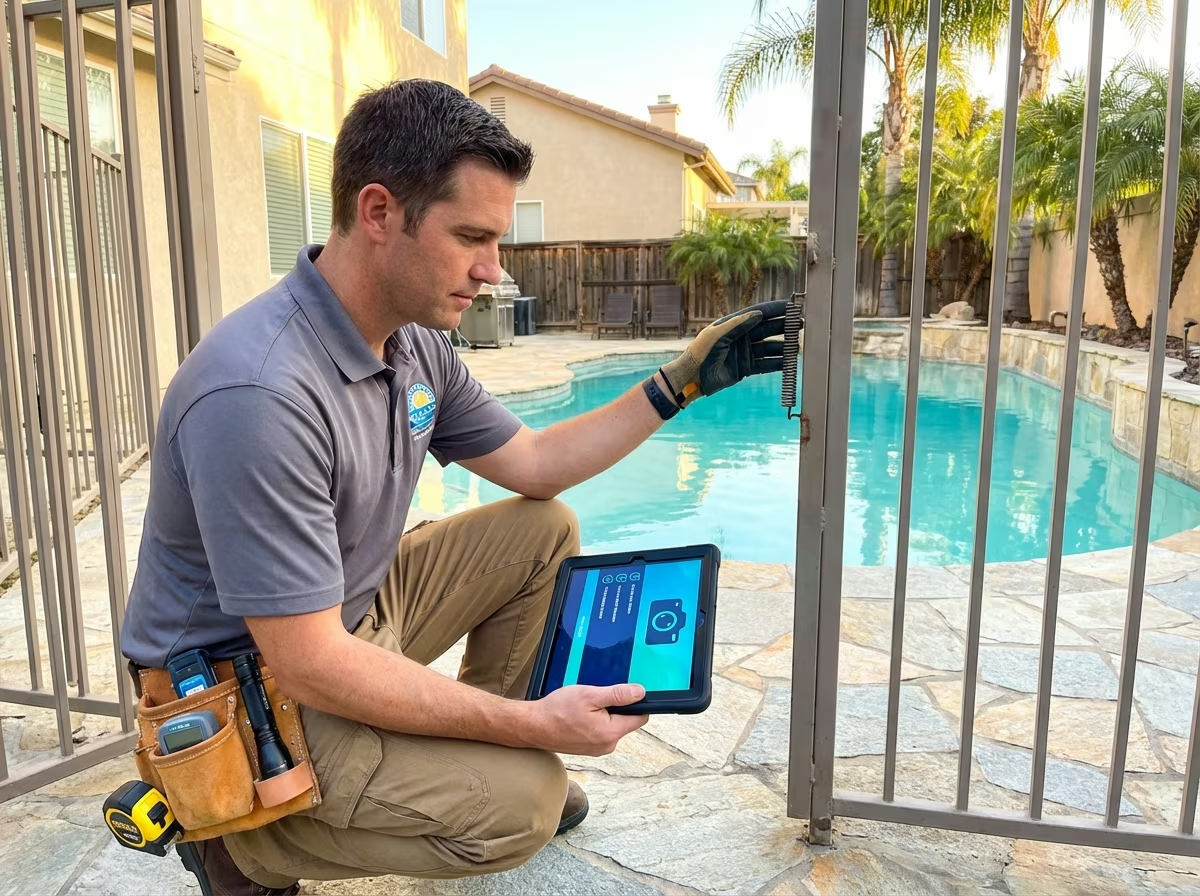
Qualified pool inspector documenting compliance findings with professional inspection software
Common compliance issues and how to fix them
The most common pool compliance failures involve barriers, gates, and drain covers — accounting for the majority of issues found during BPC §7195 inspections. Here's what inspectors find most often and how to fix each issue.
| Compliance Issue | How Common | Typical Fix Cost | Fix Difficulty |
|---|---|---|---|
| Gate not self-closing | Very common | $50–$200 | Easy — replace hinges |
| Gate latch too low | Very common | $30–$100 | Easy — relocate latch |
| Fence height under 60" | Common | $500–$2,000 | Moderate — extend fence |
| Fence gaps over 4" | Common | $200–$800 | Moderate — add members |
| Missing/broken drain covers | Common | $50–$150 | Easy — replace covers |
| No pool alarm | Moderate | $100–$300 | Easy — install device |
| Door alarm not working | Moderate | $30–$80 | Easy — replace battery/unit |
| Fewer than 2 safety features | Less common | $200–$1,500+ | Varies — add features |
Quick fixes (under $200)
- Replace gate hinges with self-closing spring hinges ($50–$150)
- Relocate or replace gate latch to meet the 54-inch height requirement ($30–$100)
- Install door alarms on all doors with direct pool access ($30–$80 per door)
- Replace drain covers with ASME/ANSI A112.19.8 certified models ($50–$150)
Moderate fixes ($200–$1,000)
- Install a pool alarm in the water ($100–$300)
- Add removable mesh fencing as an additional safety feature ($500–$1,500 for typical pool)
- Repair or replace sections of non-compliant fencing ($200–$800)
Major fixes ($1,000+)
- Install a new pool isolation fence meeting all California Building Code standards ($3,000–$10,000 depending on pool size and material)
- Install a motorized safety cover meeting ASTM F1346 standards ($5,000–$15,000)
For a detailed guide on the most frequent failures, see our top 10 pool inspection mistakes and what pool inspectors look for.
Cost of achieving pool compliance in California
Most California homeowners spend between $200 and $2,000 to bring their pool into full compliance, depending on how many issues need correction. Pools with existing safety features that just need minor repairs fall on the low end, while pools lacking basic barriers require more significant investment.
Cost breakdown by scenario
| Scenario | Typical Cost | Timeline |
|---|---|---|
| Minor fixes only (gate hardware, alarms) | $100–$500 | 1–3 days |
| Moderate repairs (fence sections, drain covers) | $500–$2,000 | 1–2 weeks |
| Major upgrades (new fence, safety cover) | $3,000–$15,000 | 2–6 weeks |
| Pool inspection fee | $150–$350 | Same day |
Is the investment worth it?
According to the CDC, proper pool barriers significantly reduce the risk of unsupervised child access to pool areas. Beyond safety, compliance affects your property in practical ways:
- Real estate transactions — Non-compliant pools can delay or derail home sales
- Insurance — Some homeowners insurance policies require proof of pool safety compliance
- Liability — Pool owners who fail to meet safety requirements face increased legal liability in the event of an accident
- Property value — A compliant, well-maintained pool adds value; a non-compliant one is a liability
For complete pricing information, see our pool inspection cost guide and how to price pool inspections.
How to maintain ongoing compliance
Pool compliance isn't a one-time event — safety features require regular maintenance and periodic verification to stay functional and meet California standards.
Monthly maintenance checklist
- Test gate self-closing mechanisms — Open and release from multiple positions
- Verify gate latches engage — Listen for the click and try to push the gate open
- Check door alarms — Open each door to confirm alarm sounds
- Inspect fence for damage — Look for bent posts, loose panels, or gaps that have widened
- Test pool alarm (if installed) — Follow manufacturer's testing procedure
Annual compliance review
- Inspect drain covers — Check for cracks, missing screws, or signs of deterioration
- Verify safety cover condition — Test tension, check for tears or worn straps
- Review fence measurements — Ground settling can change fence height and ground clearance over time
- Update any expired components — Drain covers have a rated lifespan stamped on them; replace before expiration
When regulations change
California updates pool safety regulations periodically. Senate Bill 552 took effect January 1, 2025, adding enhanced enforcement mechanisms. Stay informed about changes through:
- California Legislative Information for new bills affecting pool safety
- Your local building department for county-specific requirements
- Professional inspection tools like PoolVerify that update compliance templates when regulations change
For a deeper dive into county-level requirements, see our California county pool inspection requirements guide.
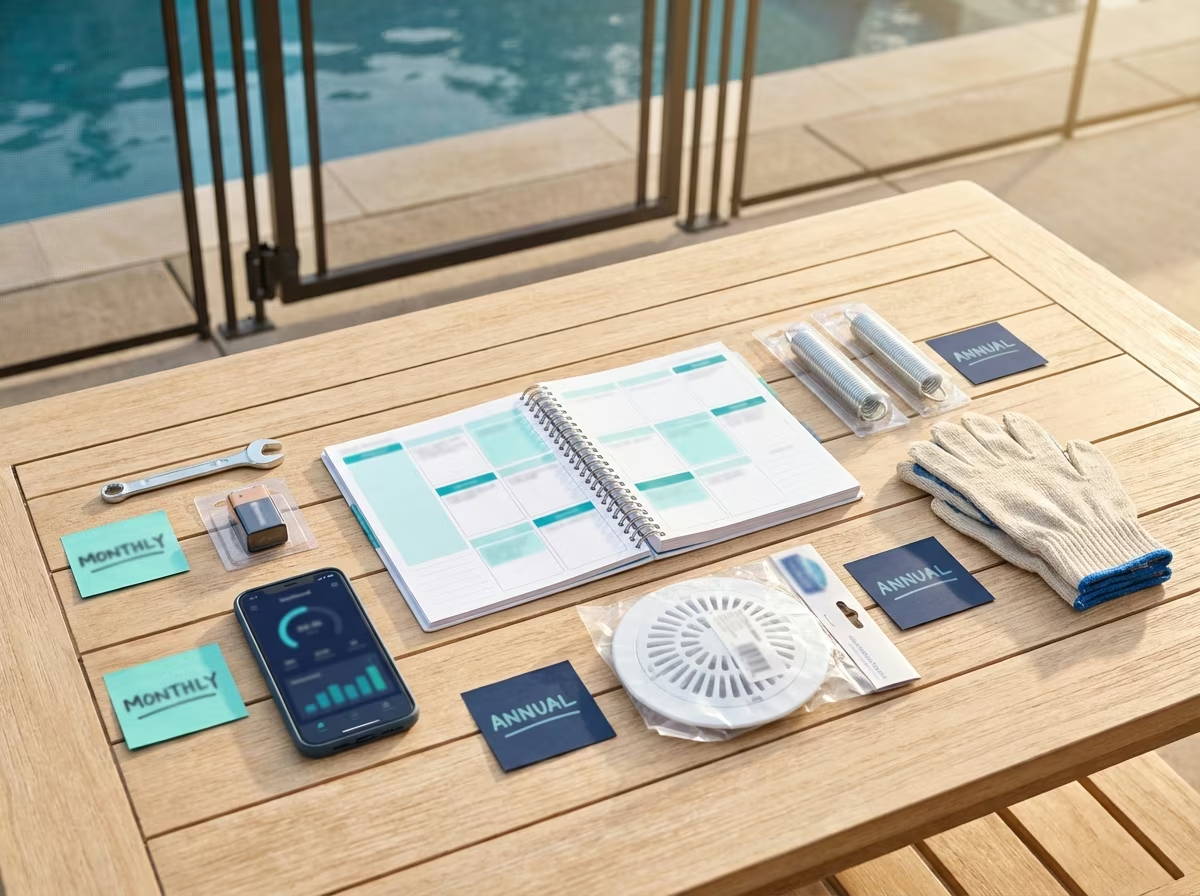
Pool maintenance schedule showing monthly and annual compliance verification tasks
Frequently asked questions
How many safety features does my California pool need?
California law (HSC §115922) requires residential pools and spas to have at least two of the seven drowning prevention safety features. These features must be in good repair and operable. During a property transfer, an inspector must document which features are present and specifically flag if the pool has fewer than two.
Do I need a pool inspection if I'm not selling my house?
A professional inspection is only legally required during property transfers under BPC §7195. However, all California pool owners must comply with HSC §115922 regardless of whether they're selling. A voluntary inspection helps you identify and fix compliance gaps before they become safety hazards or real estate transaction problems.
Who pays for the pool inspection when selling a house?
California law does not specify whether the buyer or seller pays for the pool safety inspection. In practice, this is negotiable between the parties. Many sellers arrange the inspection before listing to address issues proactively, while some buyers include it as part of their standard due diligence. The typical cost ranges from $150–$350.
What happens if my pool fails the safety inspection?
A pool inspection doesn't technically "pass" or "fail" — the report documents which safety features are present and their condition. If fewer than two safety features are identified, the report must explicitly note this. For property transfers, the buyer and seller negotiate how to address deficiencies. In most cases, the seller makes necessary repairs before closing, or the purchase price is adjusted to account for needed improvements.
Can I make my pool compliant without building a fence?
Yes — California allows multiple combinations of safety features to achieve compliance. You do not need a pool isolation fence specifically, though it is recommended as the most effective measure. Alternatives include combinations of safety covers, door alarms, pool alarms, self-closing/self-latching door hardware, and removable mesh fencing. You need at least two qualifying features.
Getting your pool compliant: next steps
Ensuring your California pool meets safety regulations protects your family, your property value, and your legal standing. Here's how to move forward:
- Conduct a self-assessment using the steps outlined above to identify obvious issues
- Count your safety features — make sure you have at least two of the seven drowning prevention features
- Hire a qualified inspector if you're selling, buying, or want professional verification
- Fix any deficiencies — start with quick fixes like gate hardware and alarms, then address larger issues
- Establish a maintenance routine to keep safety features in good working order
For professional pool inspectors looking to streamline compliance assessments, PoolVerify provides California-specific BPC §7195 and HSC §115922 inspection templates, instant PDF report generation with photos and digital signatures, and cloud storage for secure record keeping — all from any device without app downloads. Start your free trial today →
Related posts
- California Pool Laws: Complete 2026 Compliance Guide — Comprehensive breakdown of all four major California pool statutes
- Pool Safety Requirements: Complete California List — Detailed specifications for every required safety feature
- Pool Inspection Requirements for Home Sales in California — Everything sellers and buyers need to know about pool inspections during transactions
Frequently Asked Questions
How many safety features does my California pool need?
California law (HSC §115922) requires residential pools and spas to have at least two of the seven drowning prevention safety features. These features must be in good repair and operable.
Do I need a pool inspection if I'm not selling my house?
A professional inspection is only legally required during property transfers under BPC §7195. However, all California pool owners must comply with HSC §115922 regardless of whether they're selling.
Who pays for the pool inspection when selling a house?
California law does not specify whether the buyer or seller pays for the pool safety inspection. In practice, this is negotiable between the parties. The typical cost ranges from $150–$350.
What happens if my pool fails the safety inspection?
A pool inspection doesn't technically pass or fail — the report documents which safety features are present and their condition. If fewer than two safety features are identified, the report must explicitly note this.
Can I make my pool compliant without building a fence?
Yes — California allows multiple combinations of safety features to achieve compliance. You do not need a pool isolation fence specifically. Alternatives include safety covers, door alarms, pool alarms, and removable mesh fencing. You need at least two qualifying features.
Related Articles
Pool-compliance
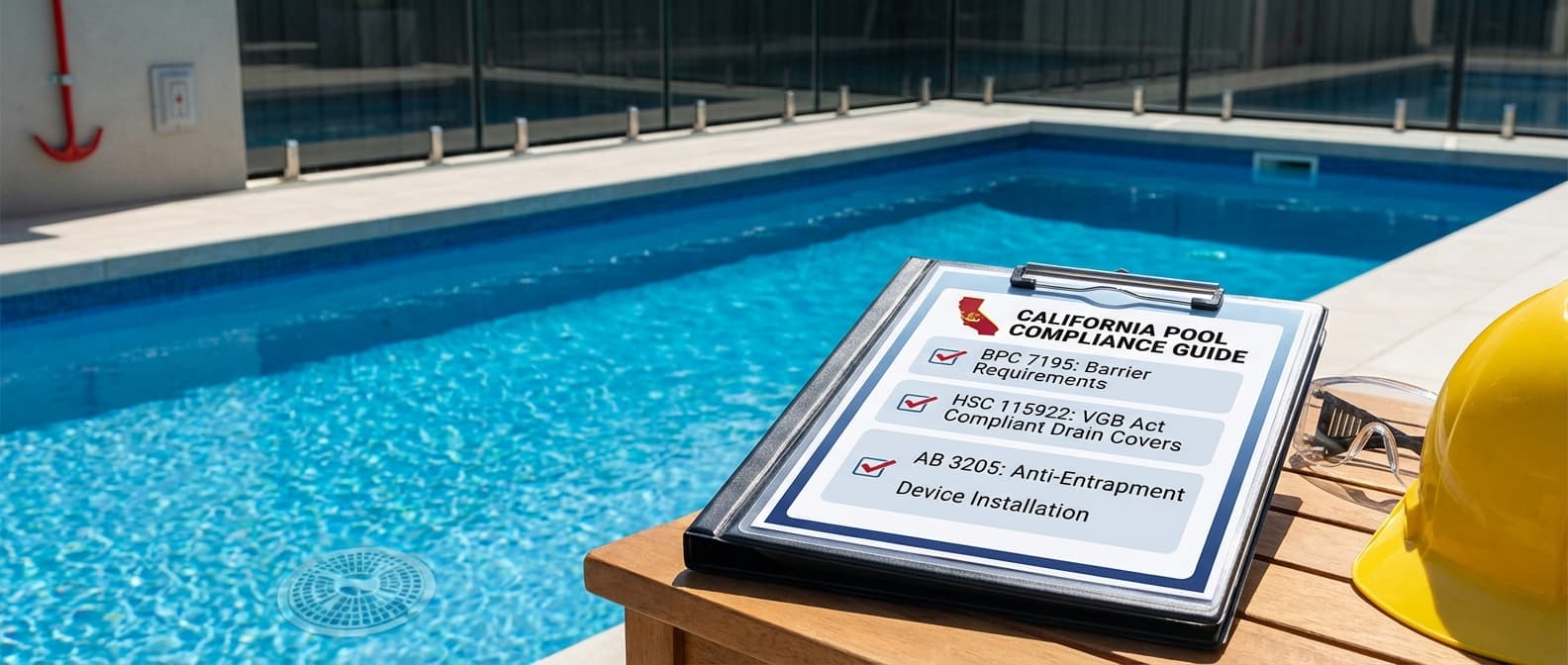
California Pool Laws: Complete 2026 Compliance Guide
Complete guide to California pool laws including BPC §7195, HSC §115922, AB 3205, and SB 552. Learn requirements for new construction, existing pools, rental properties, enforcement, and penalties.
Pool-safety
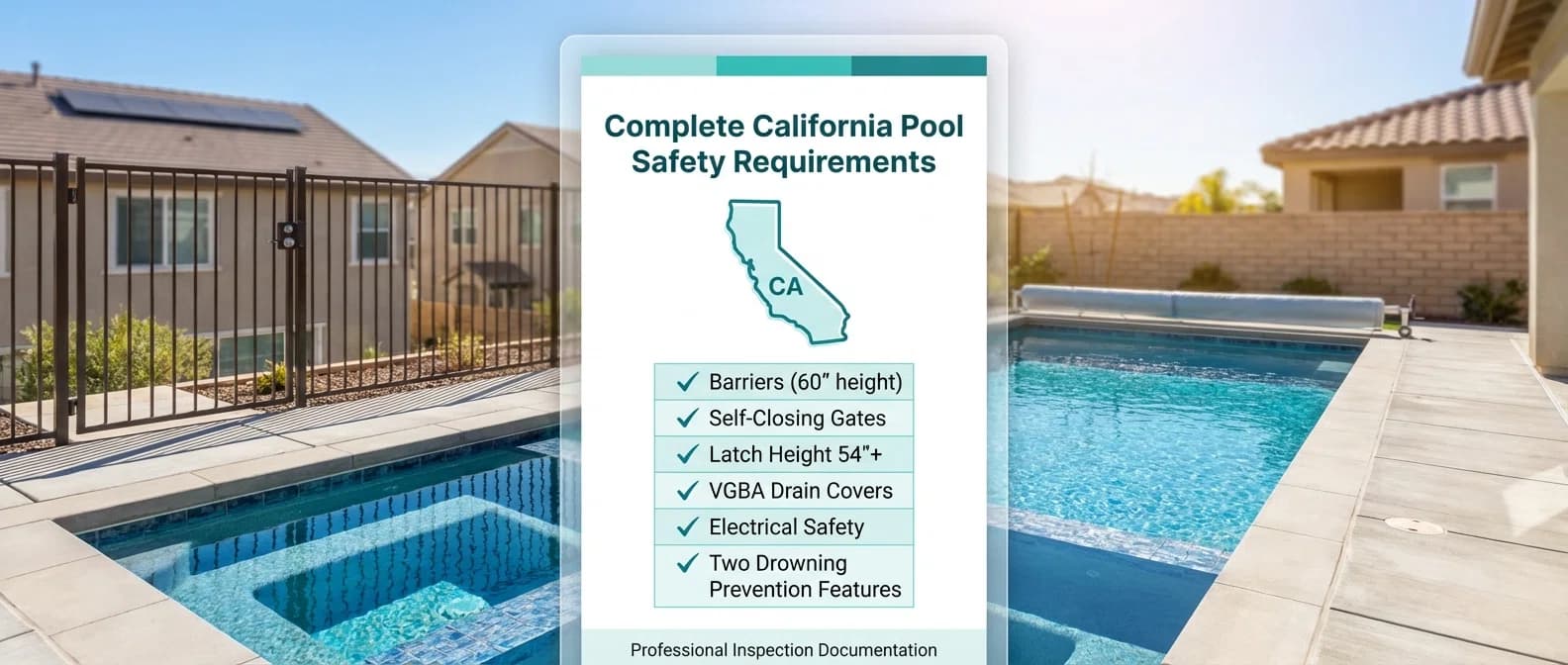
Pool Safety Requirements: Complete California List
Complete list of all California pool safety requirements including barriers, gates, latches, alarms, covers, drains, when they apply, and enforcement.
Industry-guides
Pool Inspection for CA Home Sales [2026 Realtor Guide]
Complete guide for California real estate agents on pool inspection requirements for home sales. Learn BPC §7195 compliance, AB 3205 regulations, and how to ensure smooth escrow closings.