Industry-guides
Pool Inspection Certification: How to Get Certified in California
Complete guide to pool inspection certification in California. License requirements, training options, BPC §7195 qualifications, and career pathways for 2026.

11 min read
Becoming a certified pool inspector in California offers a rewarding career opportunity in a state with millions of residential pools and strict safety compliance requirements. But what certifications or licenses do you actually need to perform pool safety inspections under California law?
This comprehensive guide explains California pool inspection certification requirements, license pathways, training programs, and career development opportunities for aspiring pool inspectors in 2026.
Whether you're transitioning from pool service, expanding from home inspection, or starting a new career entirely, this guide provides the complete roadmap to becoming a qualified California pool inspector.
Table of Contents
- Do You Need Certification to Inspect Pools in California?
- Who Can Perform BPC §7195 Pool Inspections
- Pathway 1: Home Inspector License (HI)
- Pathway 2: Contractor License (B or C-53)
- Pathway 3: Certified Pool Inspector (CPI)
- Pathway 4: Certified Pool Operator (CPO)
- Training Programs and Courses
- Starting Your Pool Inspection Business
- Income Potential and Career Outlook
- Continuing Education and Professional Development
- Frequently Asked Questions
Do You Need Certification to Inspect Pools in California?
The answer depends on what type of pool inspection you're performing.
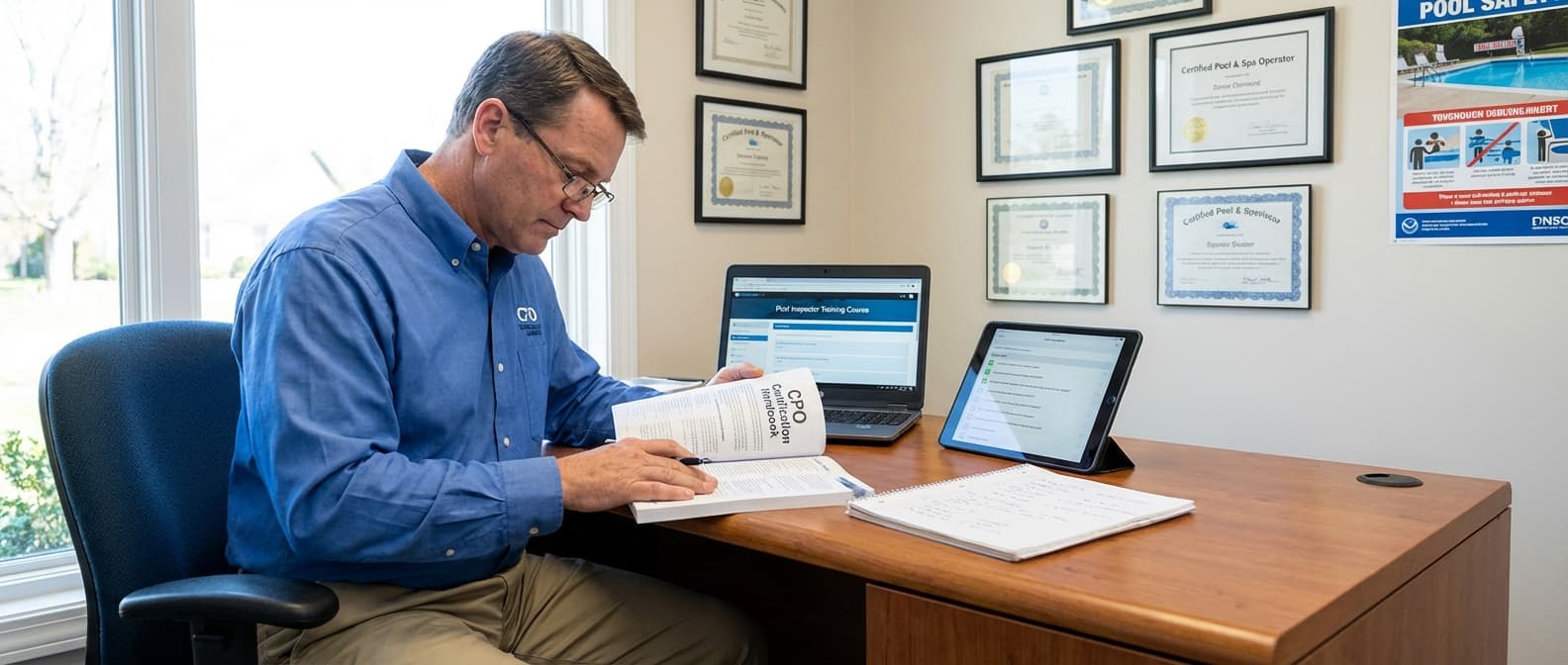
Professional pool inspector with certifications and licenses examining California residential pool with digital inspection tools and safety equipment
BPC §7195 Property Transfer Inspections
For residential property transfer inspections required under California Business and Professions Code §7195, California law specifies who is qualified:
Qualified Inspectors:
- Licensed Home Inspectors (HI license)
- Licensed General Contractors (B license)
- Licensed Pool Contractors (C-53 license)
- Other professionals as defined by local ordinances
No standalone "pool inspector" license exists in California. However, holding one of the above licenses qualifies you to perform BPC §7195 compliance inspections for property transfers.
Commercial Pool Inspections
Commercial pool inspections (hotels, apartments, public facilities) have different requirements:
- Often performed by health department inspectors
- May require CPO (Certified Pool Operator) certification
- Subject to Title 22 California Code of Regulations
- Enforced by local environmental health departments
Voluntary Certifications
While not legally required, several voluntary certifications enhance credibility and expertise:
- Certified Pool Inspector (CPI®)
- Certified Pool Operator (CPO®)
- InterNACHI Certified Pool and Spa Inspector
- NSPF Certified Pool Operator
These certifications demonstrate knowledge and professionalism, helping attract clients even when not legally mandated.
The Bottom Line
For property transfer inspections (BPC §7195): You need a California home inspector license, general contractor license, or pool contractor license.
For career credibility: Additional certifications like CPI or CPO strengthen your expertise and marketability.
For commercial inspections: CPO certification is typically required or strongly preferred.
Who Can Perform BPC §7195 Pool Inspections
California Business and Professions Code §7195 defines qualified individuals authorized to conduct pool safety inspections during property transfers.
Licensed Home Inspectors (HI License)
California home inspector license holders are explicitly authorized to perform BPC §7195 pool inspections.
Requirements:
- Pass California home inspector examination
- Meet experience and education requirements
- Register with California Department of Consumer Affairs
- Maintain liability insurance
- Complete continuing education
Advantage: Can perform comprehensive property inspections including pool assessment
Learn more: How to Become a Pool Inspector
Licensed General Contractors (B License)
General Building Contractors holding active California B licenses may conduct pool inspections.
Requirements:
- 4+ years journey-level experience
- Pass California contractor examinations (Law/Business and Trade)
- Meet financial solvency requirements
- Maintain contractor license bond
- Workers' compensation insurance (if employing)
Advantage: Can perform repairs identified during inspection
Licensed Pool Contractors (C-53 License)
Swimming Pool Contractors with C-53 specialty licenses are qualified pool inspectors.
Requirements:
- 4+ years swimming pool construction/service experience
- Pass California contractor examinations
- Meet financial and insurance requirements
- Active C-53 license in good standing
Advantage: Deep pool-specific expertise, can perform repairs and construction
Other Qualified Professionals
Some jurisdictions allow additional professionals:
- Licensed structural engineers (for structural assessments)
- Licensed architects (for design compliance)
- Other professionals approved by local building officials
Verify locally: Check with your city or county building department for approved categories.
What About CPO or CPI Certification?
CPO (Certified Pool Operator) and CPI (Certified Pool Inspector) certifications alone do NOT satisfy BPC §7195 requirements. However:
- They provide valuable technical knowledge
- Enhance credibility with clients
- May be required for commercial inspections
- Complement required licenses
Best approach: Obtain required license (HI, B, or C-53) plus voluntary certifications (CPO, CPI) for maximum credibility.

Diagram showing four pathways to pool inspection qualification in California: HI license, B license, C-53 license, plus optional CPO/CPI certifications
Pathway 1: Home Inspector License (HI)
Obtaining a California home inspector license is the most direct path for those focused primarily on inspection services rather than pool construction or general contracting.
Requirements for California Home Inspector License
Education Requirements
Minimum: High school diploma or equivalent
Recommended: Technical education in construction, engineering, or related fields
Home inspection courses: Complete approved home inspection training programs
Experience Requirements
Practical experience: Minimum number of inspections under supervision (requirements vary)
Apprenticeship: Work with licensed home inspector to gain experience
Documentation: Maintain inspection logs demonstrating competency
Examination
California Home Inspector Examination: Administered by testing services
Content areas:
- Building systems and components
- Inspection methodology
- California building codes
- Professional standards
- Report writing
- Business and professional conduct
Passing score: Typically 75% or higher
Study resources: Exam prep courses, study guides, practice tests available
Registration
Department of Consumer Affairs: Register as licensed home inspector
Application: Submit completed application with fees
Background check: May include fingerprinting
Insurance: Maintain errors and omissions insurance
Bond: May require surety bond
Timeline to HI License
Typical pathway: 3-12 months depending on:
- Existing construction knowledge
- Time dedicated to study
- Experience requirements completion
- Exam scheduling availability
Fast track: Those with construction background may complete faster
Part-time study: May extend timeline to 12-18 months
Cost of HI License
Education/training: $1,000-3,000 for courses
Examination fees: $200-500
License application: $200-400
Insurance (annual): $500-2,000+ depending on coverage
Total initial investment: $2,000-6,000
Benefits of HI License for Pool Inspection
Broadest scope: Can inspect entire properties, not just pools
Multiple revenue streams: Home inspections, pool inspections, specialized assessments
Flexibility: Work as independent inspector or with inspection firms
Scalability: Add team members and expand business
Pathway 2: Contractor License (B or C-53)
Contractor licenses provide an alternative pathway, especially beneficial for those already in construction or pool service industries.
General Contractor (B License)
Best for: Construction professionals wanting to add inspection services
Requirements
Experience: Minimum 4 years journey-level experience in general construction
Age: Must be at least 18 years old
Examination:
- Business and Law examination (all contractors)
- No separate trade exam for B license
Application: Submit to California Contractors State License Board (CSLB)
Bond: $25,000 contractor license bond
Insurance: Workers' compensation (if employing), general liability recommended
Timeline and Cost
Timeline: 4-8 months (with required experience documented)
Costs:
- Application fee: $450
- Exam fees: ~$335
- Bond: $100-200 annually
- Insurance: Varies widely
- Total: $1,000-2,000 initial costs (plus insurance)
Swimming Pool Contractor (C-53 License)
Best for: Pool service professionals, pool builders wanting to add inspections
Requirements
Experience: Minimum 4 years swimming pool construction, installation, or maintenance experience
Age: Must be at least 18 years old
Examination:
- Business and Law examination
- Swimming Pool Trade examination (covers pool construction, equipment, safety, codes)
Application: Submit to CSLB with experience verification
Bond: $25,000 contractor license bond
Insurance: Workers' compensation, general liability
Timeline and Cost
Timeline: 4-8 months with documented experience
Costs:
- Application fee: $450
- Exam fees: ~$335
- Bond: $100-200 annually
- Insurance: Varies
- Total: $1,000-2,000+ initial costs
Advantages of Contractor Licenses
Can perform repairs: Identify deficiencies and provide correction services
Established business: Many already have contracting businesses
Credibility: Construction license demonstrates technical expertise
Higher income potential: Combine inspections with repair/construction services
Existing client base: Current clients may need inspection services
Disadvantages
Higher barriers: More experience required than HI license
Regulatory oversight: CSLB enforcement and compliance requirements
Insurance costs: Workers' comp and liability insurance expensive
Continuing education: License renewal requirements
Pathway 3: Certified Pool Inspector (CPI)
The Certified Pool Inspector (CPI®) certification provides specialized training in pool safety inspection, though it doesn't replace licensing requirements for BPC §7195 inspections.
What is CPI Certification?
Offered by: Aquatic Council and other organizations
Purpose: Standardized training for pool and spa safety inspections
Target audience: Health officials, pool operators, inspectors, facility managers
Validity: Typically 3 years, requires renewal
CPI Certification Requirements
Course Curriculum
Topics covered:
- Pool and spa inspection fundamentals
- Water chemistry and testing
- Safety features and barriers (BPC §7195, HSC §115922)
- Equipment evaluation
- Filtration and circulation systems
- Electrical systems and GFCI protection
- Suction entrapment prevention (VGB Act)
- California pool codes and regulations
- Inspection methodology and reporting
Examination
Format: Online or in-person exam
Passing score: Typically 75-80%
Duration: 2-3 hours
Retake policy: Usually allowed with additional fee
Practical Training
Some programs include: Hands-on training or field inspection component
Equipment familiarity: Pool testing equipment, measurement tools
Report writing: Sample inspection reports
CPI Course Options
Online programs: Self-paced online courses ($300-600)
In-person training: Classroom-based instruction ($400-800)
Hybrid programs: Combination online and hands-on ($500-900)
Timeline and Cost
Timeline: 1-4 weeks depending on program format
Cost: $300-900 for certification course and exam
Renewal: Every 3 years, typically $100-200
CPI Benefits for California Inspectors
Specialized knowledge: Focused pool safety expertise
Credential recognition: Professional certification demonstrates competency
Complement licenses: Strengthens HI, B, or C-53 license holder credentials
Continuing education: Satisfies some professional development requirements
Not legally sufficient alone: Must hold HI, B, or C-53 license for BPC §7195 inspections
Pathway 4: Certified Pool Operator (CPO)
Certified Pool Operator (CPO®) certification focuses on pool operation and maintenance rather than inspection, but provides valuable foundational knowledge.
What is CPO Certification?
Offered by: Pool & Hot Tub Alliance (PHTA), Pool Training Academy, and other providers
Purpose: Train pool operators in safe, compliant pool maintenance
Target audience: Pool service technicians, facility managers, operators
Validity: 5 years, requires renewal
California status: Not state-mandated but recommended by many jurisdictions
CPO Course Content
Core topics:
- Pool chemistry and water balance
- Testing and treatment
- Filtration systems
- Pool equipment operation
- Safety and health regulations
- Energy efficiency
- Record keeping
- Troubleshooting
Inspection-relevant content:
- Equipment assessment
- Safety feature recognition
- Code compliance basics
- Hazard identification
CPO Certification Process
Course Formats
In-person classroom: 2-day intensive training ($200-400)
Virtual/online: Self-paced or live webinar ($150-350)
Blended: Online coursework with in-person exam ($200-400)
Examination
Format: Multiple choice exam
Duration: 90 minutes
Passing score: 75%
Administered: At training location or online proctored
Certification
Credential: CPO® certificate valid 5 years
Registry: Listed in CPO registry
Renewal: Recertification course or exam before expiration
CPO Benefits for Inspectors
Operational knowledge: Understand how pool equipment should function
Water chemistry: Assess pool water quality and treatment systems
Maintenance perspective: Know common pool maintenance issues
Commercial focus: Required for many commercial pool positions
Credibility: Demonstrates ongoing professional development
Not sufficient alone: Cannot replace HI, B, or C-53 license for residential inspections
Training Programs and Courses
Numerous organizations offer pool inspection training to supplement licensing requirements.
InterNACHI Pool and Spa Inspection Course
Provider: International Association of Certified Home Inspectors
Target: Home inspectors adding pool inspection services
Content: Residential pool safety inspection standards
Format: Online self-paced course
Credential: InterNACHI Certified Pool & Spa Inspector
Cost: Included with InterNACHI membership (~$289/year)
Benefits: Comprehensive pool inspection training specifically for home inspectors
ICA Swimming Pool & Spa Inspection Course
Provider: Inspection Certification Associates
Format: Online course updated 2022
Content: Residential pool inspection techniques
Duration: Self-paced, typically 8-12 hours
Credential: Certificate of completion
Cost: ~$300-500
Best Aquatic Management Pool Inspector Training
Provider: Best Aquatic Management
Content: Comprehensive pool inspector certification
Focus: Commercial and residential pools
Format: In-person or virtual options
Credential: Certified Pool Inspector
Space Coast Pool School Virtual CPI
Provider: Space Coast Pool School
Format: 100% live virtual course
Duration: Multiple session schedule
Content: Pool inspection methodology, safety, equipment
Credential: Certified Pool Inspector
Cost: ~$400-600
Choosing the Right Training
Consider:
- Your existing licenses or certifications
- Primary inspection focus (residential vs commercial)
- Budget and time availability
- Format preference (online vs in-person)
- Credential recognition in your market
- Continuing education requirements
Recommended approach:
- Obtain required license (HI, B, or C-53) first
- Add CPO or CPI certification for technical knowledge
- Consider InterNACHI or ICA courses for inspection methodology
- Maintain ongoing education through industry organizations

Flowchart showing recommended training path from initial license through specialized certifications and continuing education
Starting Your Pool Inspection Business
Once certified and licensed, launching your pool inspection business requires planning and investment.
Business Structure and Registration
Choose business entity:
- Sole proprietorship (simplest)
- LLC (liability protection)
- Corporation (for larger operations)
Register business name: File DBA ("Doing Business As") if needed
Obtain EIN: Federal Employer Identification Number from IRS
Local permits: Business license from city/county
Insurance Requirements
Errors & Omissions (E&O): Professional liability insurance ($500-2,000/year)
General Liability: Property damage and injury coverage ($500-1,500/year)
Workers Compensation: If employing others (varies by payroll)
Auto Insurance: Commercial auto if using vehicle for business
Total insurance costs: $1,500-5,000+ annually
Equipment and Tools
Inspection tools ($500-2,000):
- Tape measure and laser distance measurer
- 4-inch sphere for gap testing
- Water testing kit (pH, chlorine, alkalinity)
- Moisture meter
- Flashlight and inspection mirror
- GFCI tester
- Camera (smartphone usually sufficient)
- Ladder and safety equipment
Office equipment ($1,000-3,000):
- Computer/laptop
- Printer/scanner
- Inspection software (PoolVerify or alternatives)
- Mobile device (tablet recommended for field use)
Marketing materials ($500-2,000):
- Website
- Business cards
- Vehicle signage
- Digital marketing assets
Digital Inspection Software
Benefits of inspection software:
- Faster inspection completion (15-25 minutes vs 60+ minutes)
- Professional branded reports
- Photo organization and documentation
- Cloud backup and storage
- Client database management
- Mobile-friendly interface
PoolVerify advantages for California inspectors:
- Pre-built BPC §7195 compliance templates
- All seven HSC §115922 safety features pre-loaded
- Instant PDF report generation
- Works on any device (no app download required)
- California-specific compliance language
- Pricing: $29-49/month with unlimited inspections
Alternative software: Spectora, HomeGauge, ISN (typically $89-200/month, generic templates)
Streamline your California pool inspections from day one
PoolVerify's pre-built compliance templates help new pool inspectors complete BPC §7195 inspections professionally and efficiently—no template creation required.
Pricing Your Services
California pool inspection rates (2026):
Standalone pool inspection: $125-300
Pool inspection with home inspection: $100-200 (add-on)
Commercial pool inspection: $200-500+
Re-inspection: $75-150
Factors affecting pricing:
- Geographic location (higher in Bay Area, LA)
- Pool size and complexity
- Property type (single-family vs multi-unit)
- Travel distance
- Report turnaround time
- Your experience and credentials
Recommended starting price: $150-200 for residential pool safety inspection
Marketing Your Services
Target clients:
- Real estate agents and brokers
- Homeowners selling properties with pools
- Pool service companies (referral partnerships)
- Property managers
- Home inspection companies (subcontracting)
Marketing channels:
- Website with local SEO optimization
- Google Business Profile
- Real estate agent networking
- Pool industry associations
- Home inspector referrals
- Online directories (Yelp, Angi, HomeAdvisor)
First-Year Business Costs Summary
| Expense Category | Cost Range |
|---|---|
| License/certification | $1,000-6,000 |
| Insurance (annual) | $1,500-5,000 |
| Equipment | $500-2,000 |
| Office/technology | $1,000-3,000 |
| Inspection software | $348-588/year |
| Marketing | $500-2,000 |
| Business formation | $200-1,000 |
| Total first year | $5,048-19,588 |
Payback period: Completing 25-100 inspections typically covers initial investment
Income Potential and Career Outlook
Pool inspection offers solid income potential in California's robust pool market.
Income Estimates
Part-time (5-10 inspections/month):
- 5 inspections × $175 = $875/month
- 10 inspections × $175 = $1,750/month
- Annual: $10,500-21,000
Full-time (40-80 inspections/month):
- 40 inspections × $175 = $7,000/month
- 80 inspections × $175 = $14,000/month
- Annual: $84,000-168,000
Add-on services increase revenue:
- Re-inspections after repairs
- Consultation services
- Expert witness testimony
- Pool compliance consultations
- Annual safety inspections
California Pool Market
Market size: 1.2+ million residential pools in California
Property transfers: ~450,000 homes sold annually in California
Estimated pool-property sales: ~50,000-75,000 annually requiring BPC §7195 inspections
Market opportunity: Growing demand, undersupplied in many regions
Competition: Moderate in urban areas, low in suburban and rural areas
Career Advancement
Growth opportunities:
- Expand to full home inspection services
- Add commercial pool inspection
- Start pool service/maintenance business
- Develop pool inspection training courses
- Consulting for pool construction companies
- Expert witness services in litigation
Scaling options:
- Hire additional inspectors
- Develop multi-inspector firm
- Franchise model
- Software/tools development
Job Security and Outlook
Positive factors:
- Mandatory BPC §7195 inspections create consistent demand
- Pool ownership remains popular in California
- Aging pool infrastructure requires more inspections
- Increasing safety awareness drives voluntary inspections
- California's strict regulations ensure ongoing need
Challenges:
- Seasonal demand fluctuations (higher spring/summer)
- Competition from established home inspectors
- Liability exposure requires proper insurance
- Continuing education requirements
- Technology adoption (digital inspection platforms)
Continuing Education and Professional Development
Maintaining and advancing your pool inspection career requires ongoing learning.
License Renewal Requirements
Home Inspector (HI) license:
- Renewal cycle: Typically every 2 years
- Continuing education: 8-16 hours (varies)
- Topics: Building codes, inspection standards, professional ethics
- License renewal fee: $200-400
Contractor licenses (B, C-53):
- Renewal cycle: Every 2 years
- Continuing education: 8 hours law and business topics
- CSLB ethics course required
- License renewal fee: $450
Voluntary Certification Renewal
CPO certification:
- Renewal: Every 5 years
- Options: Recertification course or re-exam
- Cost: $100-250
CPI certification:
- Renewal: Every 3 years
- Requirements: Continuing education or re-examination
- Cost: $100-200
Professional Organizations
Benefits of membership:
- Networking opportunities
- Education and training
- Industry updates
- Marketing resources
- Advocacy and representation
Recommended organizations:
- International Association of Certified Home Inspectors (InterNACHI)
- California Association of Realtors (networking)
- Pool & Hot Tub Alliance (PHTA)
- Local inspector associations
Staying Current
Best practices:
- Monitor California legislation (BPC, HSC updates)
- Subscribe to industry publications
- Attend annual conferences and trade shows
- Join online inspector communities
- Follow pool safety organizations
- Update inspection knowledge regularly
- Adopt new inspection technologies
Frequently Asked Questions
Do I need a license to be a pool inspector in California?
Yes, for BPC §7195 property transfer inspections, you need a California home inspector license (HI), general contractor license (B), or pool contractor license (C-53). No standalone "pool inspector" license exists. Voluntary certifications like CPO or CPI provide valuable training but don't replace licensing requirements.
How long does it take to become a certified pool inspector in California?
Timeline varies by pathway: Home inspector license typically takes 3-12 months (education, experience, exam). Contractor licenses require 4+ years documented experience plus 4-8 months application/exam process. CPO or CPI certification alone takes 1-4 weeks but doesn't satisfy legal requirements for property transfer inspections.
How much do pool inspectors make in California?
Pool inspectors in California earn $84,000-168,000 annually doing 40-80 inspections monthly at $150-200 per inspection. Part-time inspectors (5-10 monthly inspections) earn $10,500-21,000 annually. Income varies by location, experience, services offered, and business efficiency.
Can I inspect pools with just a CPO or CPI certification?
No, not for BPC §7195 property transfer inspections. California law requires a home inspector license, general contractor license, or pool contractor license. CPO and CPI certifications provide valuable knowledge and enhance credibility but don't meet legal requirements alone. Consider them complementary credentials to required licenses.
What's the fastest way to become a pool inspector in California?
For those with construction experience: Obtain contractor license (B or C-53) if you have 4+ years experience. For career changers: Pursue home inspector (HI) license (3-12 months). Add CPO or CPI certification for technical knowledge while pursuing license. Start with required license first, add voluntary certifications second.
Is pool inspection a good career in California?
Yes. California has 1.2+ million pools, mandatory BPC §7195 property transfer inspections, and consistent demand. Income potential ranges from $10,500 part-time to $168,000+ full-time. Initial investment is moderate ($5,000-20,000), and the market is undersupplied in many regions. Combining pool inspections with home inspection or pool service maximizes income.
Do I need insurance to be a pool inspector?
Yes. Errors & Omissions (professional liability) insurance is required for most pool inspector licenses and protects against inspection errors or omissions. General liability insurance protects against property damage or injury claims. Total insurance costs run $1,500-5,000+ annually depending on coverage limits and business size.
Conclusion: Your Path to Pool Inspection Certification
Becoming a certified pool inspector in California requires obtaining one of three qualifying licenses—home inspector (HI), general contractor (B), or pool contractor (C-53)—followed by voluntary certifications like CPO or CPI to enhance expertise.
Recommended pathway for most aspiring inspectors:
- Obtain required license: Home inspector license (fastest for career changers) or contractor license (if you have construction experience)
- Add voluntary certifications: CPO for operational knowledge, CPI for inspection methodology
- Invest in tools and software: Digital inspection platforms like PoolVerify streamline California BPC §7195 compliance
- Launch your business: Market to real estate agents, homeowners, and pool professionals
- Maintain credentials: Complete continuing education and stay current with California codes
Key takeaways:
- No standalone pool inspector license exists—HI, B, or C-53 required
- CPO and CPI certifications enhance knowledge but don't replace licensing
- Income potential ranges from $10,500 part-time to $168,000+ full-time
- California's 1.2+ million pools create consistent inspection demand
- Digital inspection software improves efficiency and professionalism
- First-year investment: $5,000-20,000 depending on pathway chosen
Start your pool inspection career by identifying which license pathway suits your background, then complement with industry certifications and professional tools to build a thriving California pool inspection business.
Ready to start inspecting California pools professionally?
PoolVerify's pre-built BPC §7195 templates help new inspectors complete compliant inspections from day one. Generate professional reports instantly, even during your first inspection.
Related Posts
- How to Become a Pool Inspector
- Pool Compliance California: Complete Requirements Guide
- Pool Inspection Form: Free Download & Template
- Best Pool Inspection Software California
- How to Price Pool Inspections
Sources:
Frequently Asked Questions
Do I need certification to inspect pools in California?
For BPC §7195 property transfer inspections, you need a California home inspector license (HI), general contractor license (B), or pool contractor license (C-53). No standalone pool inspector license exists. Voluntary certifications like CPO and CPI enhance credibility but do not replace licensing requirements.
How much does pool inspection certification cost in California?
Costs vary by pathway. Home inspector license runs $2,000-6,000 total including education, exams, and insurance. Contractor licenses cost $1,000-2,000 in initial fees plus insurance. CPI certification costs $300-900 and CPO certification costs $200-400. Most inspectors invest $2,000-6,000 total to get started.
What is the fastest way to become a certified pool inspector in California?
For career changers, pursuing a home inspector license is the fastest path at 3-12 months. If you have 4+ years construction experience, obtaining a C-53 or B contractor license may be quicker. Adding CPO or CPI certification takes just 1-4 weeks for technical knowledge supplementation.
Can I inspect pools with just a CPO or CPI certification?
No, not for BPC §7195 property transfer inspections. California law requires a home inspector license, general contractor license, or pool contractor license. CPO and CPI certifications provide valuable knowledge and enhance credibility but do not meet legal requirements alone. They are best used as complementary credentials.
How much can certified pool inspectors earn in California?
Part-time inspectors earning 5-10 inspections monthly at $175 each make $10,500-21,000 annually. Full-time inspectors conducting 40-80 monthly inspections earn $84,000-168,000 annually. Additional revenue comes from re-inspections, consultation services, and combining pool inspections with home inspection services.
Related Articles
Industry-guides
Pool Inspector License Requirements: California Guide [2026]
Complete guide to pool inspector licensing in California. C-53 contractor license, B license, home inspector requirements, certification options, and step-by-step process.
Inspection-best-practices
Pool Inspector Training: Certification Programs [2026]
Compare CPO, NSPF, PHTA, and InterNACHI pool inspector training programs. Costs, duration, online vs in-person options, and certification requirements.
Guide
How to Become a Pool Inspector: Career Guide 2026
Complete guide to becoming a certified pool inspector. Learn about requirements, certifications, training programs, income potential, and how to start your career.