HOA and Apartment Pool Rules in California: What the Law Requires
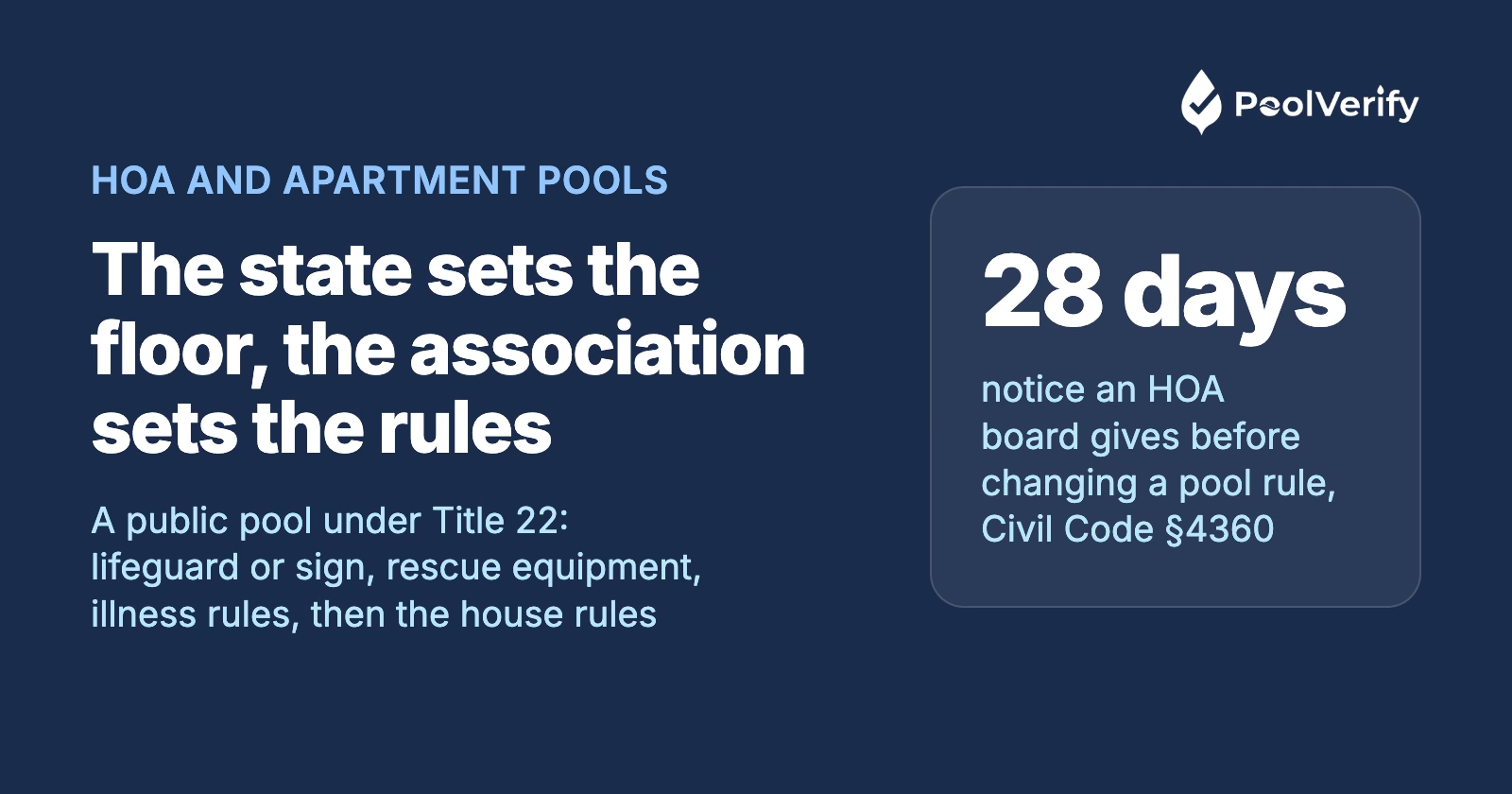
An HOA or apartment pool in California is a public pool under Title 22 (22 CCR §65503), so state law sets part of its rules: lifeguards or a sign saying none are provided (HSC §116045), a life ring and rescue pole (22 CCR §65540), and illness rules (22 CCR §65541). The rest is up to the association or the owner: how an HOA adopts and members can reverse a pool rule under Civil Code §4340 to §4365, and why age-based pool rules raise a familial status question under Government Code §12955.
An HOA or apartment pool in California is a public pool under Title 22, so state law sets part of its rules and the association or owner sets the rest. 22 CCR §65503 lists homeowner association, condominium and apartment house pools among public pools; HSC §116045 requires lifeguards or signs saying none are provided; 22 CCR §65540 requires a life ring and rescue pole.
This guide covers why these pools are public pools, what the state requires of every one, the illness rules, what is left to the association or owner, how an HOA adopts and members can reverse a pool rule, and the fair housing question age-based rules raise. Our commercial pool guide covers the public pool program as a whole, including water quality and the county's inspections.
Why an HOA or apartment pool is a public pool
The line is the number of homes the pool serves. 22 CCR §65503 applies its chapter to "all public pools and public pool sites, including, but not limited to" apartment house pools, condominium pools and homeowner association pools, and defines a private pool as one "intended for use by occupants of not more than three residential units." HSC §116064.2 likewise defines a public swimming pool to include one available to residents of "a multiunit apartment building, apartment complex, residential real estate development, or other multifamily residential area."
Two consequences follow. The county environmental health department enforces the public pool rules at these pools, and the residential Swimming Pool Safety Act does not apply: HSC §115925 exempts public pools and "an apartment complex, or any residential setting other than a single-family home." Our rental property guide sets out where the lines fall for two to four unit properties.
What state law requires at every HOA and apartment pool
Lifeguards at a public pool of wholly artificial construction that charges a direct fee; at every other public pool, lifeguards or "signs shall be erected clearly indicating that the service is not provided"
Suction outlet safety systems meeting ANSI/APSP-16, with a compliance form filed with the local environmental health department
Most HOA and apartment pools charge no direct fee, so the practical rule is the sign: if no lifeguard is provided, a sign must say so clearly. Where an operator does provide lifeguards, 22 CCR §65539 requires written proof of their certifications, continuous surveillance of pool users, and apparel that identifies them as lifeguards, and §65540(b) adds a first aid kit, an operating telephone and a backboard with a head immobilizer. HSC §116045 also requires an automated external defibrillator at a pool that must provide lifeguards and charges a direct fee. Our drain cover guide covers the anti-entrapment rule.
The illness rules
Title 22 sets two health rules that belong in any posted pool rules. Under 22 CCR §65541(b), no pool user "having a communicable disease while in an infectious state," or with symptoms such as a cough, cold sore, or nasal or ear discharge, or wearing bandages, may enter public pool water unless they give the operator a current written statement from a licensed physician that they do not present a health hazard. Under §65541(c), if two or more pool users or lifeguards report within 5 days of each other that they have had diarrhea, the operator reports it to the enforcing agent.
Decide in writing, before the first report arrives, who at the association or the property receives those reports and who calls the county.
What the association or owner decides
Everything the state does not set is a house rule. Typical subjects:
Hours the pool is open, and whether the gate is locked overnight.
Guests: how many per household, and whether a resident must be present.
Supervision: who must accompany a young or non-swimming resident.
Conduct: glass, food, music, diving where the pool is not built for it.
Access: keys, fobs or codes, and what happens when one is lost.
Reservations for private events.
For an apartment complex, these rules usually live in the lease or its attachments. For an HOA, they are operating rules, and the Davis-Stirling Act sets how they are made.
How an HOA adopts a pool rule
A pool rule is an operating rule. Civil Code §4340 defines an operating rule as "a regulation adopted by the board that applies generally to the management and operation of the common interest development or the conduct of the business and affairs of the association," and a rule change as its adoption, amendment or repeal. Under §4350, a rule is valid and enforceable only if it is in writing, within the board's authority, not in conflict with governing law or the governing documents, adopted in good faith and in substantial compliance with the article, and reasonable.
Because a pool rule governs "use of the common area or of an exclusive use common area," the first subject listed in §4355(a), it follows the notice procedure:
Step
What Civil Code requires
Notice before the decision
General notice of the proposed rule change at least 28 days before the board makes it, under §4360
The decision
Made at a board meeting, after considering any comments made by members
Notice after the decision
General notice within 15 days after the rule change is made
Emergency changes
Allowed without advance notice for an imminent threat to public health or safety or substantial economic loss; they expire after 120 days
Member reversal
Members owning 5 percent or more of the separate interests may call a special vote within 30 days of the notice; a majority of a quorum reverses the change, under §4365
Age-based rules and fair housing
Rules that single out children are the ones most often challenged. Government Code §12955 makes it unlawful for the owner of any housing accommodation to discriminate against or harass any person because of familial status, among other protected bases, and a rule an HOA adopts must also be reasonable under Civil Code §4350. Whether a particular rule, such as adults-only hours, crosses that line depends on its wording and its effect, so have counsel review it before the board adopts it.
Where PoolVerify fits
PoolVerify is built for the residential side of the line: single-family homes under the Swimming Pool Safety Act and the BPC §7195 report at a sale. It does not cover the public pool program described here. For an HOA or apartment portfolio that also includes single-family homes with pools, those homes are inside PoolVerify's California checklist, and our rental property guide explains the difference.
Limitations
This guide is general information about California law, not legal advice. The current text of HSC §116045 and §116064.2, Title 22 §65503 to §65541, Civil Code §4340 to §4365 and Government Code §12955 controls, and the county environmental health department enforces the public pool rules and may require more, including signage and posted rules under the building code, which this guide does not quote. It does not cover water chemistry, pool construction or insurance. PoolVerify is inspection software for California residential pool safety inspections; it does not perform inspections or issue compliance certificates.
Frequently asked questions
Do apartment or HOA pools need a lifeguard in California?
Not always. HSC §116045 requires lifeguard service at a public pool of wholly artificial construction that charges a direct fee for use. For all other public pools, including most apartment and HOA pools, the operator either provides lifeguard service or erects signs clearly indicating that the service is not provided.
Is an HOA pool a public pool in California?
Yes, for the public pool regulations. 22 CCR §65503 lists homeowner association pools, condominium pools and apartment house pools among the public pools its chapter covers, and treats only a pool used by occupants of not more than three residential units as private. The county environmental health department enforces those rules.
What safety equipment must an HOA or apartment pool have?
Under 22 CCR §65540, a life ring of at least 17 inches exterior diameter with an attached throw rope of at least 3/16 inch, and a rescue pole of at least 12 feet fixed length with a permanently attached body hook, readily visible and available at all times. Pools with lifeguards need a first aid kit, a telephone and a backboard.
How does an HOA change its pool rules?
A rule on use of the common area follows Civil Code §4360: general notice of the proposed change at least 28 days before the board decides it at a board meeting, after considering members' comments, and notice within 15 days after adoption. Under §4365, members owning 5 percent or more of the separate interests can call a special vote to reverse it.
Can an apartment or HOA pool have adults-only hours?
That is a legal question to put to counsel before adopting the rule. Government Code §12955 makes it unlawful for the owner of a housing accommodation to discriminate because of familial status, among other bases, and an HOA rule must also be reasonable under Civil Code §4350. Whether a given rule is lawful depends on its wording and its effect on families with children.
Can a pool user with diarrhea be kept out of an HOA or apartment pool?
22 CCR §65541(b) bars a pool user with a communicable disease in an infectious state, or with symptoms such as a cough, cold sore, nasal or ear discharge, or wearing bandages, from entering public pool water without a physician's written statement. Under §65541(c), two or more reports of diarrhea within 5 days must be reported to the enforcing agent.
Conclusion
An HOA or apartment pool in California is a public pool. State law sets the floor: a lifeguard or a clear sign that none is provided, a 17 inch life ring with a throw rope and a 12 foot rescue pole in view, the illness rules, and anti-entrapment outlets. The association or owner sets the rest, and an HOA does it through the Davis-Stirling procedure: 28 days' notice, a board decision, notice within 15 days, and a member vote to reverse if 5 percent ask for one. For single-family rentals with pools, see our rental property guide, or start a 14-day free trial of PoolVerify, no credit card to start.
A branded PDF with the compliance summary, the feature table, each finding with its photos, and the signature, generated on‑site when the BPC §7195 and HSC §115922 checklist is complete.