Inspection-best-practices
How to Improve Pool Inspection Accuracy: Safety-First Best Practices
Proven strategies to improve pool inspection accuracy — systematic inspection sequences, measurement verification techniques, documentation methods, and quality assurance practices that prevent missed violations.
PoolVerify Team
13 min read
The difference between a competent pool inspection and an excellent one comes down to systematic accuracy — using repeatable techniques that catch every violation regardless of fatigue, time pressure, or property complexity. Inspectors who implement these accuracy practices reduce missed violations to near zero while completing inspections faster through eliminated rework.
# How to Improve Pool Inspection Accuracy: Safety-First Best Practices
Pool inspection accuracy isn't just a professional standard — it's a liability shield. A missed drain cover violation, an overlooked gate mechanism failure, or an undocumented barrier deficiency can lead to injury, lawsuits, and career consequences. The inspectors who build accuracy into their process through systematic techniques and verification methods protect both their clients and themselves.
This guide covers the specific techniques, tools, and habits that separate consistently accurate inspectors from those who occasionally miss critical items.
Table of contents
- Why accuracy matters more than speed
- The systematic inspection sequence
- Measurement verification techniques
- The most commonly missed items
- Photo documentation for accuracy
- Using checklists effectively
- Managing inspection fatigue
- Quality assurance after the inspection
- Inspector safety during inspections
- Frequently asked questions
Why accuracy matters more than speed
Speed and accuracy aren't opposing forces — the most accurate inspectors are often the fastest because they don't waste time second-guessing, returning to missed items, or rewriting reports. But when they do conflict, accuracy wins every time.
The cost of inaccuracy
- Missed violations: A violation you don't document is one you become liable for. If someone is injured because of a non-compliant feature you failed to report, you carry that responsibility
- Client disputes: Inaccurate reports generate callbacks, disputes, and reputation damage. An agent who receives inconsistent findings from the same inspector stops referring them
- Re-inspection costs: When a buyer's inspector catches something you missed, you've lost the client's confidence and potentially face a free re-inspection
- Legal exposure: Under California's negligence per se doctrine, failing to document a code violation that later contributes to an injury creates significant liability. See our non-compliance penalties guide for the full picture
The accuracy-speed relationship
Experienced inspectors who use systematic methods complete accurate inspections in 20-30 minutes — faster than inspectors who skip items and then spend time fielding questions and correcting reports afterward. The time investment in accuracy is front-loaded during the inspection; the time cost of inaccuracy is back-loaded in disputes, corrections, and liability.
The systematic inspection sequence
A fixed inspection sequence is the single most impactful accuracy improvement you can make. When you follow the same spatial and logical order every time, muscle memory prevents skipped items.
The perimeter-first approach
Start at the main pool gate and work your way around the entire property:
Phase 1 — Barriers (perimeter walk)
- Begin at the main gate and walk clockwise around the entire pool barrier
- At each barrier section: measure height, check for gaps (4-inch sphere test), inspect for climbable features, assess structural integrity
- Document each section with photos before moving to the next
- Note all connection points between barrier types (fence-to-wall, fence-to-fence, fence-to-house)
Phase 2 — Gates (return to each gate)
- Test each gate for self-closing function (90°, 45°, 6° positions)
- Test self-latching — verify positive engagement from every closing position
- Measure latch height from grade on pool side
- Check for accessibility issues (can a child reach over/through to access the latch?)
Phase 3 — Access points (enter the house)
- Test every door alarm that opens to the pool area
- Test every window alarm with pool access
- Verify alarm timing (within 7 seconds) and volume (85+ dB)
- Check for bypass switches and auto-re-arm features
Phase 4 — Pool-level items
- Inspect all drain covers (ASTM marking, condition, fastening, size, date)
- Check for SVRS on single-drain configurations
- Test pool alarm (if present as a safety feature)
- Verify safety cover (if present — ASTM F1346 compliance)
- Count total HSC §115922 safety features
Phase 5 — Completion check
- Review the checklist — is every item marked?
- Verify minimum photo count
- Confirm notes are complete
This sequence works because it follows a spatial logic that prevents random jumping. Each phase builds on the previous one, and the completion check catches anything the sequence missed.
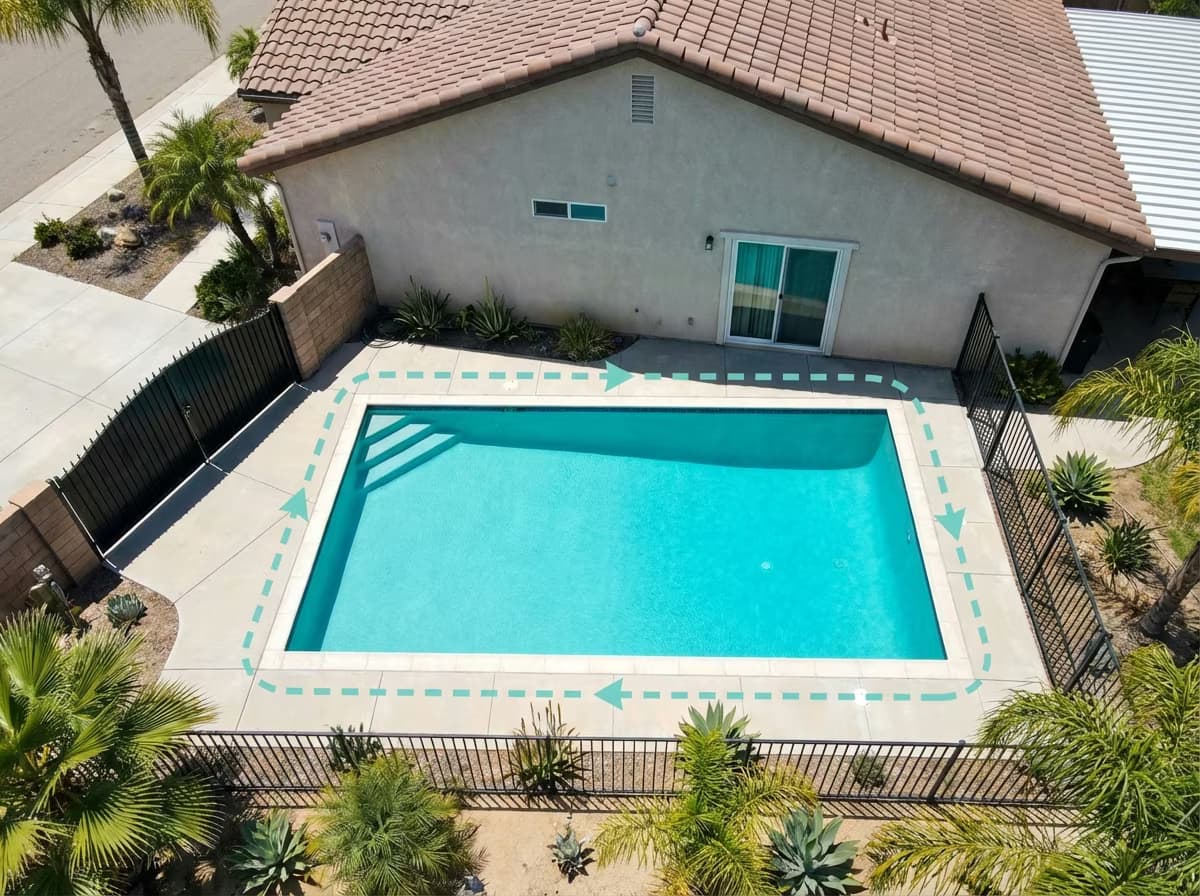
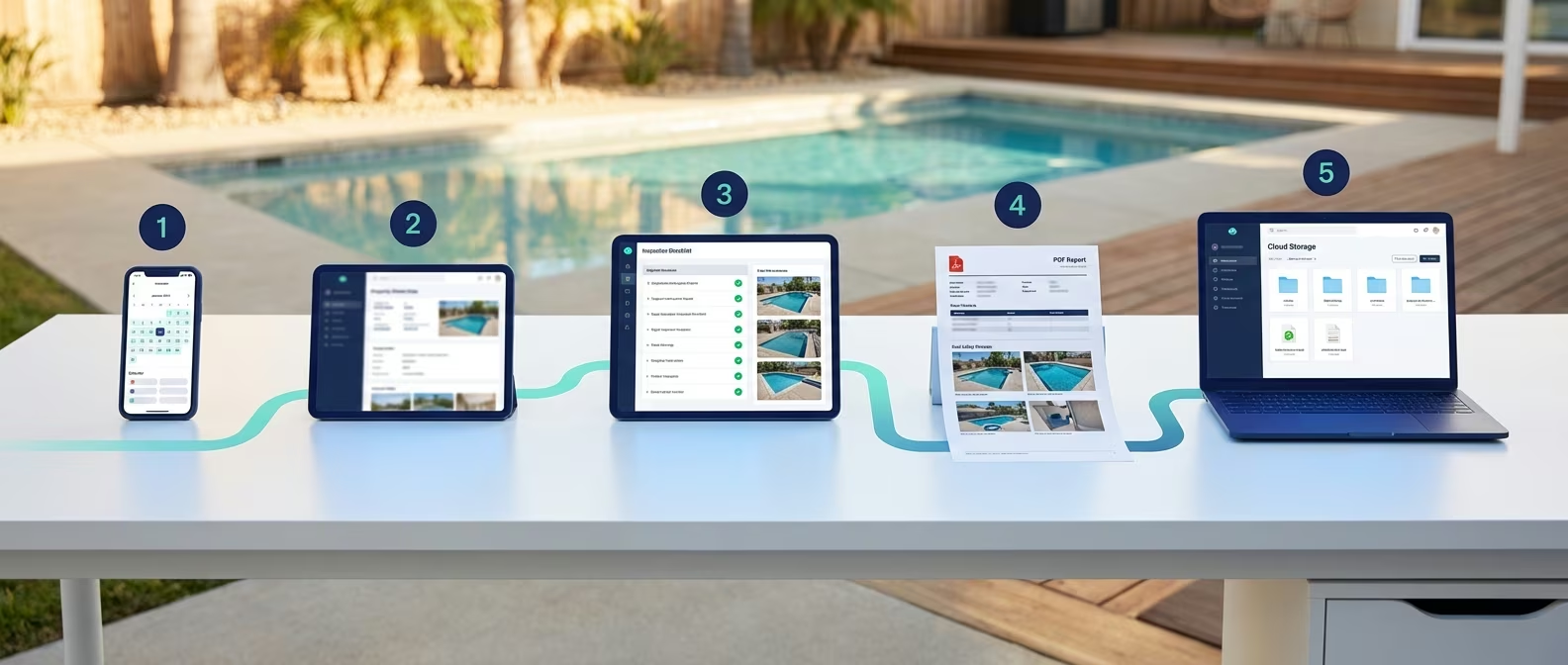
Diagram showing the systematic pool inspection sequence from barriers to gates to access points
Measurement verification techniques
Accurate measurements are the foundation of defensible inspection reports. Approximate measurements create disputes; precise measurements create trust.
Double-measurement protocol
For every critical dimension, measure twice:
Barrier height — Measure from the exterior finished grade to the top of the barrier. Then step 3 feet to the side and measure again. If the two measurements differ by more than 1 inch, investigate the ground level. Always report the lowest measurement, as that's where the barrier is weakest.
Gap width — Don't just test one gap per barrier section. Run the 4-inch sphere test at the widest-looking gap, the tightest-looking gap, and 2-3 random intermediate points. Pay extra attention to:
- Where the barrier meets the ground (bottom gaps)
- Where barrier sections connect
- Gate-to-post gaps on both sides
- Where the barrier meets the house wall
Gate latch height — Measure from the finished grade on the pool side (not the exterior side). Note: if the ground slopes, measure from the lowest point within 3 feet of the gate.
Measurement photo technique
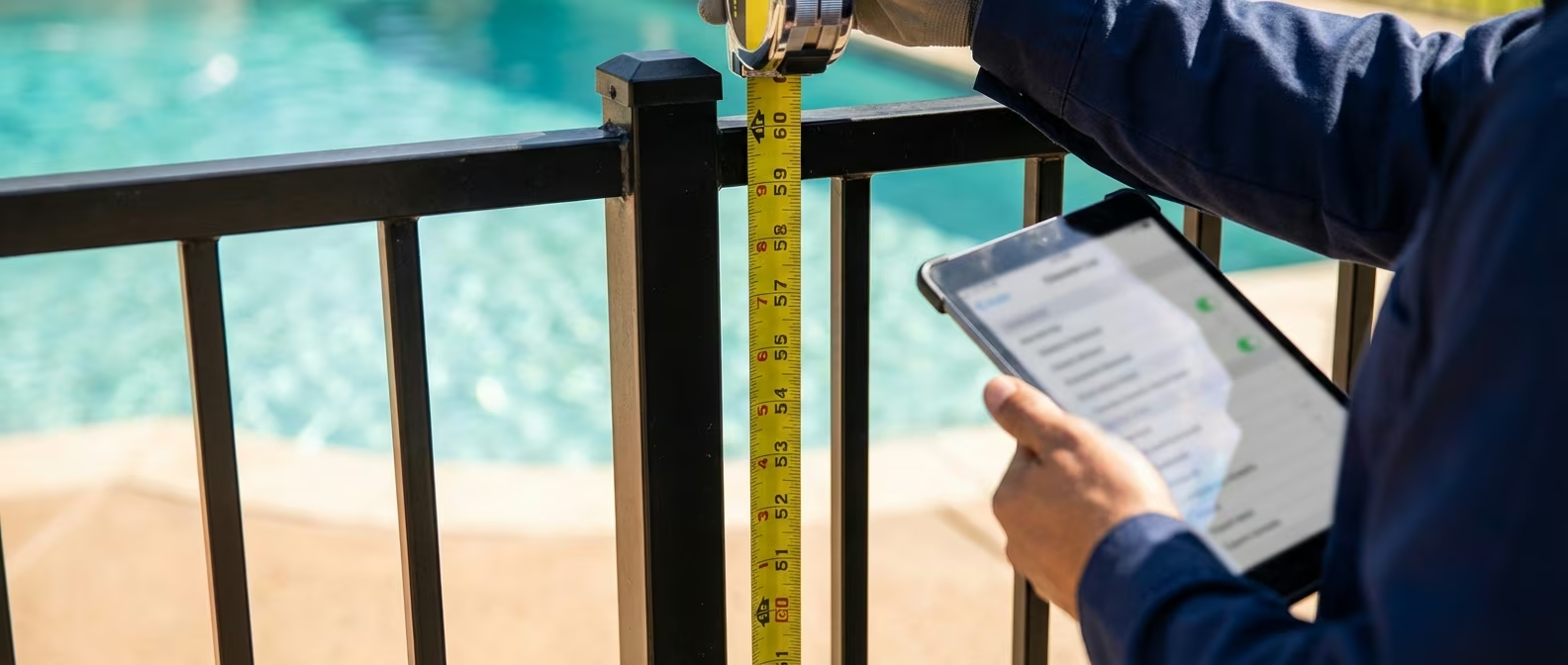
Always photograph critical measurements with the tape measure visible in the frame:
- Hold the tape measure against the surface being measured
- Ensure the measurement markings are clearly readable in the photo
- Include enough context to identify the location (which barrier section, which gate)
- Take the photo perpendicular to the tape for minimal perspective distortion
This creates an objective, verifiable record that eliminates "I measured it differently" disputes.
Calibration habit
Start each day by verifying your tape measure against a known reference (a standard door frame is 80 inches). Tape measures stretch, jam, and become inaccurate with heavy use. Replace yours annually or whenever you notice inconsistency.
The most commonly missed items
Certain inspection items are missed far more frequently than others. Knowing what these are allows you to build extra attention into your process.
Top 5 missed items
1. Drain cover expiration dates — Inspectors check for ASTM markings but forget that drain covers have a maximum service life (typically 7-10 years from manufacture). An ASTM-marked cover installed in 2014 may be past its rated life even though it looks fine. Check the manufacture date stamped on every cover.
2. Bottom barrier gaps on soft ground — The gap standard changes based on surface type: 2 inches maximum on hard surfaces (concrete, stone), 4 inches on soft ground (dirt, grass, mulch). Inspectors who apply the 2-inch standard universally may miss compliant configurations — and those who apply the 4-inch standard universally may miss violations on hard surfaces.
3. Climbable features within 4 feet of barriers — It's easy to inspect the barrier itself and miss the planter, retaining wall, furniture, or tree branch within climbing distance. Walk the interior side of every barrier checking for objects that could serve as stepping aids within a 4-foot radius.
4. Alarm bypass switches — Door and window alarms often have bypass buttons for everyday use. If the bypass is engaged during your inspection, the alarm appears non-functional when it may actually work. Check for bypass mode and test with bypass disengaged. Also verify the alarm has an auto-re-arm feature.
5. Second-floor windows — Windows above the first floor that open to a balcony or rooftop with pool access below are sometimes overlooked because inspectors focus on ground-level access points. Any window that provides a path to the pool area needs an alarm, regardless of floor level.
How to prevent these oversights
- Add these items as explicit checklist items — if they're on the list, they get checked
- Use inspection software with guided checklists that include these specific items. PoolVerify's BPC §7195 templates include checks for drain cover dates, surface-specific gap standards, and climbable feature proximity
- Create a personal "hot list" of items you know you tend to overlook, and review it before each inspection
For the complete list of common violations and how to identify them, see our 10 most common pool safety violations guide.
Photo documentation for accuracy
Photos serve dual purposes: they prove what you found, and the act of photographing forces you to physically verify each item.
Minimum photo standards
Set a minimum photo count for every inspection. A good target is 15-30 photos:
| Category | Minimum Photos | What to Capture |
|---|---|---|
| Full perimeter | 4-6 | Wide shots of each barrier section from the exterior |
| Gates | 2-3 per gate | Open position, closed/latched, latch close-up with measurement |
| Barrier details | 3-5 | Height measurements, gap tests, any climbable features |
| Access points | 1-2 per door/window | Alarm device, testing in action |
| Pool-level | 3-5 | Each drain cover, pool alarm, safety cover |
| Violations | 2-3 per violation | Wide context shot + close-up detail |
Photo accuracy habit
Photograph before you mark the checklist item. This creates a behavioral link between verification and documentation — you can't check the box without first taking the photo, which means you can't check the box without physically looking at the item.
Timestamp everything
Use inspection software that automatically timestamps photos. Manual timestamps on paper are unreliable. Timestamped photos create a verifiable chronological record that's defensible in disputes and legal proceedings.
Complete California pool inspections with confidence and accuracy.
PoolVerify's guided BPC §7195 checklists enforce systematic inspection sequences and require photo documentation at each step.
Using checklists effectively
Checklists are the most studied and proven accuracy tool across all inspection industries — from aviation to surgery to pool safety.
Why checklists work
- They override memory: You don't have to remember what to check — it's written down
- They enforce completeness: Every item must be addressed before the inspection is complete
- They create consistency: Different inspectors following the same checklist produce comparable results
- They reduce decision fatigue: The checklist makes the "what's next?" decision for you
Paper vs. digital checklists
| Factor | Paper Checklists | Digital Checklists |
|---|---|---|
| Enforced completion | No — items can be skipped | Yes — software can require all items |
| Photo integration | Separate process | Embedded in workflow |
| Code references | Must be memorized or looked up | Built into each checklist item |
| Report generation | Manual (30-60 min) | Automatic (seconds) |
| Audit trail | None | Complete timestamp history |
| Weather resistance | Poor (rain, sweat) | Good (tablet with case) |
Digital checklists are objectively more accurate because they can enforce completion and integrate photo documentation into the inspection flow. PoolVerify provides guided BPC §7195 and HSC §115922 checklists that walk you through every required check in a fixed sequence, with photo prompts at each step.
For a detailed comparison, see our paper forms vs. digital inspection software guide.
Managing inspection fatigue
Accuracy degrades predictably with fatigue. The eighth inspection of the day is statistically less thorough than the second — unless you actively manage fatigue.
Physical fatigue management
- Hydration: Carry water to every inspection, especially in California summer heat. Dehydration impairs concentration before you feel thirsty
- Breaks: Take a 5-10 minute break between inspections — sit in your vehicle with AC, drink water, reset mentally
- Nutrition: Eat a substantial lunch between your morning and afternoon inspection blocks. Low blood sugar directly impairs attention to detail
- Sun protection: Hat, sunscreen, and light-colored clothing reduce heat fatigue during outdoor work
Mental fatigue management
- Daily limit: Cap yourself at 6-8 inspections per day. Beyond this, error rates increase measurably regardless of experience level
- Variety positioning: If possible, alternate between simple pools (basic rectangular, standard fencing) and complex pools (multiple access points, mixed barrier types) to maintain engagement
- Checklist reliance: On your final inspections of the day, rely more heavily on the checklist rather than memory. Let the system maintain your accuracy when your attention is fading
- End-of-day review: Before submitting your final 2-3 reports, review them for completeness. Late-day reports are the ones most likely to have gaps
Quality assurance after the inspection
Accuracy doesn't end when you leave the property. Post-inspection quality checks catch the items that slip through even the best on-site process.
Self-review checklist
Before delivering any report to a client, verify:
- [ ] Every checklist item has a status (pass, fail, N/A) — no blanks
- [ ] Every failure has a specific code reference
- [ ] Minimum photo count is met
- [ ] Measurement photos are clear and readable
- [ ] HSC §115922 safety feature count is documented (at least 2 of 7)
- [ ] Property address and client information are correct
- [ ] Report date and inspection date match
- [ ] No typos in client-facing sections
Periodic accuracy audits
If you're a solo inspector, audit your own work periodically. Pick one completed inspection per week and ask yourself:
- "If another inspector reviewed this report, would they reach the same conclusions?"
- "Could I defend every finding with photo evidence and code references?"
- "Is there anything I know about the property that's not in the report?"
If you manage a team, see our team training and QA guide for structured audit processes.
Inspector safety during inspections
Accuracy requires focus, and focus requires personal safety. Rushing through hazardous conditions degrades both your safety and your inspection quality.
Common on-site hazards
- Wet pool decks: Slippery surfaces cause falls. Wear non-slip footwear and move carefully around pool edges
- Electrical hazards: Pool equipment areas may have exposed wiring. Never touch pool electrical equipment unless qualified
- Animal encounters: Dogs, bees, snakes, and spiders are common in California backyards. Scan the area before entering and ask homeowners to secure pets before your arrival
- Heat exposure: Inland California temperatures regularly exceed 100°F. Know the signs of heat exhaustion — dizziness, nausea, excessive sweating — and stop working if they appear
- Structural instability: Deteriorated fences, unstable pool decks, and aging equipment can collapse or break. Test structural elements carefully before applying force
Safety-first mindset
- Never compromise your safety to complete a checklist item. If a drain cover is at the bottom of a pool you can't safely access, document it as "unable to inspect — pool filled" rather than entering the water
- Carry a first aid kit in your vehicle
- Inform someone of your schedule — your office, a colleague, or a family member should know your inspection route for the day
Frequently asked questions
What is the most commonly missed item during pool inspections?
Drain cover compliance is the most commonly missed item. Inspectors often visually confirm a drain cover is present but fail to verify the ASTM F1346-91 marking, check the manufacture date (covers expire after 7-10 years), confirm proper sizing, or test for secure fastening. This oversight is particularly dangerous because drain entrapment incidents have extremely high fatality rates. See our pool drain safety guide for complete drain cover inspection procedures.
How can I verify my pool measurements are accurate?
Use the double-measurement technique for every critical dimension. Measure barrier height from the exterior finished grade at multiple points along each section. For gap testing, run the 4-inch sphere at the widest gap, tightest gap, and several random points. Photograph every measurement with the tape visible in frame. Start each inspection day by verifying your tape measure against a known reference to catch tool wear.
How many photos should I take per pool inspection?
Professional inspectors take 15-30 photos per inspection minimum. Coverage includes: full perimeter shots (4-6), each gate mechanism (2-3 per gate), latch measurements, every drain cover, alarm locations, all safety features, and 2-3 photos per violation. The act of photographing each item forces physical verification, making photos both a documentation tool and an accuracy tool. Use PoolVerify to capture and organize photos within the inspection workflow automatically.
What is the best inspection sequence for accuracy?
Follow a fixed clockwise perimeter-first sequence. Start at the main gate, walk the entire barrier perimeter completing all checks, then return to test each gate mechanism, then move to doors/windows for alarm testing, then finish with pool-level items (drains, alarms, covers). This spatial logic prevents random back-and-forth movement that causes missed items. Digital checklists that enforce this order provide additional consistency — see our pool inspection workflow guide.
How do I avoid inspection fatigue affecting accuracy?
Cap your daily inspections at 6-8, take breaks between inspections, and rely more heavily on checklists as the day progresses. Physical factors matter: stay hydrated, eat adequately, and protect yourself from heat. Mental fatigue is the bigger threat — your fifth inspection feels routine, and routine breeds complacency. Guided digital checklists maintain your accuracy when your attention is fading because they prevent skipping items regardless of how you feel.
Build accuracy into your process
Inspection accuracy isn't a talent — it's a system. The inspectors who consistently catch every violation aren't more gifted; they've built systematic processes, verification techniques, and quality checks into their workflow that make accuracy automatic.
Start with the highest-impact changes: adopt a fixed inspection sequence, implement the double-measurement protocol, and set minimum photo standards. These three practices alone will measurably improve your accuracy on the next inspection you perform.
For inspectors ready to systematize accuracy, PoolVerify provides guided BPC §7195 and HSC §115922 checklists that enforce completion, integrate photo documentation, and generate professional reports instantly. Start your 14-day free trial and build accuracy into every inspection.
Frequently Asked Questions
What is the most commonly missed item during pool inspections?
Drain cover compliance is the most commonly missed item. Inspectors often visually confirm a drain cover is present but fail to verify the ASTM F1346-91 marking, check the manufacture date (covers expire after 7-10 years), confirm proper sizing, or test for secure fastening. This single oversight creates significant entrapment liability.
How can I verify my pool measurements are accurate?
Use the double-measurement technique: measure each critical dimension twice from different positions. For barrier height, measure from the exterior finished grade at multiple points along each section. For gaps, test with a 4-inch sphere at every opening, not just a sample. Document measurements with photos showing the tape measure in frame.
How many photos should I take per pool inspection?
Professional inspectors take 15-30 photos per inspection minimum. This includes: full perimeter shots of all barriers, close-ups of each gate mechanism, latch measurements, every drain cover, alarm locations, safety features, and any violations. More photos is always better — excess photos are easy to exclude from the report, but missing photos cannot be recreated.
What is the best inspection sequence for accuracy?
Follow a fixed clockwise or counterclockwise perimeter walk, completing all barrier checks before moving to gates, then doors/windows, then pool-level items (drains, alarms, covers). This spatial sequence prevents the random back-and-forth that causes missed items. Digital checklists that enforce this order further improve consistency.
How do I avoid inspection fatigue affecting accuracy?
Limit yourself to 6-8 inspections per day maximum. Take a 5-10 minute break between inspections. Use guided digital checklists that prevent skipping items regardless of fatigue level. Drink water and eat between inspections, especially in California summer heat. If you notice yourself rushing, slow down — a thorough inspection protects both your client and your liability.
Related Articles
Blog
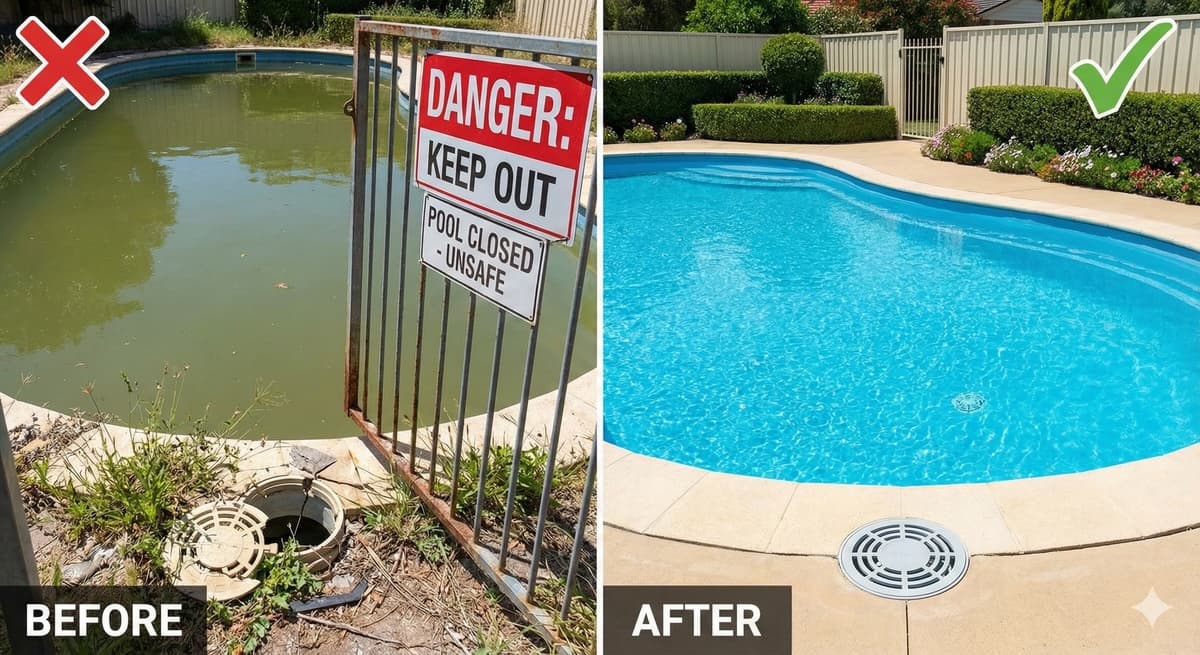
Top 10 Pool Inspection Mistakes to Avoid
Discover the most common pool inspection mistakes that cost inspectors time, money, and reputation. Learn how to avoid these pitfalls with expert tips.
Pool-compliance
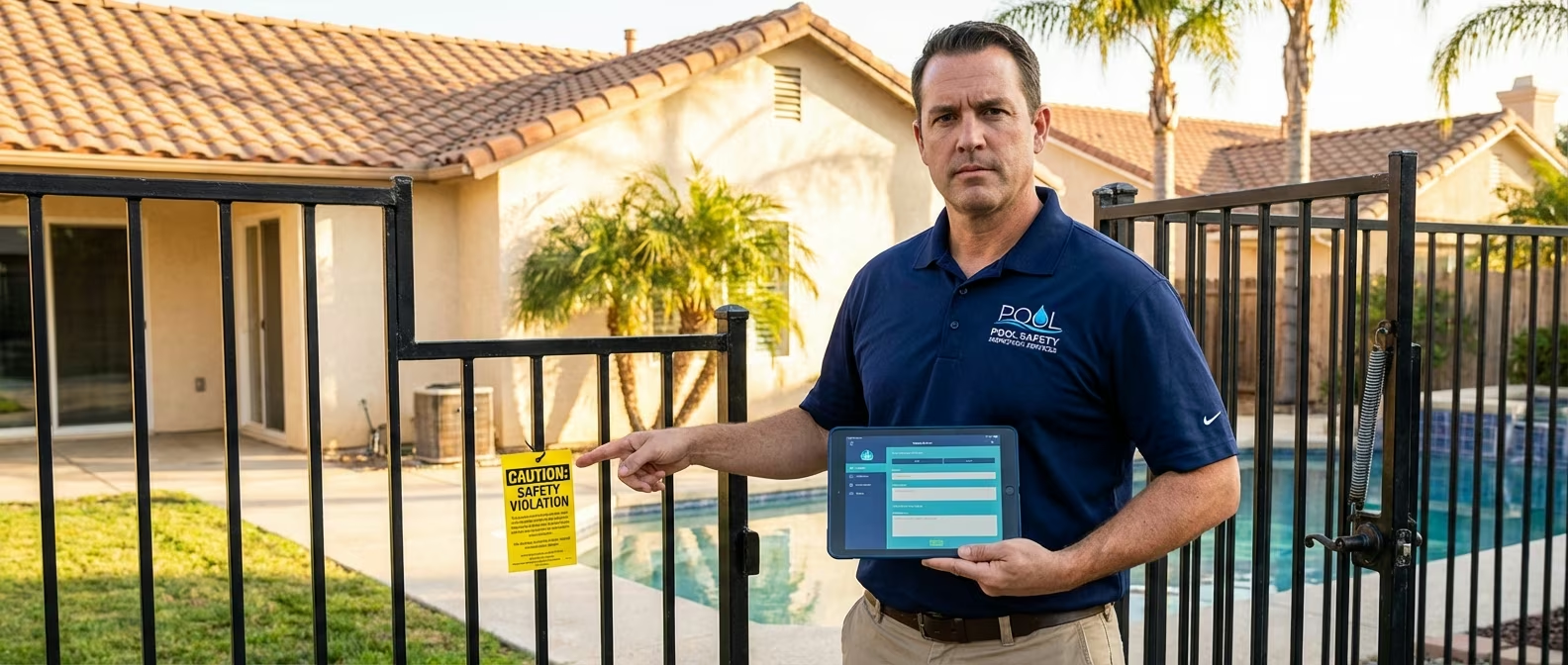
10 Most Common Pool Safety Violations in California
Discover the 10 most common pool safety violations in California, why they fail inspections, and exactly how to fix each one to meet BPC §7195 compliance.
Inspection-best-practices
Pool Inspection Workflow: How to Streamline from Start to Finish
Streamline your pool inspection workflow in 6 steps. Eliminate bottlenecks in scheduling, on-site inspection, reporting, and follow-up for BPC §7195 compliance.