How to Train a Pool Inspection Team: Onboarding Guide
Complete guide to training and onboarding pool inspection team members, from California certification requirements and field shadowing to digital tool adoption and quality assurance processes.
Training a pool inspection team requires more than teaching someone where to point the tape measure. Effective onboarding covers California code knowledge, hands-on field technique, software proficiency, client communication, and quality assurance processes, all structured to produce inspectors who deliver consistent, defensible results from their first independent inspection.
Growing a pool inspection business from solo operation to a multi-inspector team is one of the biggest growth opportunities in the California pool safety market. With BPC §7195 requiring inspections on every property transfer involving a pool, demand consistently exceeds supply in most California markets.
But adding inspectors without proper training creates risk, inconsistent reports, missed violations, client complaints, and liability exposure. This guide provides a structured onboarding framework that gets new team members productive quickly while maintaining the inspection quality that protects your business and your clients.
Before you hire: qualification requirements
California has specific requirements for who can perform pool safety inspections under BPC §7195. Before investing in training, verify your candidate meets the legal qualifications.
Who can perform BPC §7195 inspections
California law allows pool safety inspections to be performed by:
Licensed contractors holding a valid California State License Board (CSLB) license in relevant classifications (C-53 Swimming Pool, C-61/D-35 Pool & Spa Maintenance, or B General Building)
Licensed home inspectors registered with the California Business and Professions Code
Certified building inspectors employed by local jurisdictions
Other qualifying professionals as defined by local building departments
What to verify before hiring
Before bringing a new inspector onto your team:
License verification: Check CSLB license status at the California Contractors State License Board website, confirm it's active, not expired or suspended
Insurance coverage: Verify the inspector carries (or can be added to) your company's general liability and E&O insurance
Background check: Standard for anyone entering private residences
Physical capability: Pool inspections require climbing, bending, reaching, and working in heat, confirm the candidate is physically able
Transportation: Inspectors need reliable transportation to reach inspection sites throughout your service area
The first week focuses entirely on code knowledge. An inspector who doesn't know the code can't identify violations, explain findings to clients, or write defensible reports.
Core codes to cover
Every inspector on your team must thoroughly understand these California pool safety laws:
BPC §7195, Property Transfer Inspection Requirements
When inspections are required (property transfers involving residential pools/spas)
What must be inspected (all barrier features, safety equipment, access points)
Report requirements (what must be documented and disclosed)
Inspector qualification standards
HSC §115922, Swimming Pool Safety Act
The seven approved drowning prevention features
Minimum two-feature requirement for all residential pools
Specific standards each feature must meet (ASTM F1346, ASTM F2286, etc.)
How SB 442 strengthened these requirements
California Building Code (Title 24), Barrier Standards
Case study reviews: Walk through 10-15 completed inspection reports, discussing what was found and why each item is a violation (or passes)
Code quizzes: Test knowledge of specific code requirements, barrier heights, gap dimensions, latch heights, feature counts
Photo identification: Show photos of common violations and have the trainee identify the code violation and the applicable section
County variation review: Brief each inspector on county-specific requirements for your primary service areas. Our county requirements guide covers regional differences
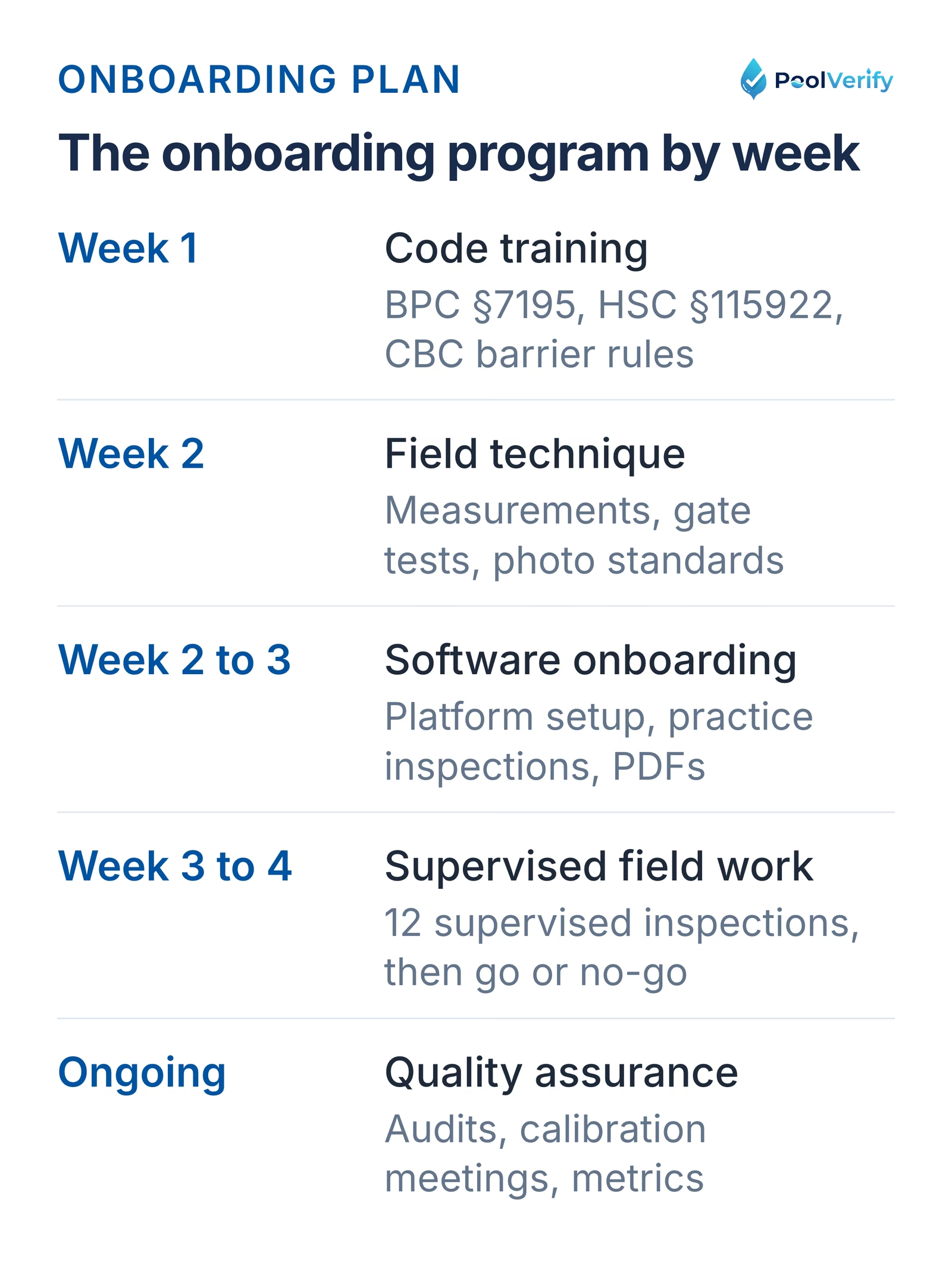
The onboarding timeline: code training in week 1, field technique in week 2, software, supervised inspections, then QA.
Week 2: Hands-on field technique training
Code knowledge becomes practical skill through hands-on training. This phase teaches inspectors how to physically perform each inspection task correctly and efficiently.
Measurement techniques
Train each of these measurement procedures until the inspector can perform them confidently:
Barrier height: Measuring from exterior finished grade to top of barrier, not from the pool side, not from a raised area. How to handle sloped ground, retaining walls, and multi-level barriers
Gap testing: Using a 4-inch sphere at every opening, between pickets, under gates, at post connections, and where barrier sections meet. Bottom gap measurement (2 inches on hard surfaces, 4 inches on soft ground)
Gate latch height: Measuring from grade to the release mechanism on the pool side of the gate
Alarm testing: Using a decibel meter (or calibrated smartphone app) to verify 85+ dB output within 7 seconds of door opening
Testing procedures
Self-closing gate test: Open the gate to 90 degrees, 45 degrees, and 6 inches, release each time and verify it closes and latches
Self-latching verification: Confirm the latch engages positively from every closing position without manual assistance
Drain cover inspection: Check for ASTM F1346-91 marking, physical integrity, secure fastening, proper sizing, and manufacture date
Pool alarm functionality: Test floating or subsurface alarms per manufacturer instructions
Door/window alarm testing: Open each access point and verify alarm sounds within 7 seconds
Photo documentation standards
Establish clear photo requirements that every inspector follows:
Minimum photos per inspection: Set a number (typically 15-25) that ensures comprehensive coverage
Required shots: Full barrier perimeter, each gate (open and closed), latch close-up, any violation, drain covers, pool alarms, door alarms, safety cover (if applicable)
Measurement photos: Include the tape measure in photos of barrier height, gap width, and latch height, this creates verifiable evidence
Context photos: Wide shots showing the overall pool area, house-to-pool relationship, and access points
Practice location
If possible, designate a practice pool (your own facility, a willing client's property, or a mock setup) where trainees can practice measurements and testing procedures without the pressure of a client watching.
Week 2-3: Software and tools onboarding
Your inspection software is the operating system of your business. Every inspector must be proficient before going to the field independently.
Platform setup
For each new inspector:
Create their account with appropriate role-based permissions
Configure their profile: name, license number, contact information for reports
Assign to the correct team (if using multi-team features)
Walkthrough the checklist workflow: show them how the BPC §7195 template guides the inspection step by step
Software training sequence
Follow this progression to build proficiency:
Day 1: Platform orientation (30-60 minutes)
Account login and navigation
Understanding the inspection checklist structure
How each checklist item maps to a specific code requirement
Basic photo capture and attachment
Day 2-3: Practice inspections (2-3 hours)
Complete 2-3 practice inspections using the software on a real or mock pool
Focus on: starting a new inspection, navigating checklist sections, capturing and attaching photos, adding notes, marking pass/fail items
Day 4-5: Report generation and delivery (1-2 hours)
Generate PDF reports from completed practice inspections
Review the output for accuracy and completeness
Practice digital signature collection
Send a test report via email to verify the delivery workflow
Web-based platforms like PoolVerify simplify this process, no app installation required, works on any device, and the guided BPC §7195 checklists ensure new inspectors follow the complete inspection sequence.
Equipment checklist
Ensure every inspector has:
Tablet or smartphone: charged, with protective case for outdoor use
Tape measure: 25-foot minimum for barrier height measurements
4-inch sphere: for gap testing (a standard softball works in a pinch)
Decibel meter app: calibrated for alarm testing
Flashlight: for equipment areas and shaded barriers
Business cards: for client interactions
Company-branded polo or shirt: professional appearance matters
Week 3-4: Supervised field inspections
Supervised field work is where training becomes competence. New inspectors learn more from 10 real inspections than from 40 hours of classroom study.
Shadowing phase (inspections 1-3)
The senior inspector leads the inspection while the trainee observes and takes notes:
Inspection 2: Trainee performs measurements and testing while the senior inspector verifies. Trainee captures photos and enters data into the inspection software
Inspection 3: Trainee conducts the inspection with the senior inspector observing but not directing. Senior provides feedback after, not during
Supervised solo phase (inspections 4-8)
The trainee leads the inspection independently while the senior inspector is present but stays back:
Intervene only for safety issues or significant code misinterpretations
After each inspection, review the report together, discuss what was done well and what needs improvement
Focus feedback on: thoroughness, efficiency, client communication, and documentation quality
Independent with support (inspections 9-12)
The trainee conducts inspections alone with the senior inspector available by phone:
Review every report the trainee produces before it goes to the client
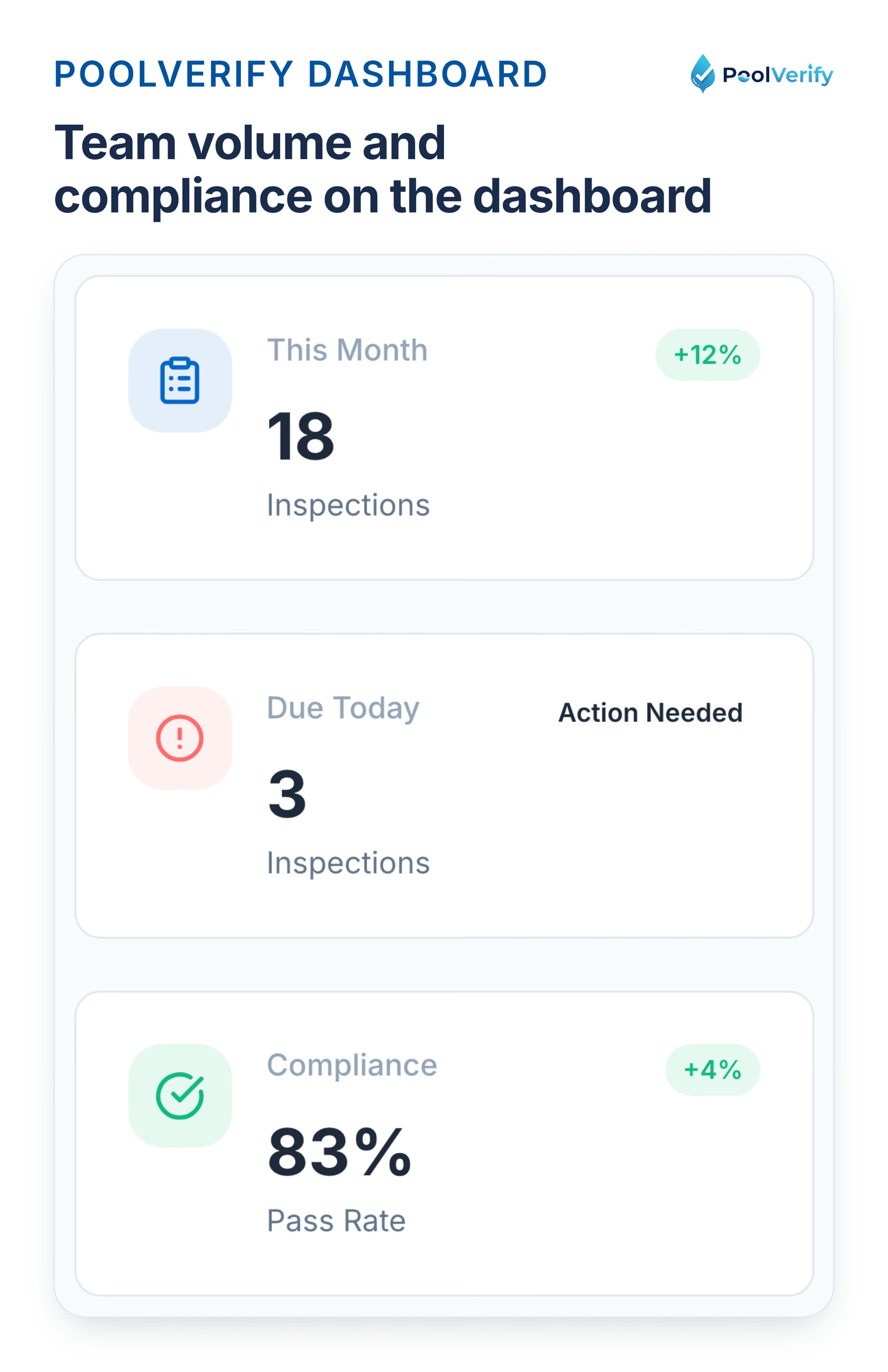
Track inspection duration, are they completing in a reasonable timeframe?
Monitor client feedback, any complaints or concerns?
After inspection 12, make a go/no-go decision on full independence
Red flags during supervised field work
Watch for these issues that may require additional training:
Rushing through the checklist without physically verifying each item
Insufficient photo documentation: relying on memory rather than evidence
Code confusion: misidentifying which code section applies to a finding
Poor client communication: using jargon, being dismissive of concerns, or not explaining findings clearly
Measurement inconsistency: getting different measurements on the same barrier when tested twice
Ongoing: Quality assurance and calibration
Training doesn't end when onboarding is complete. Ongoing quality management is what maintains consistency as your team grows.
Report auditing
Implement a structured audit process:
First month: Review 100% of new inspector reports before client delivery
Months 2-3: Review 50% of reports (selected randomly)
Ongoing: Review 10-20% of reports from each inspector monthly
Review quarterly: Update for code changes, policy updates, and lessons learned
Incorporate feedback: Add sections based on questions new hires consistently ask
Version control: Date each revision so inspectors know they're referencing the latest version
Common onboarding mistakes to avoid
These are the most frequent mistakes inspection companies make when training new team members:
Rushing the process
Mistake: Sending a new inspector to the field after 1-2 days of training because demand is high.
Consequence: Incomplete inspections, missed violations, client complaints, and potential liability. One bad report from a poorly trained inspector can cost more than weeks of lost revenue.
Fix: Follow the full 2-4 week program. The short-term revenue loss is a fraction of the long-term cost of poor quality.
Skipping code training
Mistake: Assuming an experienced home inspector or contractor already knows California pool safety codes.
Consequence: General construction knowledge doesn't translate to BPC §7195 specifics. Pool barrier requirements, safety feature combinations, and drain cover standards are specialized knowledge.
Fix: Every new hire completes the full code training module, regardless of prior experience. Give credit for relevant knowledge but verify competency through testing.
No documentation standards
Mistake: Telling new inspectors to "take photos" without specifying what, how many, and from what angles.
Consequence: Inconsistent reports, insufficient evidence for disputed findings, and unprofessional client deliverables.
Fix: Specify exact photo requirements (minimum count, required shots, measurement inclusion) and audit compliance during onboarding.
Ignoring soft skills
Mistake: Training only on technical inspection procedures while ignoring client communication, professional appearance, and conflict resolution.
Consequence: Technically competent inspectors who generate client complaints, agent friction, and referral loss due to poor interpersonal skills.
Fix: Include client communication practice in the training program. Role-play common scenarios: explaining a major violation to a seller, handling an agent who wants you to minimize findings, and dealing with a frustrated homeowner. See our guide on challenges pool inspectors face for more on handling these situations.
Limitations
This guide is general information about pool safety law, not legal advice; the current text of HSC §115922 and BPC §7195 on leginfo.legislature.ca.gov controls, and local building departments add their own requirements. PoolVerify is inspection software for California residential pool safety inspections; it does not perform inspections, certify inspectors, or issue compliance certificates.
Frequently asked questions
How long does it take to train a new pool inspector?
A structured onboarding program typically takes 2-4 weeks to produce a competent, independent inspector. This includes 3-5 days of code study, 5-10 supervised field inspections, software training, and a gradual transition to independent work with quality audits. Inspectors with prior construction or home inspection experience may complete the program faster, but every hire should complete the full code training module regardless of background.
What certifications do pool inspectors need in California?
California requires pool safety inspectors to hold a valid qualifying license under BPC §7195. This includes CSLB contractor licenses (C-53, C-61/D-35, or B classifications), home inspector registrations, or certified building inspector credentials. Additional certifications like NSPF CPO (Certified Pool Operator) or PHTA certifications are recommended for professional development but not legally required for BPC §7195 safety inspections. See our certification guide for details.
How do I ensure consistent inspection quality across my team?
Consistency comes from standardized processes, not individual talent. Use digital inspection platforms like PoolVerify with guided BPC §7195 checklists that walk every inspector through the same sequence. Set minimum photo documentation requirements, conduct random report audits (10-20% monthly), and hold monthly team calibration sessions where inspectors review edge cases together. Track completeness scores and inspection duration for each team member.
What should a pool inspector training checklist include?
A comprehensive training checklist covers technical, operational, and communication competencies. Technical: California pool safety codes (BPC §7195, HSC §115922, SB 442), barrier measurement techniques, gate mechanism testing, alarm verification, drain cover compliance, and safety feature identification. Operational: inspection software proficiency, photo documentation standards, report generation, and scheduling procedures. Communication: client interaction scripts, finding explanation techniques, and dispute resolution approaches.
How do I onboard inspectors onto inspection software?
Follow a progressive training sequence starting with a 30-60 minute platform walkthrough covering account setup, checklist navigation, photo capture, and report generation. Have new inspectors complete 2-3 practice inspections using the software before going to the field. Pair them with an experienced user for their first 5 real inspections to build confidence. Web-based tools like PoolVerify require no app installation, which simplifies deployment, inspectors just open a browser on any device and log in.
Build a team that delivers consistent results
The investment in structured onboarding pays dividends in quality, reputation, and scalability. Companies with documented training programs experience fewer client complaints, lower liability exposure, faster inspector ramp-up, and stronger agent referral relationships.
For inspection companies ready to standardize their team operations, PoolVerify provides the platform foundation: guided BPC §7195 checklists ensure every inspector follows the same process, team management features enable role-based access and report review, and cloud storage keeps all inspection records centralized and secure. Start your 14-day free trial with your Business plan and onboard your team in minutes.
Last updated: September 9, 2026
What the client receives
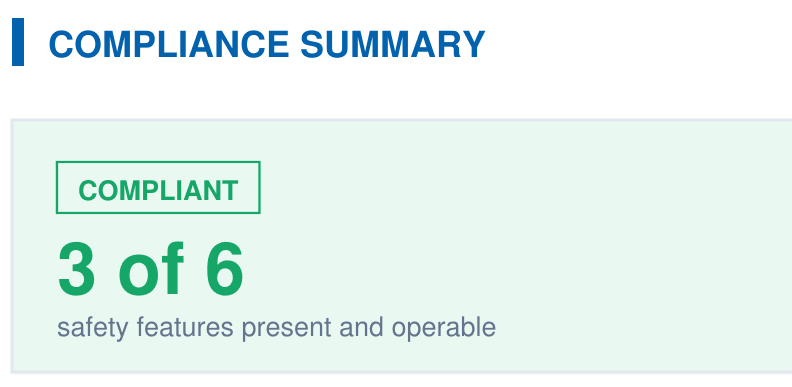
A branded PDF with the compliance summary, the feature table, each finding with its photos, and the signature, generated on‑site when the BPC §7195 and HSC §115922 checklist is complete.