Pool-compliance
Pool Electrical Inspection: Code Requirements [California 2026]
Complete guide to pool electrical inspection requirements under NEC Article 680 and California amendments. GFCI protection, bonding, grounding, and safety standards for 2026.
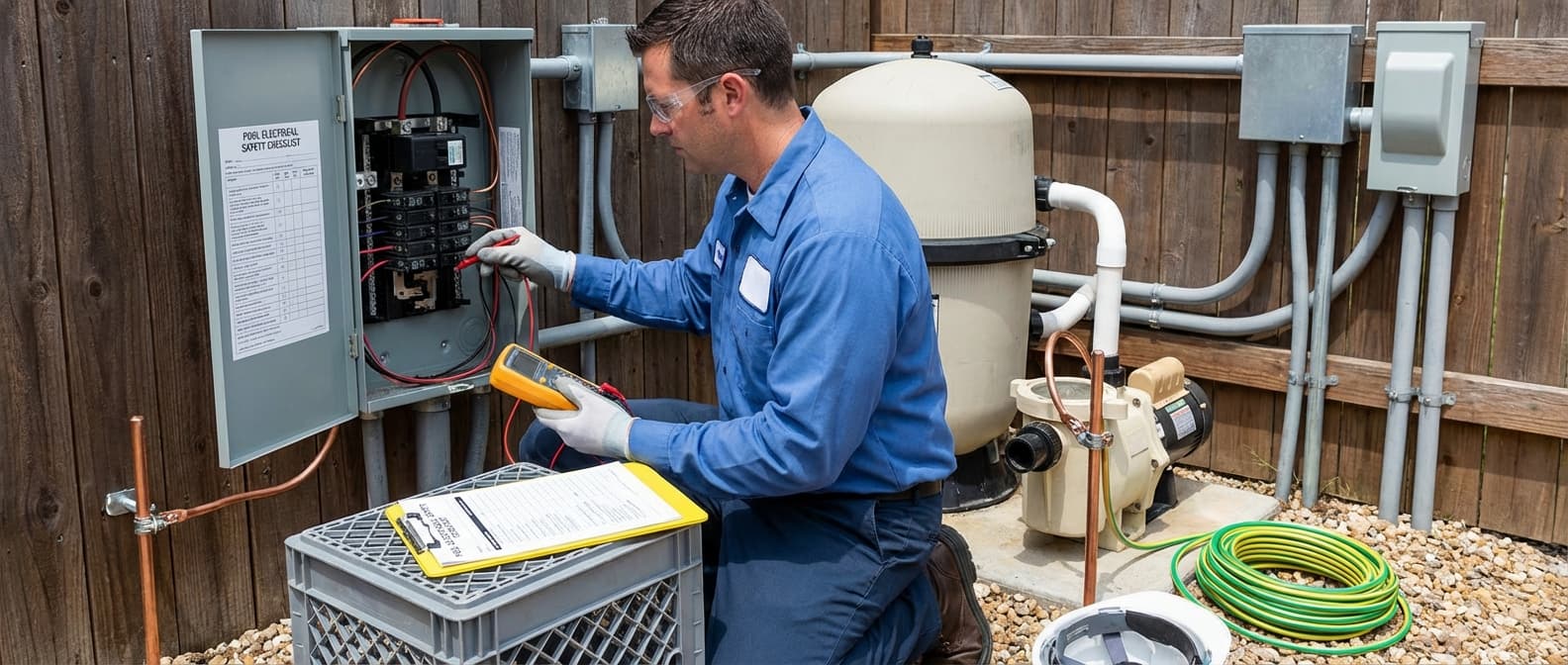
12 min read
Pool electrical systems are among the most critical safety components inspected during California pool compliance assessments. With California's adoption of the 2023 NEC effective January 1, 2026, pool electrical inspection requirements have become more comprehensive, expanding GFCI protection coverage and strengthening bonding requirements to prevent electrical shock hazards.
Understanding NEC Article 680 requirements for swimming pools is essential for pool inspectors, electricians, and property owners navigating California's electrical safety standards. This guide covers everything from GFCI protection rules to equipotential bonding grids that keep swimmers safe from electrical hazards.
Table of Contents
- Understanding NEC Article 680: Foundation of Pool Electrical Safety
- California 2026 Electrical Code Updates for Pools
- GFCI Protection Requirements
- Pool Bonding and Grounding Requirements
- The 5-Foot and 10-Foot Rules: Receptacle Location Requirements
- Overhead Power Line Clearances
- Underwater Lighting Safety Requirements
- Transformer and Power Supply Requirements
- Junction Box Requirements
- Conduit Installation and Burial Depth Requirements
- Equipment Grounding Requirements
- Pool Electrical Inspection Checklist
- Common Pool Electrical Violations
- Frequently Asked Questions
Understanding NEC Article 680: Foundation of Pool Electrical Safety
NEC Article 680 establishes the electrical installation requirements for swimming pools, spas, hot tubs, fountains, and similar installations. According to the National Electrical Code, if this article has one overriding concern, it's to keep people and water separated from electricity.
The core principle behind Article 680 is reducing the risk of electrical shock in and around bodies of water. Water is an excellent conductor of electricity, and the combination of wet surfaces, barefoot swimmers, and electrical equipment creates unique hazards that standard electrical code doesn't adequately address.
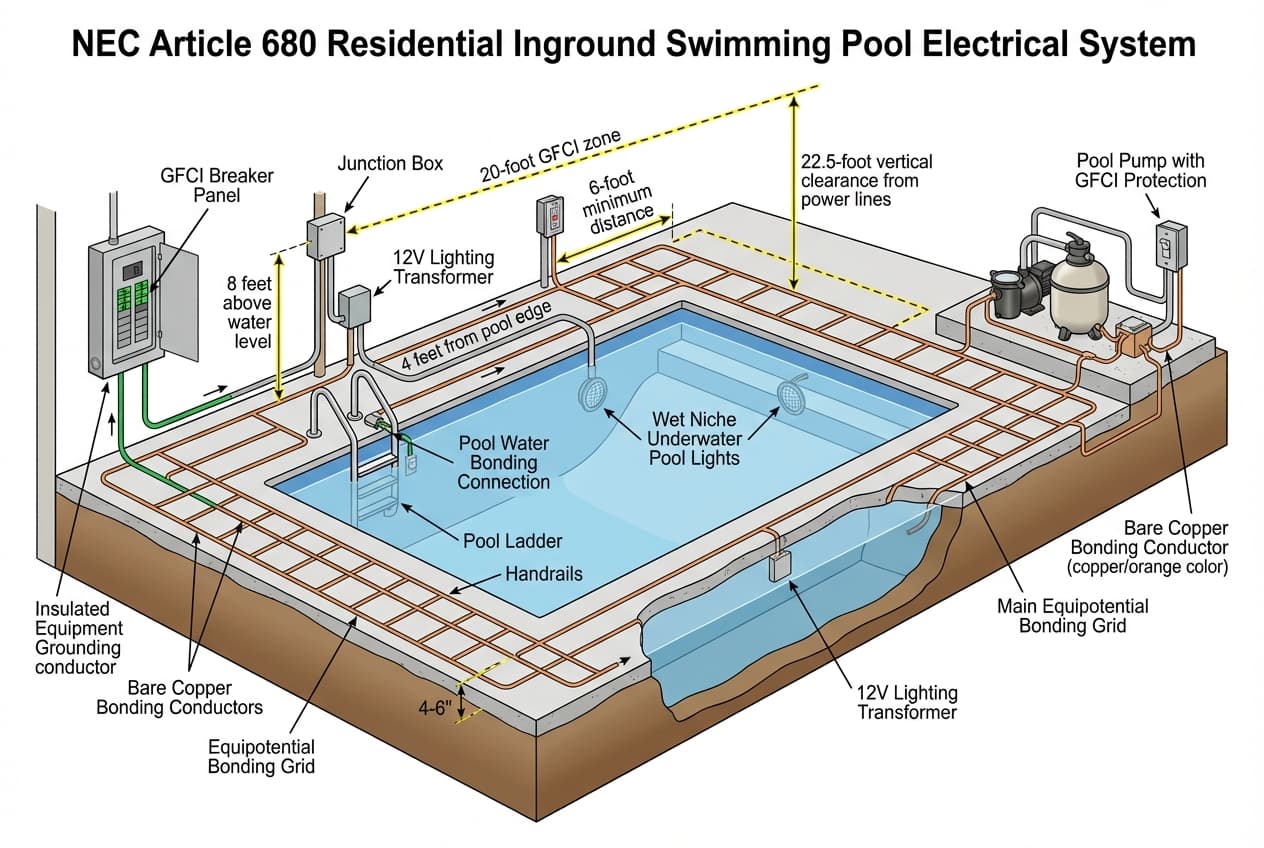
Technical illustration showing NEC Article 680 scope with pool electrical system components labeled including GFCI protection, bonding, lighting, and equipment
Article 680 covers several critical areas:
Grounding and bonding requirements that create equipotential planes around pools to eliminate voltage gradients that could cause shock. GFCI protection for virtually all electrical equipment and receptacles near pools. Wiring methods and distances that maintain safe separation between electrical components and water. Underwater lighting systems with specific requirements for transformers, junction boxes, and wet niche fixtures.
Pool inspectors conducting California pool safety inspections must thoroughly understand these requirements to identify code violations that could create life-threatening electrical hazards. Digital inspection tools like PoolVerify include comprehensive electrical inspection checklists based on current NEC Article 680 requirements.
California 2026 Electrical Code Updates for Pools
California's building code operates on a three-year adoption cycle, and significant changes took effect January 1, 2026, when the state adopted the 2023 NEC as part of its Title 24 Building Standards Code. These updates strengthen electrical safety requirements for pools across California.
According to the California Building Standards Commission, the 2026 updates include three major areas of electrical changes:
Expanded GFCI Coverage
The 2026 code expands GFCI protection requirements to include automation systems, lighting transformers, and even solar-powered pool equipment. Previously, some low-voltage systems were exempt from GFCI protection, but the expanded coverage addresses electrical shock risks from all powered pool equipment.
Stricter Bonding Requirements
California's amendments to Article 680 require additional bonding of metallic conduits, railings, and deck equipment. The enhanced bonding rules create more comprehensive equipotential planes that eliminate voltage gradients around pools.
Energy Efficiency Mandates
While not strictly a safety code requirement, Title 24 energy standards now mandate variable-speed pool pumps, timers, and energy-efficient lighting. These requirements affect electrical inspections because they change the types of equipment installed and their electrical characteristics.
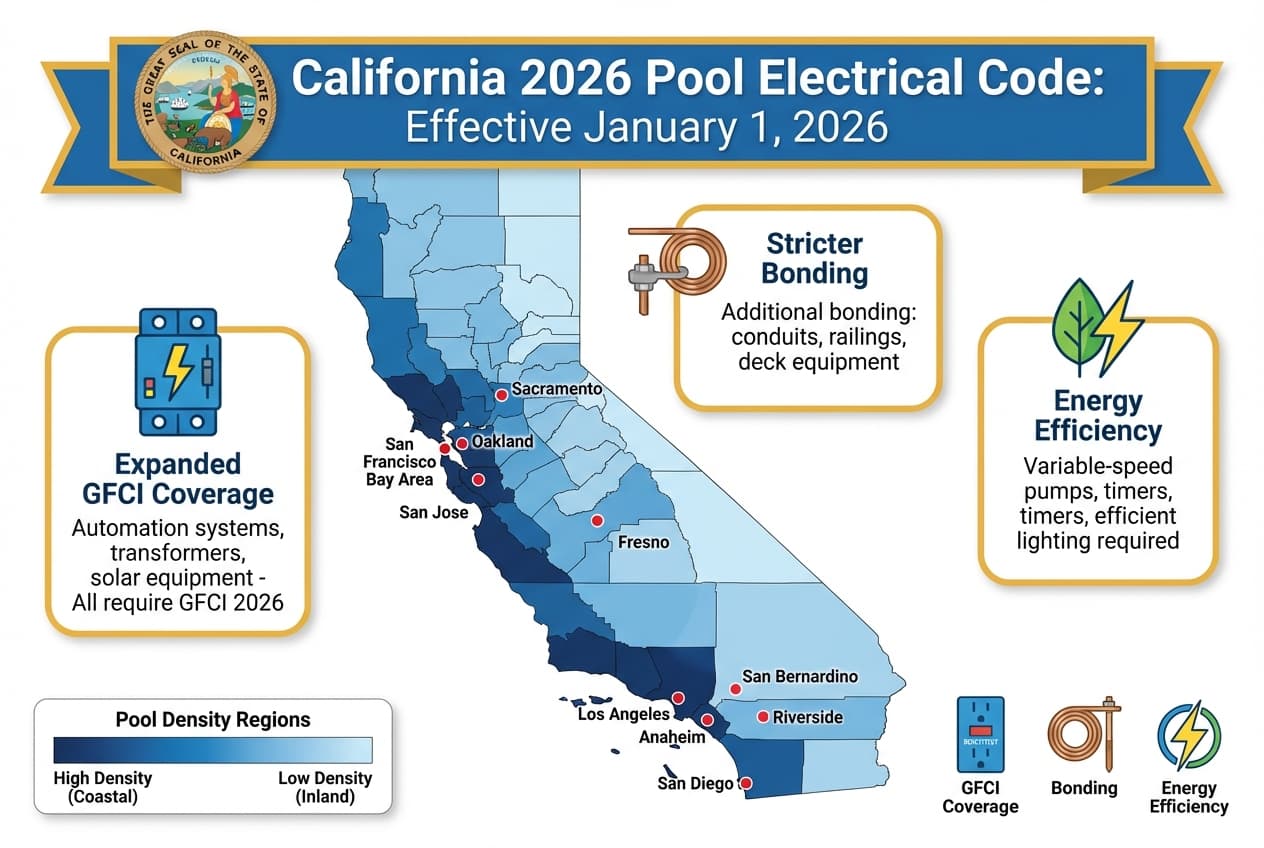
California map highlighting counties with Title 24 pool electrical requirements and effective dates for 2026 code adoption
For pool construction projects, the effective date matters significantly. Permit applications submitted before December 31, 2025 were evaluated under the previous code standards, while applications submitted on or after January 1, 2026 must comply with the new requirements.
Pool inspectors should verify which code year applies to each inspection based on the original permit date. For digital documentation of code compliance, PoolVerify automatically references the appropriate code requirements based on inspection date and location.
GFCI Protection Requirements
Ground-Fault Circuit Interrupters (GFCI) are the primary protection against electrical shock in pool environments. According to NEC 680.21, GFCI protection is required for nearly all pool- and spa-related circuits, including pumps, electrical heaters, lighting, and convenience outlets near water.
Pool Pump Motors
All pool pump motors on branch circuits rated 150 volts or less to ground and 60 amperes or less must have Class A ground-fault circuit-interrupter protection. This requirement applies to single-phase and three-phase motors.
When replacing an existing pool pump motor for maintenance or repair, the replacement pump must be provided with GFCI protection even if the original installation was grandfathered under older code. This "upgrade on replacement" rule ensures older pools gradually come into compliance with current safety standards.
Receptacle GFCI Protection
All 15-ampere and 20-ampere, 125-volt receptacles located within 20 feet of the inside wall of the pool must be GFCI protected. This rule applies to convenience receptacles, equipment receptacles, and any other electrical outlets in the pool area.
The 20-foot measurement is taken horizontally from the inside pool wall, following the shortest path and measured along the walking surface. Walls, buildings, or other barriers don't reduce this measurement unless they provide complete separation that prevents someone from reaching the receptacle while in contact with the pool water.
Lighting and Equipment GFCI Protection
According to NEC Article 680 requirements, luminaires (light fixtures), lighting outlets, and ceiling-suspended paddle fans located between 5 and 10 feet from the inside pool wall must have GFCI or SPGFCI protection in accordance with NEC 680.5(B) or (C).
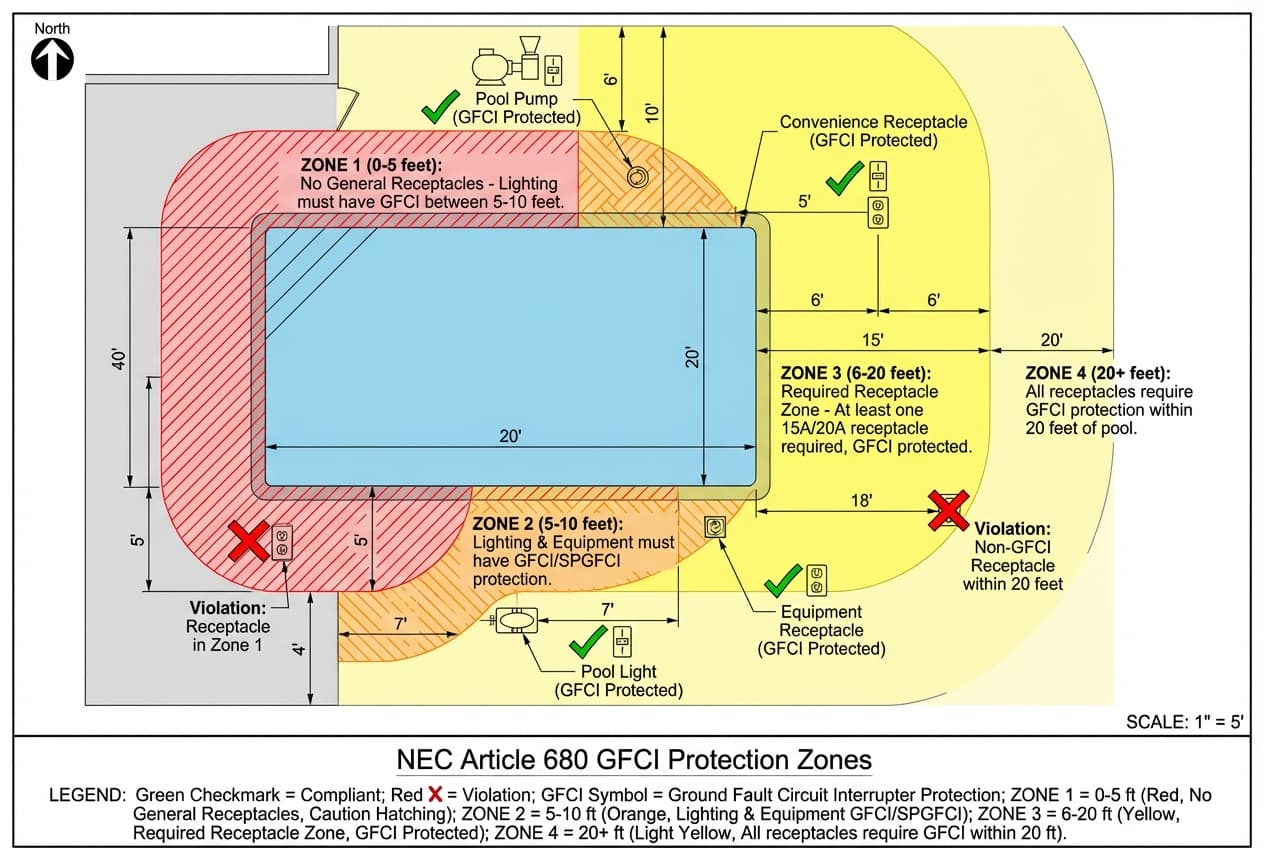
Technical diagram showing GFCI protection zones around pool with 5-foot, 10-foot, and 20-foot measurement lines and equipment placement
GFCI Protection Standards
Pool electrical systems must meet specific GFCI protection levels:
Class A GFCI Protection (6mA) - Standard GFCI protection required by NEC 210.8 for most pool equipment and receptacles. Trips when ground fault current exceeds 6 milliamperes.
Class C SPGFCI Protection (20mA) - Special purpose ground-fault circuit-interrupter protection allowed for specific pool equipment under NEC 680.5(C). Trips when ground fault current reaches 20 milliamperes.
Pool inspectors should verify GFCI protection by testing each protected circuit. Digital pool inspection platforms like PoolVerify include photo documentation fields for recording GFCI test results and device labels during inspections.
Streamline your pool electrical inspections with digital tools
PoolVerify helps California pool inspectors document electrical compliance with photo uploads, GFCI test recording, and code-compliant report generation.
Pool Bonding and Grounding Requirements
Bonding and grounding are separate but related electrical safety concepts that work together to protect swimmers from electrical shock. Understanding the distinction is critical for proper pool electrical inspections.
Grounding connects electrical equipment to the earth to provide a path for fault currents and trip overcurrent protection devices. Bonding connects all metallic components together to create an equipotential plane that eliminates voltage differences between objects.
Equipotential Bonding Requirements (NEC 680.26)
According to NEC 680.26, equipotential bonding must be installed to reduce voltage gradients in the pool area. The bonding system creates an equipotential plane that keeps all metallic objects at the same electrical potential, preventing shock if someone simultaneously touches two objects.
The following components must be bonded together using insulated, covered, or bare solid copper conductors not smaller than 8 AWG:
- Pool structural steel - All reinforcing steel in the pool shell unless separated by expansion joint
- Pool shell - Non-conductive pool shells must include a copper conductor grid
- Perimeter surfaces - Concrete, stone, or other paved surfaces within 3 feet of the pool edge
- Metallic components - Ladders, handrails, and metal deck equipment
- Electrical equipment - Pumps, heaters, and other fixed equipment
- Metal fittings - Underwater lighting fixtures and through-wall metal fittings
- Pool water - Intentional bonding connection to the pool water
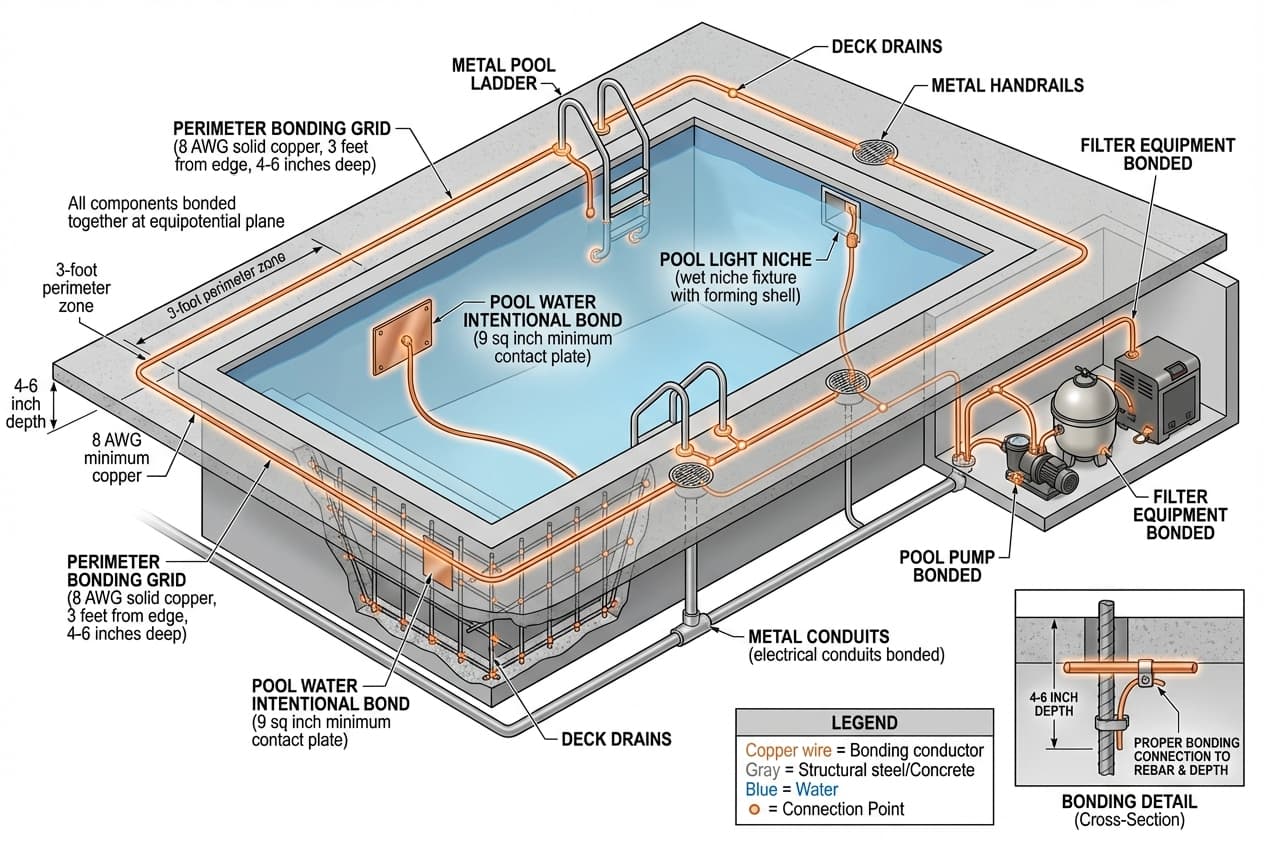
Technical illustration showing comprehensive equipotential bonding grid around pool including perimeter surfaces, equipment, and structural components
Perimeter Surface Bonding
The perimeter surface bonding requirement extends 3 feet (1 meter) horizontally beyond the inside walls of the pool and includes unpaved surfaces, concrete, stone, and other types of paving. According to NEC 680.26(B)(2), perimeter bonding must be accomplished by one of three methods:
Structural reinforcing steel bonded together with steel tie wires. Bare copper conductor not smaller than 8 AWG installed in a 4 to 6 inch depth within concrete or around the perimeter of pool. Alternative means approved by the authority having jurisdiction that provides equivalent bonding.
Pool Water Bonding
An intentional bond to the pool water is required using a minimum conductive surface area of 9 square inches. According to NEC 680.26(C), this connection can be made through:
The pool water can be bonded by metal-sheathed cable or with an 8 AWG copper conductor attached to approved fittings on the circulation pump, metal pool ladder, or other approved metal pool surfaces.
Bonding Conductor Requirements
The 8 AWG or larger solid copper bonding conductor provided to reduce voltage gradients must not be required to be extended or attached to remote panelboards, service equipment, or electrodes. This is a critical distinction - the bonding system is separate from the grounding electrode system.
Bonding conductors can be insulated, covered, or bare. They must be continuous without splices except as permitted by approved pressure connectors, terminal bars, exothermic welding, or listed cable splicing devices.
Pool inspectors should verify bonding connections are secure and that all required components are bonded. For comprehensive bonding documentation, California pool inspection software like PoolVerify includes detailed bonding inspection checklists and photo documentation fields.
The 5-Foot and 10-Foot Rules: Receptacle Location Requirements
NEC Article 680 establishes specific distance requirements for electrical receptacles around pools. These distance rules prevent swimmers from using electrical devices while in contact with pool water, reducing electrocution risk.
Required Receptacle Location
According to NEC 680.22(A)(1), at least one 125-volt, 15-ampere or 20-ampere receptacle must be located not less than 6 feet from, and not more than 20 feet from, the inside wall of the pool. This required receptacle ensures convenient power access for pool maintenance while maintaining safe distance from the water.
General Receptacle Distance Requirements
Other receptacles must be located not less than 6 feet from the inside walls of a pool. This 6-foot minimum prevents someone from using a plug-in device while standing in or immediately next to the pool.
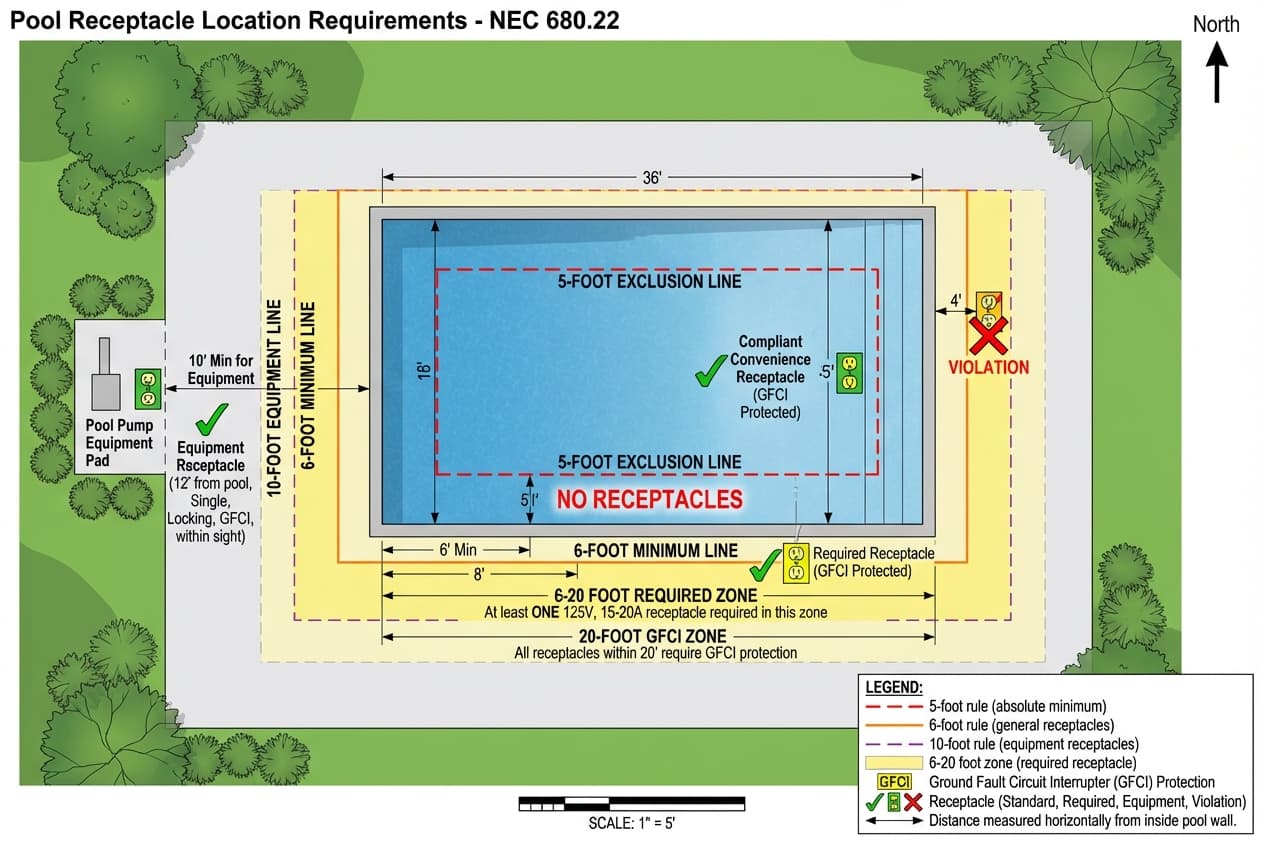
Overhead view diagram showing receptacle location zones around pool with 6-foot minimum, 10-foot pump equipment zone, and 20-foot required receptacle maximum distances
Pool Equipment Receptacle Requirements
For circulation and sanitation systems, receptacles that provide power for water pump motors or other loads directly related to the circulation and sanitation system have different requirements. According to NEC 680 pool electrical requirements, these receptacles must be:
Located at least 10 feet from the inside walls of the pool, OR located not less than 6 feet from the inside walls if all of the following conditions are met:
- Single receptacles only (not duplex)
- Locking type configuration
- GFCI protected
- Located within sight of pool equipment
The reduced distance for equipment receptacles recognizes that service technicians need convenient access to pool equipment while maintaining appropriate safety measures through the locking configuration and GFCI protection.
Height Requirements
While NEC Article 680 doesn't specify minimum height above grade for pool receptacles, local amendments may require specific mounting heights. California typically requires outdoor receptacles to be at least 6 inches above grade to prevent water intrusion during rain or pool splashing.
Overhead Power Line Clearances
Overhead electrical conductors pose serious electrical hazards around pools. Objects like pool cleaning poles, pool covers, and inflatable toys can contact overhead lines, creating electrocution risk. NEC Article 680 establishes strict clearance requirements for overhead conductors.
Utility Service Drop Clearances
According to NEC 680.8, overhead power lines must maintain minimum clearances from pools:
Communication, radio, and television coaxial cables - Minimum 10 feet above water level, diving structures, and observation platforms.
Network-powered broadband systems - Minimum 10 feet above water level.
Power lines 0-750 volts to ground - The most common service drops require 22.5 feet vertical clearance above the water surface and a minimum horizontal clearance of 10 feet from the pool edge.
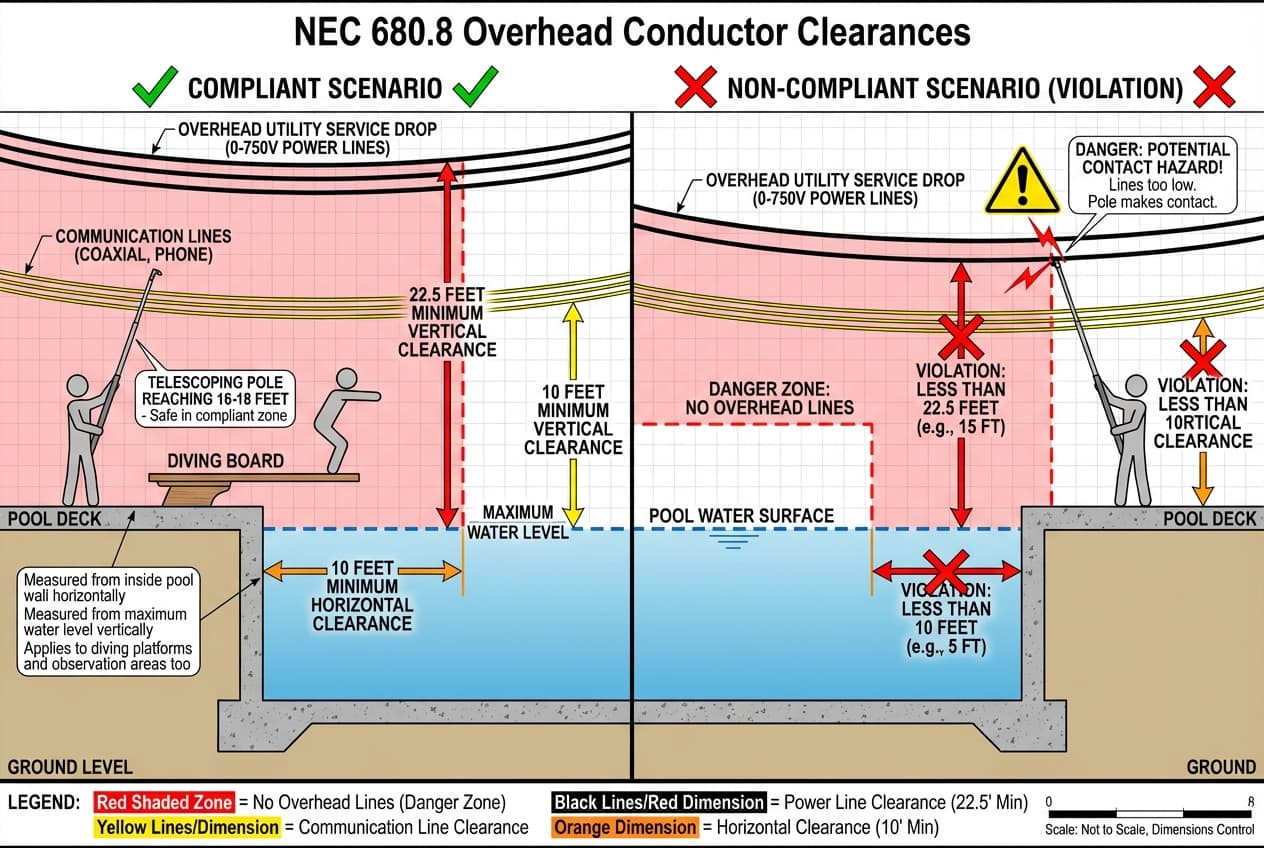
Side elevation view showing overhead power line clearance requirements with 22.5-foot vertical and 10-foot horizontal clearance zones around pool
Horizontal Distance Measurement
The 10-foot horizontal clearance is measured from the inside walls of the pool and extends outward. This creates a protective zone where overhead conductors cannot be located. The horizontal and vertical clearances work together - within the 10-foot horizontal zone, the vertical clearance requirements apply to overhead lines.
Clearance for Diving Structures
Clearances to diving boards, platforms, towers, and other observation platforms must meet the same requirements as clearances above the water surface. A diving board that extends 8 feet from the pool edge requires overhead clearance measured from the outer edge of that board.
Clearance Violations
Overhead clearance violations are serious electrical hazards that require immediate correction. Pool inspectors should document clearance violations with measurements and photos showing the relationship between overhead lines and the pool.
If overhead clearances don't meet code, property owners have two options: relocate the utility service drop (expensive) or relocate/remove the pool or structure creating the violation. For existing installations where utility lines were added after the pool, utility companies may be required to relocate service at their expense.
Underwater Lighting Safety Requirements
Underwater pool lights create unique electrical hazards because they operate while submerged in conductive water. NEC 680.23 establishes comprehensive requirements for underwater luminaires (light fixtures) to eliminate electrical shock risk.
Low-Voltage vs. Line-Voltage Lighting
Pool lighting systems operate at different voltages, each with specific requirements:
Low-voltage lighting (15 volts or less) - The safest option for underwater lighting. When supplied through listed transformers or power supplies, these systems can operate without additional protection.
Medium-voltage lighting (over 15V, not more than 150V) - Requires specific transformer protection and GFCI protection.
Line-voltage lighting - Must be specifically listed and labeled for pool use with comprehensive protection requirements.
According to the NEC 680.23 underwater luminaire requirements, the trend in pool lighting is toward low-voltage LED systems that provide superior safety and energy efficiency.
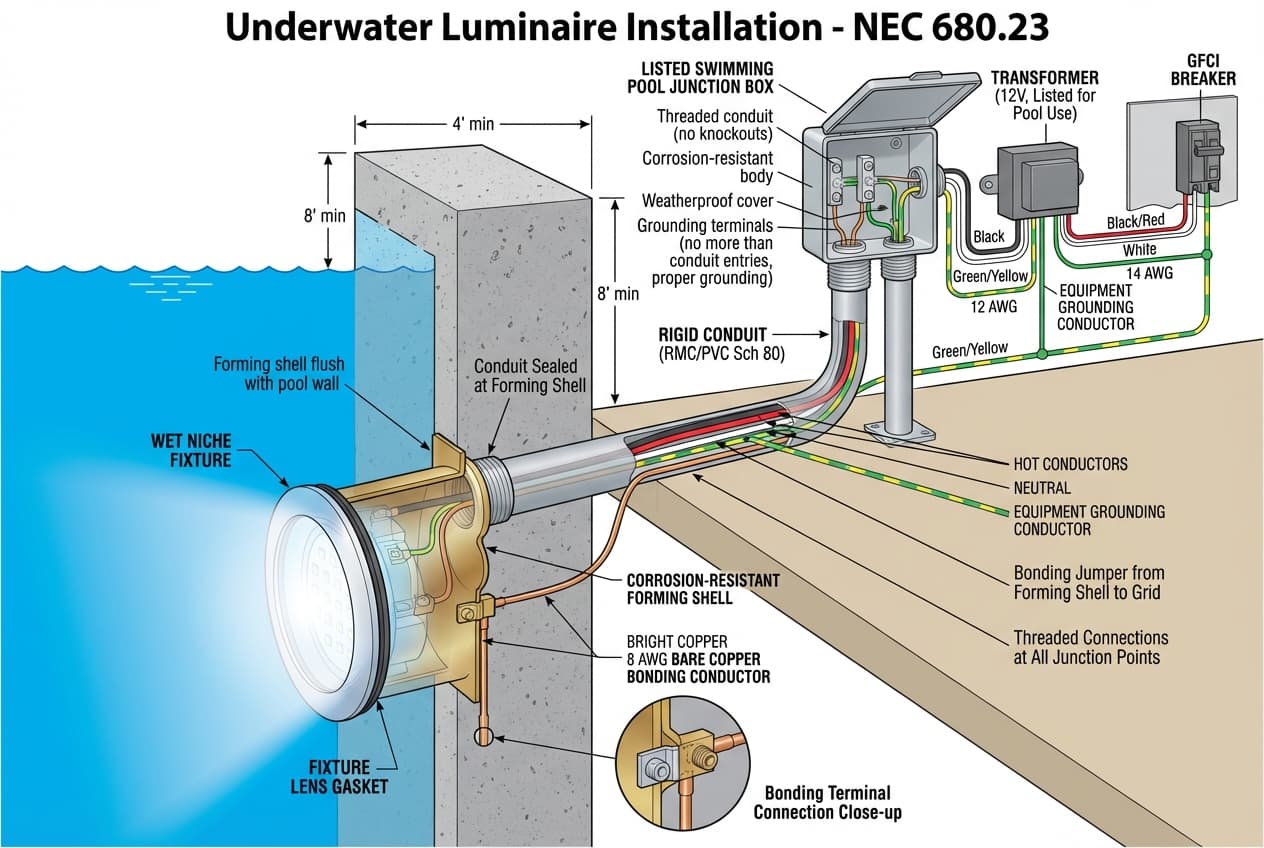
Cutaway technical diagram showing underwater pool light wet niche installation with transformer, junction box, bonding, and conduit connections labeled
Wet Niche Fixture Requirements
Wet niche fixtures are recessed luminaires intended for installation in the pool wall where the fixture is in direct contact with the water. These fixtures must be:
Listed and labeled for swimming pool use. Equipped with a threaded entry or hub for conduit connection. Made of corrosion-resistant materials like brass, bronze, or approved plastics. Properly grounded and bonded through the equipment grounding conductor and bonding conductor.
Forming Shells and Mounting
Forming shells provide the structural mounting for wet niche fixtures. The shell must be installed when the pool is constructed, with rigid conduit extending from the forming shell to the junction box.
The forming shell must be equipped with provisions for threaded conduit entries and installed so the top of the forming shell is flush with the pool wall. A permanently attached grounding terminal is required on the forming shell to connect the fixture grounding conductor.
Fixture Replacement and Modernization
When replacing underwater luminaires, inspectors should verify the replacement fixture is compatible with the existing forming shell and meets current code requirements for GFCI protection and bonding. Many pool renovations upgrade to LED fixtures that improve safety while reducing energy consumption.
Transformer and Power Supply Requirements
Transformers and power supplies for pool lighting must meet specific safety requirements to isolate swimmers from line voltage. According to NEC 680.23 transformer requirements, transformers and power supplies used for underwater luminaire supply must be listed, labeled, and identified for swimming pool and spa use.
Transformer Installation Location
Transformers and GFCI devices must be located:
Not less than 4 feet from the inside wall of the pool unless separated by a permanent barrier. Not less than 8 feet from the inside wall of the pool for indoor installations unless separated by a permanent barrier. In a location that prevents submersion during pool use or maintenance.
The separation requirements prevent swimmers from contacting transformer enclosures, which could become energized during fault conditions.
Transformer Types
Two-winding transformers - Standard isolation transformers with separate primary and secondary windings. Required for most medium-voltage pool lighting systems.
Autotransformers - Prohibited for pool lighting applications because they don't provide adequate isolation between primary and secondary circuits.
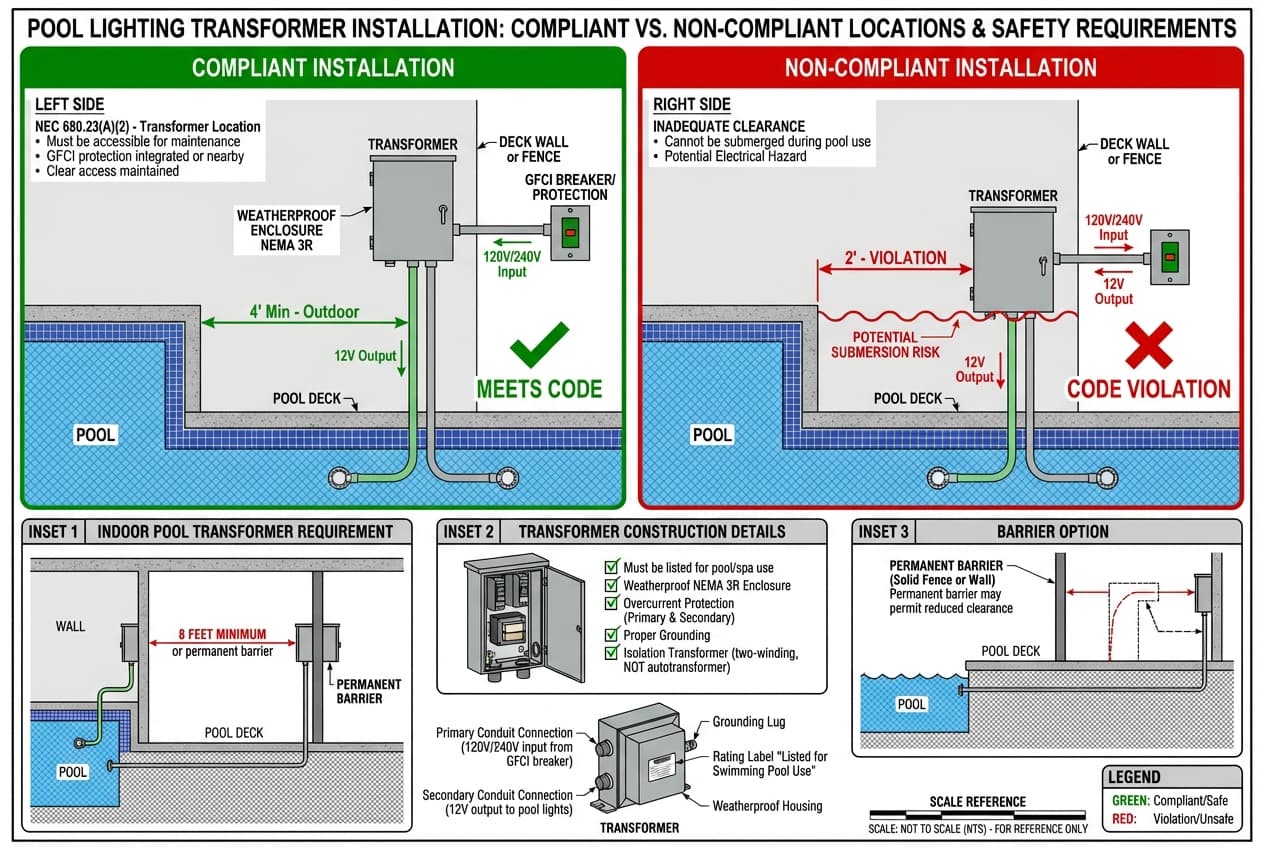
Technical illustration showing approved transformer installation with dimensions, barriers, and GFCI protection for pool lighting systems
Power Supply Requirements
Listed power supplies for LED pool lighting must meet the same installation requirements as transformers. Many modern pool LED systems use power supplies rated for 12-volt output, providing superior safety compared to older 120-volt systems.
Power supplies must have overcurrent protection on both primary and secondary sides to prevent fire hazards from fault conditions.
Junction Box Requirements
Junction boxes for pool lighting circuits must meet stringent requirements because they're installed in permanently wet locations near the pool. According to NEC 680.24, junction boxes connected to conduit extending directly to forming shells or mounting brackets must meet specific construction requirements.
Junction Box Construction
Junction boxes for underwater lighting must be:
Listed, labeled, and identified as a swimming pool junction box. Equipped with threaded entries or hubs - No knockout openings are permitted. Constructed of corrosion-resistant material - Typically copper, brass, or rigid PVC. Equipped with adequate grounding terminals - Minimum of one more grounding terminal than the number of conduit entries.
The additional grounding terminal accommodates the bonding conductor from the equipotential bonding system.
Junction Box Location Requirements
Junction boxes must be located:
Not less than 4 feet from the inside wall of the pool. Not less than 8 feet above the maximum pool water level. Where they can't be submerged during pool operation or maintenance.
For indoor pools, junction boxes must be located not less than 8 feet from the inside wall of the pool unless separated by a permanent barrier.
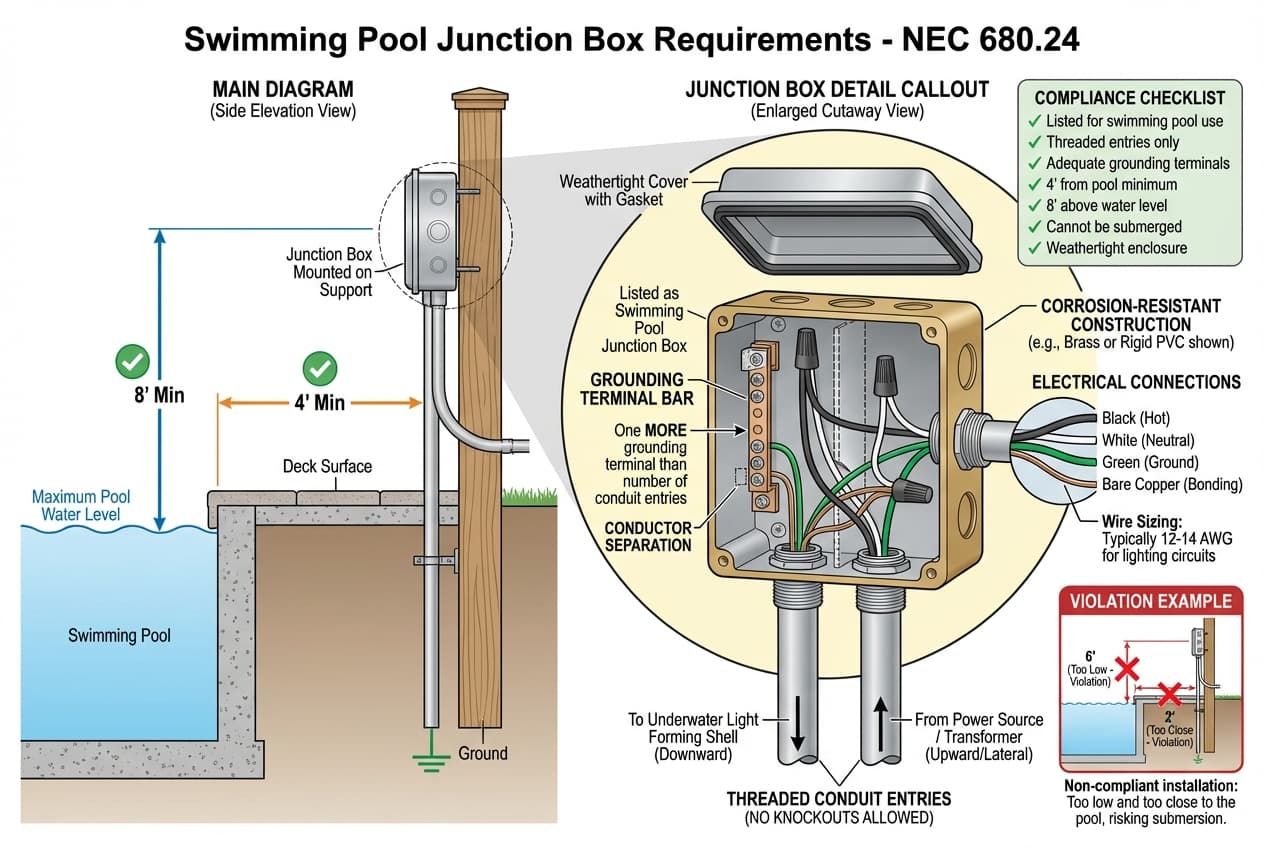
Technical diagram showing proper junction box installation with measurements from pool edge and water level plus grounding terminal configuration
Conductor Separation in Junction Boxes
Conductors on the load side of a GFCI or transformer must not occupy raceways, boxes, or enclosures containing other conductors unless the other conductors are also GFCI protected. This separation prevents fault currents from bypassing GFCI protection.
When inspecting pool junction boxes, verify proper conductor separation, secure connections, adequate grounding terminals, and weathertight enclosure integrity.
Conduit Installation and Burial Depth Requirements
Conduit protects electrical conductors from physical damage and moisture intrusion. Pool installations require specific conduit types and burial depths to ensure long-term safety and reliability.
Approved Conduit Types
According to NEC 680 conduit requirements, feeders and branch circuits for pool equipment may be installed in:
Rigid metal conduit (RMC) - Galvanized steel or aluminum conduit suitable for direct burial. Intermediate metal conduit (IMC) - Lighter weight than RMC but still suitable for burial. Liquidtight flexible nonmetallic conduit (LFNC) - For above-ground installations requiring flexibility. PVC conduit (Schedule 40 or 80) - Most common for direct burial around pools. Reinforced thermosetting resin conduit (RTRC) - Alternative to PVC for specific applications.
Within buildings, electrical nonmetallic tubing (ENT) is also permitted. Electrical metallic tubing (EMT) is allowed for feeder raceways on or within buildings but is not approved for direct burial.
Burial Depth Requirements
According to NEC Table 300.5, minimum cover requirements for underground pool wiring are:
Rigid metal conduit (RMC, IMC) - Minimum 6 inches burial depth. PVC conduit (Schedule 80) - Minimum 18 inches burial depth. PVC conduit (Schedule 40) under concrete - May be reduced to 4 inches under minimum 2 inches of concrete.
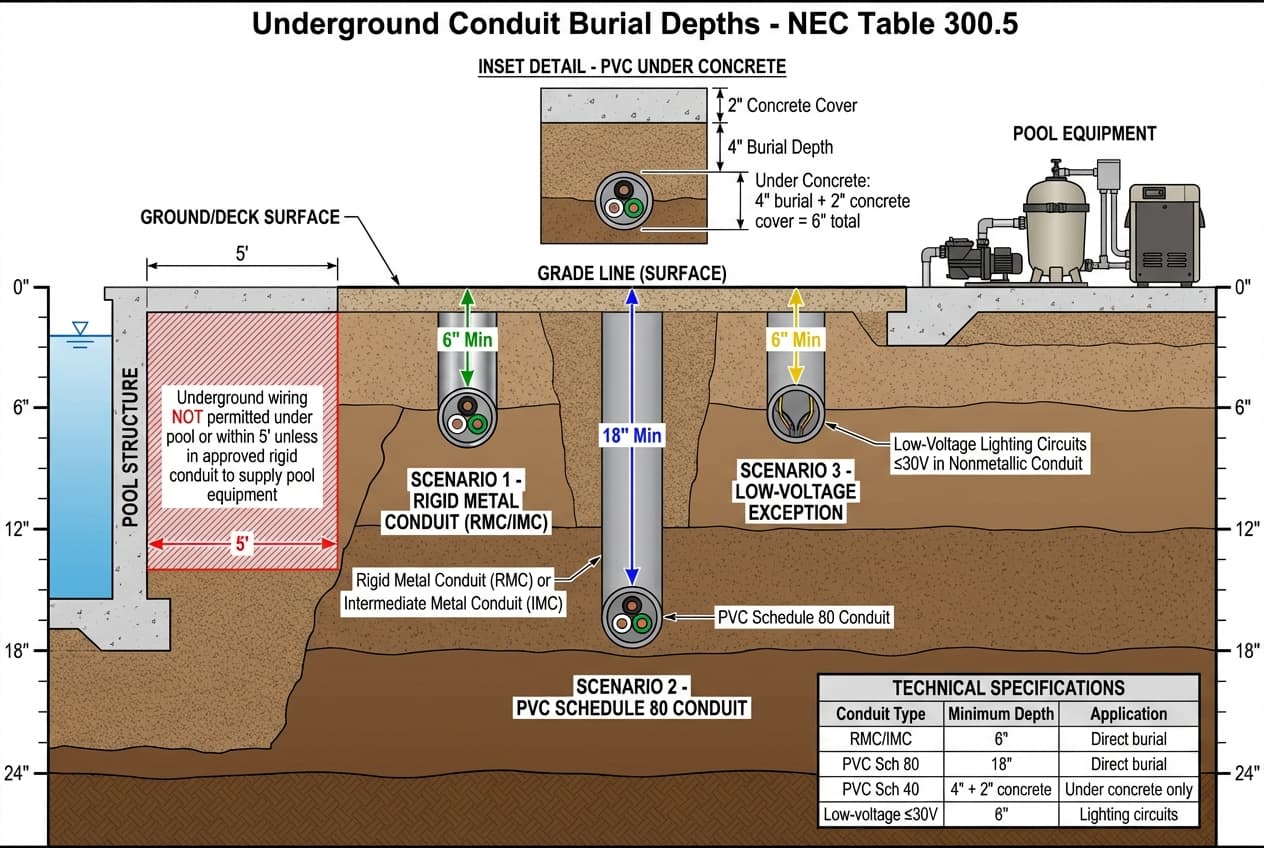
Cross-section diagram showing proper conduit burial depths for RMC at 6 inches and PVC at 18 inches with pool equipment connections
Special Requirements for Pool Lighting Circuits
For pool, spa, and fountain lighting circuits, a reduced burial depth of 6 inches is permitted for:
Lighting installed in nonmetallic raceway. Systems limited to not more than 30 volts. Listed low-voltage lighting systems.
This exception recognizes the reduced shock hazard from low-voltage systems while still requiring physical protection through conduit.
Underground Wiring Location
According to NEC 680.11, underground wiring must not be installed:
Under the pool or within 5 feet horizontally from the inside wall of the pool. UNLESS the wiring is necessary to supply pool equipment and is installed in rigid conduit (RMC, IMC, or PVC Schedule 80) at minimum burial depth.
This requirement keeps underground conductors away from the pool area where excavation for repairs could damage the pool shell or bonding system.
Equipment Grounding Requirements
Equipment grounding provides a low-impedance path for fault currents to trip overcurrent protection devices. While separate from bonding, proper equipment grounding is essential for pool electrical safety.
Equipment Grounding Conductor Requirements
All fixed pool equipment must be grounded with an insulated copper equipment grounding conductor. The equipment grounding conductor must be sized according to NEC Table 250.122 based on the rating of the circuit overcurrent protective device.
For pool pump motors, the equipment grounding conductor is typically:
- 12 AWG copper for 20-ampere circuits
- 10 AWG copper for 30-ampere circuits
- 8 AWG copper for 40-50 ampere circuits
Grounding Methods
Equipment grounding for pool equipment may be accomplished by:
Insulated copper equipment grounding conductor - Run with the circuit conductors in the same raceway or cable. Metal conduit system - RMC or IMC properly connected provides an equipment grounding path. Listed cable assembly - Type MC cable or other listed cable with integral equipment grounding conductor.
The equipment grounding conductor must be connected to all metal parts of the equipment, including motor frames, equipment enclosures, and junction boxes.
Double Insulated Equipment
Double insulated pool equipment is prohibited within 5 feet of the pool. According to NEC 680.21(A), all electrical equipment associated with the pool circulation system must be grounded - double insulation is not an acceptable substitute within this zone.
Grounding Terminal Connections
Equipment grounding terminals in pool junction boxes must accommodate both the equipment grounding conductor and the bonding conductor. Junction boxes must have at least one more grounding terminal than the number of conduit entries to ensure adequate connection points.
When inspecting pool electrical systems, verify equipment grounding conductor continuity, proper sizing, secure connections at equipment and panel, and that no double-insulated equipment is used within 5 feet of the pool. Pool inspection software like PoolVerify provides comprehensive electrical grounding checklists to ensure complete inspection coverage.
Pool Electrical Inspection Checklist
Professional pool electrical inspections should cover all aspects of NEC Article 680 requirements. Use this comprehensive checklist for thorough electrical safety assessments:
GFCI Protection
- [ ] Pool pump motor has GFCI protection (Class A, 6mA)
- [ ] All receptacles within 20 feet of pool have GFCI protection
- [ ] GFCI devices are readily accessible for testing and resetting
- [ ] GFCI protection tested and confirmed operational
- [ ] Lighting between 5-10 feet from pool has GFCI protection
- [ ] All underwater lighting has appropriate GFCI protection
Bonding System
- [ ] 8 AWG or larger copper bonding conductor installed
- [ ] Pool structural steel bonded together
- [ ] Perimeter surfaces within 3 feet bonded (copper grid or rebar)
- [ ] Metal ladders, handrails, and deck equipment bonded
- [ ] Pool water intentionally bonded (9 square inch contact)
- [ ] Fixed electrical equipment bonded to bonding system
- [ ] All metal pool fittings bonded
- [ ] Bonding connections secure and corrosion-free
Equipment Grounding
- [ ] Pool pump has proper equipment grounding conductor
- [ ] Heater has proper equipment grounding conductor
- [ ] Lighting transformers properly grounded
- [ ] Junction boxes properly grounded
- [ ] Equipment grounding conductor sized per NEC Table 250.122
- [ ] No double-insulated equipment within 5 feet of pool
Receptacles and Wiring
- [ ] At least one receptacle located 6-20 feet from pool
- [ ] Other receptacles minimum 6 feet from inside pool wall
- [ ] Equipment receptacles minimum 6-10 feet from pool (per criteria)
- [ ] No overhead lines within clearance zones
- [ ] Underground wiring not under pool or within 5 feet (unless approved)
- [ ] Conduit types and burial depths meet NEC requirements
Underwater Lighting
- [ ] Luminaires listed and labeled for pool use
- [ ] Forming shells properly installed and bonded
- [ ] Junction boxes located minimum 4 feet from pool
- [ ] Junction boxes minimum 8 feet above water level
- [ ] Transformers listed for pool use
- [ ] Transformers located minimum 4 feet from pool
- [ ] Low-voltage lighting properly isolated from line voltage
Overall System
- [ ] Electrical system matches permit and approved plans
- [ ] All electrical work completed by licensed electrician
- [ ] No visible damaged conduit, conductors, or equipment
- [ ] All enclosures weathertight and secured
- [ ] Labels and identification present on all equipment
- [ ] As-built documentation available
Digital pool inspection platforms like PoolVerify include this complete electrical checklist with photo documentation fields for each item, ensuring nothing is missed during inspections.
Conduct comprehensive pool electrical inspections faster
PoolVerify's digital checklist covers all NEC Article 680 requirements with built-in photo fields, pass/fail indicators, and instant PDF report generation.
Common Pool Electrical Violations
Understanding common electrical violations helps pool inspectors identify hazards quickly and educate property owners about necessary corrections. These are the most frequently observed pool electrical code violations:
Missing or Non-Functional GFCI Protection
The most common violation is missing GFCI protection on pool pumps, especially older installations that predated current code requirements. Many pool pumps installed before 2000 were not GFCI protected, creating serious shock hazards.
When pool pump motors are replaced, the new installation must include GFCI protection even if the original didn't have it. Many contractors overlook this upgrade requirement.
Inadequate Bonding System
Missing or incomplete bonding systems create dangerous voltage gradients around pools. Common bonding violations include:
No perimeter bonding within 3 feet of pool edge. Metal ladders, handrails, or equipment not bonded to bonding system. No intentional bond to pool water. Undersized bonding conductors (smaller than 8 AWG). Corroded or disconnected bonding connections.
Receptacle Location Violations
Receptacles located too close to the pool are extremely hazardous. Common violations include:
Convenience receptacles within 6 feet of pool edge. No required receptacle between 6-20 feet from pool. Equipment receptacles within 6 feet without meeting special criteria. Non-GFCI receptacles within 20 feet of pool.
Overhead Clearance Violations
Overhead service drops that don't maintain 22.5-foot vertical clearance and 10-foot horizontal clearance create electrocution risk. These violations typically occur when:
Pools are installed too close to existing service drops. Service drops are installed after pool construction. Property owners don't understand clearance requirements.
Improper Underwater Lighting Installation
Common underwater lighting violations include:
Non-listed luminaires used for pool applications. Junction boxes located less than 4 feet from pool edge. Junction boxes less than 8 feet above water level. Transformers not listed for pool use. Missing GFCI protection on lighting circuits. Damaged or deteriorated fixture gaskets allowing water intrusion.
Underground Wiring Violations
Improper underground wiring creates hazards during excavation and routine maintenance:
Wiring under pool or within 5 feet without approved conduit. Insufficient burial depth for conduit type. Wrong conduit type for burial application (EMT directly buried). No protection for wiring in areas subject to damage.
Equipment Grounding Violations
Missing or inadequate equipment grounding prevents proper fault clearing:
No equipment grounding conductor on pool equipment. Undersized equipment grounding conductors. Equipment grounded through conduit only without conductor. Disconnected or corroded grounding connections.
When electrical violations are identified during pool inspections, document them thoroughly with photos showing the condition, measurements demonstrating non-compliance, and clear descriptions of required corrections. For comprehensive violation documentation, California pool inspection software includes violation libraries with standard descriptions and correction recommendations.
Frequently Asked Questions
What is NEC Article 680 and why does it matter for pools?
NEC Article 680 establishes electrical installation requirements specifically for swimming pools, spas, hot tubs, and fountains. It matters because water and electricity create unique shock hazards that standard electrical code doesn't adequately address. Article 680 requirements for GFCI protection, bonding, and equipment location dramatically reduce electrical shock risk in pool environments.
Do older pools need to meet current electrical code requirements?
Existing pools are generally grandfathered under the code in effect when they were built. However, when pool electrical equipment is replaced or modified, the new work must comply with current code. California requires GFCI protection when pool pump motors are replaced, even if the original installation didn't have GFCI protection.
What's the difference between bonding and grounding in pools?
Grounding connects electrical equipment to earth to provide a path for fault currents. Bonding connects all metallic objects together to create an equipotential plane at the same electrical potential. Both are required but serve different purposes - grounding trips breakers during faults while bonding prevents shock from voltage differences between objects.
How far do receptacles need to be from a swimming pool?
General-use receptacles must be at least 6 feet from the inside pool wall. At least one receptacle is required between 6 and 20 feet from the pool. Pool equipment receptacles must be at least 10 feet away or at least 6 feet if they're single, locking-type receptacles with GFCI protection located within sight of the equipment.
What GFCI protection is required for pool equipment?
Pool pump motors require Class A GFCI protection (6mA trip level). All receptacles within 20 feet of the pool require GFCI protection. Lighting and equipment between 5-10 feet from the pool require GFCI or SPGFCI protection. Underwater lighting requires GFCI protection unless supplied by listed low-voltage transformers.
Can overhead power lines be located near swimming pools?
Power lines must maintain minimum clearances: 22.5 feet vertically above the water surface and 10 feet horizontally from the pool edge for lines 0-750 volts. Communication and coaxial cables require 10 feet vertical clearance. These clearances prevent contact with pool cleaning poles, covers, and other equipment.
What burial depth is required for pool electrical conduit?
Rigid metal conduit (RMC, IMC) requires minimum 6-inch burial depth. PVC conduit requires minimum 18-inch burial depth. Low-voltage pool lighting circuits (30 volts or less) in nonmetallic conduit may use 6-inch burial depth. Underground wiring generally cannot be located under the pool or within 5 feet of the inside pool wall.
Who can perform pool electrical inspections in California?
California requires licensed electricians to install pool electrical systems. Pool safety inspections for BPC §7195 compliance can be performed by certified pool inspectors, licensed contractors, or qualified professionals. Electrical inspections may require consultation with a licensed electrician for complex systems. See our guide on how to become a pool inspector in California for certification requirements.
Conclusion
Pool electrical inspection requires comprehensive knowledge of NEC Article 680 requirements and California's specific amendments effective in 2026. From GFCI protection and equipotential bonding to underwater lighting safety and overhead clearances, every component of the pool electrical system must be carefully inspected to ensure swimmer safety.
California's adoption of the 2023 NEC brings expanded GFCI coverage, stricter bonding requirements, and new energy efficiency standards that affect pool electrical installations. Pool inspectors must stay current with these requirements to properly assess compliance and identify electrical hazards.
The key takeaways for pool electrical inspection include verifying GFCI protection on all required circuits, confirming proper bonding of all metallic components within 3 feet of the pool, ensuring proper receptacle locations and distances, checking overhead power line clearances, and inspecting underwater lighting systems for proper installation and protection.
Professional pool inspectors conducting California pool safety inspections should document all electrical components thoroughly with photos, measurements, and detailed notes. Digital inspection platforms like PoolVerify streamline this process with comprehensive electrical checklists, photo documentation fields, and instant PDF report generation that meets California compliance requirements.
Whether you're a pool inspector, electrician, or property owner, understanding NEC Article 680 requirements is essential for maintaining safe pool electrical systems that protect swimmers from electrical shock hazards.
Related Posts
Frequently Asked Questions
What is NEC Article 680 and why does it matter for pools?
NEC Article 680 establishes electrical installation requirements specifically for swimming pools, spas, hot tubs, and fountains. It addresses GFCI protection, bonding, grounding, and equipment placement to reduce electrical shock risk. Water is an excellent conductor, making standard electrical code insufficient for pool environments.
Do older pools need to meet current electrical code requirements?
Existing pools are generally grandfathered under the code in effect when built. However, when pool electrical equipment is replaced or modified, the new work must comply with current code. California requires GFCI protection when pool pump motors are replaced, even if the original installation lacked it.
How far do electrical receptacles need to be from a swimming pool?
General-use receptacles must be at least 6 feet from the inside pool wall. At least one receptacle is required between 6 and 20 feet from the pool. Pool equipment receptacles must be at least 10 feet away, or 6 feet if they are single, locking-type, GFCI-protected receptacles within sight of equipment.
What GFCI protection is required for pool equipment?
Pool pump motors require Class A GFCI protection that trips at 6 milliamperes. All receptacles within 20 feet of the pool require GFCI protection. Lighting and equipment between 5-10 feet from the pool require GFCI or SPGFCI protection. Underwater lighting also requires GFCI protection unless supplied by listed low-voltage transformers.
What is the difference between bonding and grounding in pools?
Grounding connects electrical equipment to earth to provide a fault current path that trips breakers. Bonding connects all metallic objects together to create an equipotential plane at the same electrical potential, preventing shock from voltage differences. Both are required under NEC Article 680 but serve different safety purposes.
Related Articles
Inspection-best-practices
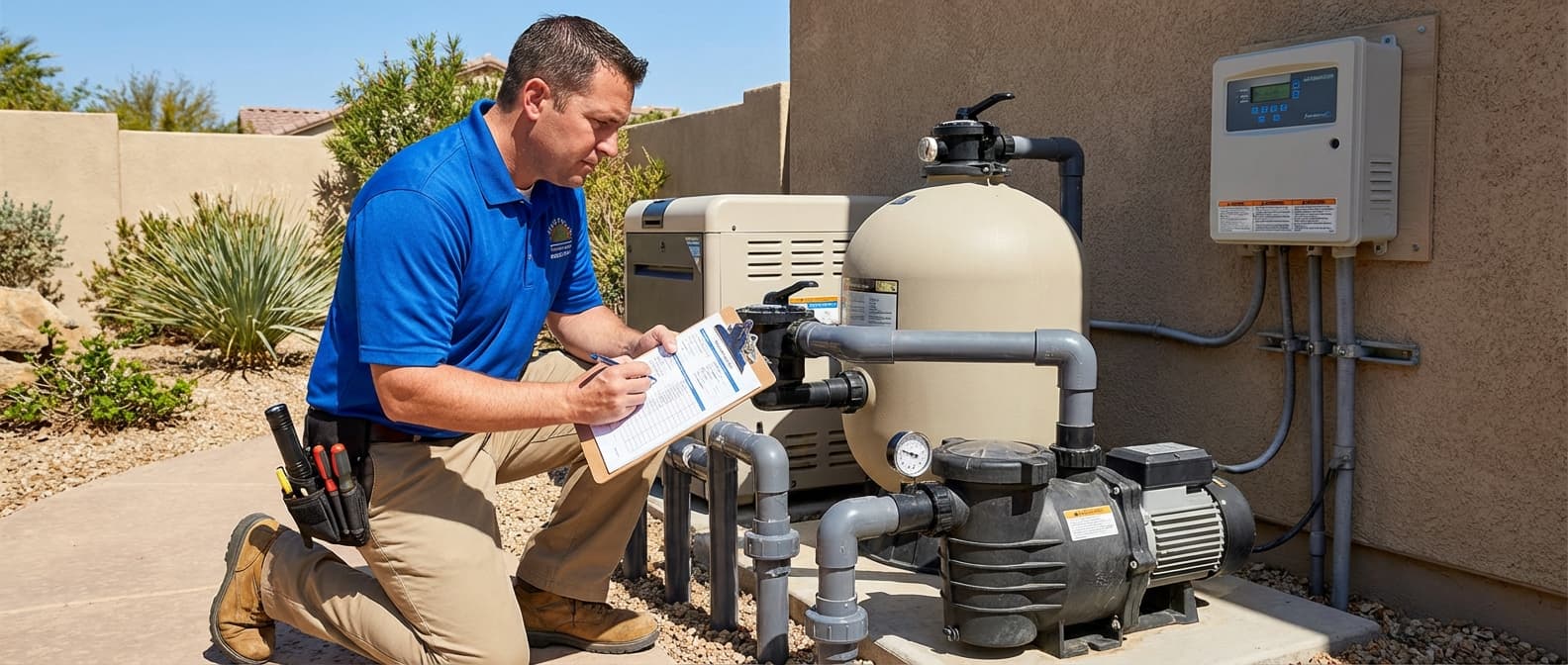
Pool Equipment Inspection: Pumps, Filters & Systems Checklist [2026]
Complete pool equipment inspection guide covering pumps, filters, automation, chlorinators, and all pool systems. Learn what inspectors check, common problems, maintenance needs, and lifespan expectations.
Inspection-best-practices
Pool Inspection: Complete Guide for Homeowners & Inspectors [2026]
Complete guide to pool inspections: what they are, what inspectors check, California requirements, costs, and how to prepare. Expert insights for homeowners and inspectors.
Pool-safety
Pool Plumbing Inspection: Complete Safety Guide [2026]
Expert guide to pool plumbing inspection covering leak detection, pressure testing, PVC vs copper piping, main drain requirements, and California building code compliance for pool plumbing systems.