Education-training
Pool Inspector: Complete Career Guide, Salary & Certification [2026]
Complete guide to becoming a pool inspector: certification requirements (CPO, CPI), salary expectations in California and nationwide, career paths, required skills, and how to start your pool inspection business.
![Pool Inspector: Complete Career Guide, Salary & Certification [2026]](/_next/image?url=%2Fresources%2Fpool-inspector-career-guide-hero.webp&w=3840&q=75)
15 min
A pool inspector is a specialized professional who evaluates swimming pools and spas for safety compliance, structural integrity, equipment function, and overall condition. Pool inspectors play a critical role in preventing drowning incidents, ensuring regulatory compliance, and protecting property values. In California, pool safety inspections are required during property transfers under BPC §7195, creating steady demand for qualified pool inspectors.
Whether you're considering a career as a pool inspector, looking to add pool inspections to existing home inspection services, or simply curious about the profession, this comprehensive guide explains what pool inspectors do, how to become certified, salary expectations, career paths, and everything you need to know about this specialized field.
What Does a Pool Inspector Do?
Pool inspectors assess residential and commercial pools and spas to verify safety compliance, identify hazards, evaluate equipment condition, and document findings in formal reports.
Primary Responsibilities
1. Safety Compliance Verification
Pool inspectors verify compliance with local, state, and federal safety regulations:
- California BPC §7195: Seven drowning prevention safety features required during property transfer
- HSC §115922: Swimming Pool Safety Act requirements for new and remodeled pools
- VGB Act: Suction entrapment protection (drain covers)
- Local ordinances: Municipal pool barrier and fence requirements
Learn more about California pool safety requirements
2. Barrier and Gate Inspection
Critical safety barrier assessment includes:
- Fence height: Verify minimum 60-inch (5-foot) requirement
- Gate function: Test self-closing and self-latching mechanisms
- Latch height: Confirm 54+ inch positioning above ground
- Gap compliance: Measure ground clearance (≤2 inches) and picket spacing (≤4 inches)
- Gate direction: Verify outward opening (away from pool)
Detailed guide to pool fence requirements
3. Equipment Assessment
Pool inspectors evaluate all mechanical and electrical systems:
- Circulation system: Pumps, filters, return lines
- Heating equipment: Gas heaters, heat pumps, solar systems
- Automation: Timers, controllers, remote systems
- Cleaning systems: Automatic cleaners, suction ports
- Lighting: Underwater lights, deck lighting
- Water features: Waterfalls, fountains, jets
4. Structural Evaluation
Inspectors assess pool structure and surrounding areas:
- Pool shell: Cracks, delamination, structural damage
- Pool deck: Trip hazards, settlement, drainage issues
- Coping: Loose or damaged coping tiles
- Plaster/liner: Surface condition, staining, deterioration
- Tile: Cracked or missing tiles
5. Water Quality Testing
Basic water chemistry assessment:
- pH levels: 7.2-7.8 optimal range
- Chlorine: Free chlorine, combined chlorine levels
- Alkalinity: Total alkalinity balance
- Calcium hardness: Scale prevention
- Cyanuric acid: Stabilizer levels
6. Documentation and Reporting
Professional documentation of all findings:
- Photo documentation: Comprehensive photos of all areas and issues
- Written reports: Detailed inspection findings
- Compliance scoring: Pass/fail determination per safety feature
- Recommendations: Suggested repairs or upgrades
- Municipal submission: Reports formatted for regulatory authorities
Types of Pool Inspections
Pool inspectors conduct various inspection types depending on specialization:
Pre-Purchase Inspections (Most Common)
- Property buyers assessing pool condition before purchase
- Identify repair costs and safety issues
- Negotiate purchase price based on findings
- Typical fee: $75-200
California Compliance Inspections (BPC §7195)
- Required during property transfer in California
- Verify seven drowning prevention safety features
- Submit compliance report to municipality
- Typical fee: $100-250
Insurance Inspections
- Insurance companies requiring pre-coverage assessment
- Verify safety features and liability risk factors
- Annual re-inspection sometimes required
- Typical fee: $100-175
Commercial Pool Inspections
- Hotels, apartments, HOAs, community pools
- Health department compliance verification
- More complex equipment and higher liability
- Typical fee: $200-500+
Renovation Assessment
- Evaluate pool before major renovation project
- Identify hidden issues, structural concerns
- Recommend appropriate upgrades
- Typical fee: $150-300
Expert Witness Services
- Legal cases involving pool accidents or disputes
- Provide professional opinion and testimony
- Highest earning potential in pool inspection
- Typical fee: $150-300/hour
Typical Workday for a Pool Inspector
Morning (8:00 AM - 12:00 PM)
- Review day's scheduled inspections (2-3 properties)
- Drive to first inspection site (30-45 min typical)
- Conduct first inspection: safety barriers, equipment, structure (45-60 min)
- Generate and email report to client on-site using mobile inspection software
- Travel to second inspection (20-30 min)
- Conduct second inspection and report (45-60 min)
Afternoon (12:00 PM - 5:00 PM)
- Lunch break
- Third inspection of the day
- Follow-up calls with clients from previous inspections
- Respond to new inspection requests
- Administrative tasks: scheduling, invoicing, continuing education
Workload:
- Busy inspectors: 3-5 inspections per day
- Average inspectors: 2-3 inspections per day
- Part-time/seasonal: 5-10 inspections per week
Schedule flexibility: Most inspections occur during business hours (8 AM - 5 PM), but some weekend work accommodates homeowner schedules. Self-employed inspectors control their own schedules.
How to Become a Pool Inspector
Step 1: Meet Basic Requirements
Minimum qualifications:
- Age: 18+ years old (16+ for some certification programs)
- Education: High school diploma or equivalent
- Physical ability: Ability to climb, kneel, crouch, and work outdoors
- Valid driver's license: Travel to inspection sites
- Clean background: No felony convictions (for some positions)
Helpful but not required:
- Pool service or maintenance experience
- Construction or trades background
- Home inspection experience
- Science or chemistry knowledge
Step 2: Obtain Certified Pool Operator (CPO) Certification
The Certified Pool Operator (CPO) credential is the foundation for pool inspection careers.
What CPO covers:
- Pool and spa chemistry (pH, chlorine, alkalinity, calcium hardness)
- Water testing procedures
- Pool circulation and filtration systems
- Pool maintenance and troubleshooting
- Health and safety regulations
- Record keeping and documentation
CPO certification process:
- Enroll in CPO course ($250-400 depending on provider)
- Attend 2-day training (16 hours total, in-person or virtual)
- Pass CPO exam (50 questions, open-book, 75% passing score)
- Receive certification (valid for 2 years)
Where to get CPO certified:
- Pool & Hot Tub Alliance (PHTA) - primary certifying body
- Local community colleges offering CPO courses
- Private training providers (Pool Operation Management, Space Coast Pool School)
- Online/virtual CPO courses (increasingly popular post-2020)
Cost: $250-400 (includes training, materials, exam, 2-year certification)
Time: 2 days (weekend courses common)
Renewal: Every 2 years ($50-100 renewal fee, may require refresher course)
Step 3: Gain Pool Industry Experience
Recommended: 1-2 years of hands-on pool experience before conducting inspections independently.
Ways to gain experience:
Option 1: Work for pool service company
- Learn pool maintenance, equipment repair, troubleshooting
- Develop understanding of common issues and failures
- Build knowledge of various pool types and equipment brands
- Typical duration: 1-2 years
- Pay: $15-25/hour starting
Option 2: Apprentice with established inspector
- Shadow experienced pool inspectors on actual inspections
- Learn inspection techniques, report writing, client communication
- Understand business operations and pricing
- Typical duration: 6-12 months
- Pay: Varies (some unpaid, some commission-based)
Option 3: Start part-time while employed elsewhere
- Conduct inspections on weekends/evenings
- Build skills gradually with lower-pressure timeline
- Maintain income while learning
- Typical duration: 1-2 years before going full-time
Option 4: Add to existing home inspection business
- Leverage existing inspection and client relationships
- Expand service offerings to include pools
- Lower risk (existing income stream)
- Typical transition: 3-6 months to proficiency
Step 4: Obtain Certified Pool Inspector (CPI) Certification
The Certified Pool Inspector (CPI) credential is advanced training specifically for inspection work.
What CPI covers:
- Regulatory compliance (codes, standards, ADA requirements)
- Structural assessment and defect recognition
- Equipment evaluation and failure modes
- Safety feature inspection (barriers, alarms, covers, drains)
- Inspection methodology and documentation
- Report writing and professional communication
- Liability and risk management
CPI requirements:
- Prerequisite: CPO certification OR 2+ years pool industry experience
- Recommended age: 18+ (some programs allow 16+)
- Training: 2-3 day course (16-24 hours)
- Exam: 35-50 questions, open-book, 1 hour, 70-75% passing score
- Certification validity: 3 years
Where to get CPI certified:
- Aquatic Council, LLC - primary CPI provider
- Pool Operation Management (POM)
- Integrity Consultants
- Space Coast Pool School
- Best Aquatic Management
Cost: $400-600 (includes training, materials, exam, 3-year certification)
Time: 2-3 days (often offered as long weekend course)
Renewal: Every 3 years ($75-150 renewal fee)
CPI vs CPO:
| Feature | CPO | CPI |
|---|---|---|
| Focus | Pool operation & maintenance | Pool inspection & assessment |
| Target audience | Pool operators, facility managers | Pool inspectors, compliance professionals |
| Duration | 2 days | 2-3 days |
| Cost | $250-400 | $400-600 |
| Validity | 2 years | 3 years |
| Prerequisites | None | CPO or 2 years experience recommended |
| Depth | Operational fundamentals | Inspection methodology, compliance |
Step 5: Understand California Regulations
If conducting inspections in California, you must thoroughly understand state-specific requirements:
California BPC §7195:
- Seven drowning prevention safety features
- Inspection timing (during property transfer)
- Report submission requirements
- Inspector qualifications
California HSC §115922:
- Swimming Pool Safety Act
- New and remodeled pool requirements
- Approved safety features and ASTM standards
Study resources:
- California Pool Safety Requirements Guide
- Pool Fence Requirements Guide
- Complete Pool Inspection Guide
- California Department of Public Health pool regulations
- Local municipal codes
No California state license required: Unlike some states, California does not require a specific pool inspector license. CPO/CPI certifications plus regulatory knowledge are sufficient for conducting BPC §7195 compliance inspections.
Exception: If you perform repairs or alterations, you need a C-53 Swimming Pool Contractor license from the California Contractors State License Board (CSLB).
Step 6: Set Up Your Inspection Business
Business structure options:
Sole proprietorship (simplest)
- Operate under your own name or DBA (Doing Business As)
- File Schedule C with personal tax return
- Personal liability for business debts
- Best for: Solo inspectors starting out
LLC (Limited Liability Company) (recommended)
- Separates personal and business liability
- Professional appearance
- Flexible tax treatment
- Best for: Inspectors planning to grow or hire
Corporation (uncommon for solo inspectors)
- Most complex structure
- Highest liability protection
- Double taxation (unless S-corp election)
- Best for: Large inspection companies
Business requirements:
- [ ] Register business name (DBA or entity formation)
- [ ] Obtain EIN (Employer Identification Number) from IRS
- [ ] Open business bank account
- [ ] Get business insurance (general liability, E&O)
- [ ] Set up accounting system (QuickBooks, FreshBooks, etc.)
- [ ] Create website and online presence
- [ ] Design logo and business cards
- [ ] Purchase inspection tools and equipment
- ] Select [digital inspection software
Startup costs:
- CPO certification: $250-400
- CPI certification: $400-600
- Business registration: $50-500
- Insurance (annual): $500-2,000
- Website: $0-500 (DIY) or $1,000-3,000 (professional)
- Inspection equipment: $500-1,500
- Digital inspection software: $39-79/month
- Marketing: $200-1,000
- Total startup: $2,000-10,000
Step 7: Get Inspection Software and Tools
Essential tools:
Water testing equipment ($200-500):
- Test strips (pH, chlorine, alkalinity, hardness)
- Digital water testing kit (more accurate)
- Thermometer
Measurement tools ($100-200):
- Measuring tape (25-foot minimum)
- Laser distance measurer
- Fence height measurement pole
- Gap measurement templates (4-inch sphere)
Documentation tools ($500-1,000):
- Digital inspection software (most important) - PoolVerify or alternative
- Smartphone with good camera (iPhone/Android)
- Tablet for larger screen field use
- Backup camera (optional)
Safety equipment ($100-200):
- Flashlight (for equipment rooms, underwater lighting inspection)
- Safety glasses
- Gloves
- Non-slip shoes
Professional presentation ($100-300):
- Branded polo shirts
- Business cards
- Vehicle magnets or decals
- Clipboard/notepad (backup to digital)
Total equipment investment: $1,000-2,200
Most critical tool: Digital pool inspection software like PoolVerify eliminates manual report writing, provides California-compliant checklists, and generates professional PDF reports instantly. This single tool saves 30-45 minutes per inspection compared to paper-and-clipboard methods.
Step 8: Market Your Services
Primary marketing channels:
Real estate agents (highest ROI):
- Introduce yourself to 20-30 local agents
- Provide educational materials on BPC §7195 requirements
- Offer quick turnaround (same-day reports)
- Build relationships through reliability and professionalism
Property managers:
- Contact apartment complexes, HOAs, commercial properties
- Offer annual inspection contracts
- Emphasize insurance and liability protection
- Pitch commercial pool expertise
Online presence:
- Google Business Profile (free, critical for local search)
- Website with service descriptions and pricing
- Yelp, Angie's List, HomeAdvisor listings
- Facebook business page
Networking:
- Join local chamber of commerce
- Attend real estate networking events
- Partner with home inspectors (referrals for pool-only inspections)
- Connect with pool service companies (refer inspection-only work)
Pricing strategy:
- Research local competitors (typically $75-250 per inspection)
- Start slightly below market rate to build clientele
- Raise prices as you gain experience and reputation
- Offer package discounts for property managers
Pool Inspector Salary and Income
Salaried Employment
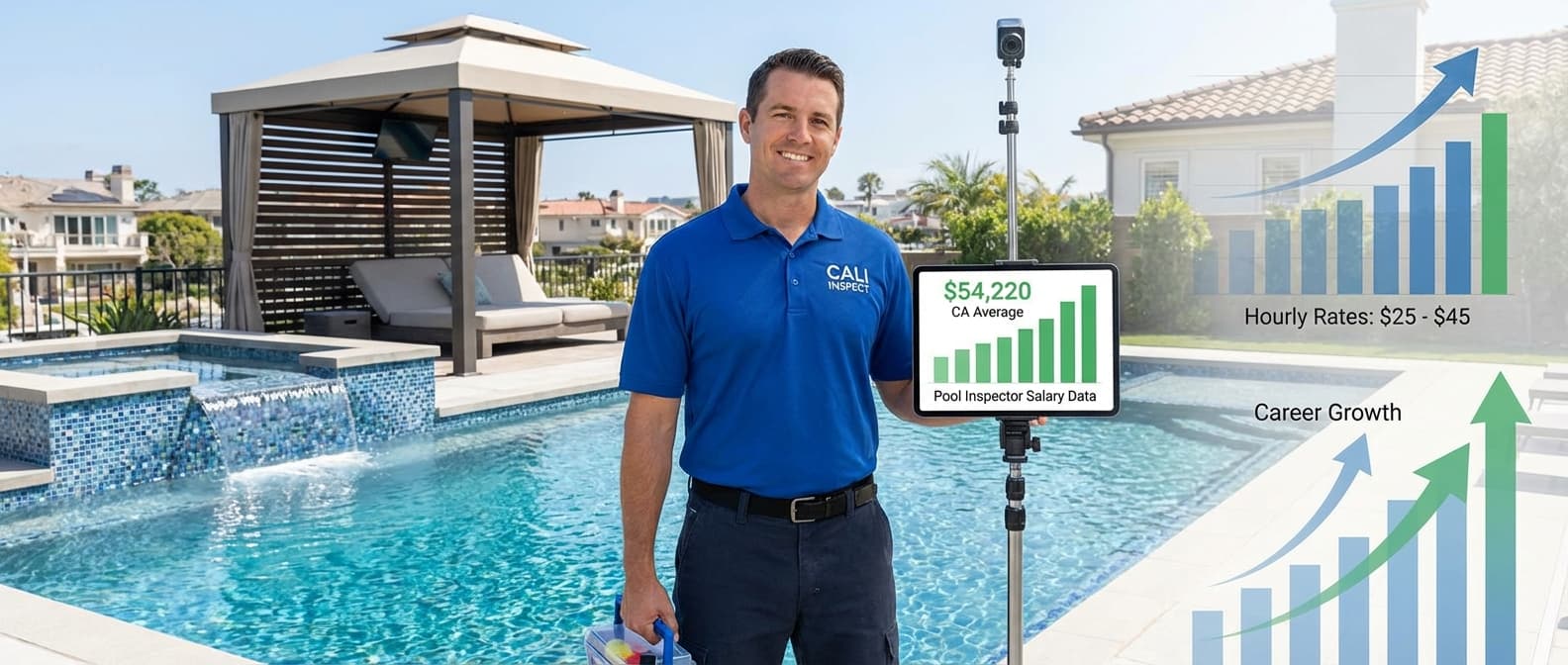
California average: $54,220 per year ($26.07/hour) as of 2026
Salary range:
- Entry-level (25th percentile): $38,000/year
- Mid-career (median): $54,220/year
- Experienced (75th percentile): $62,700/year
- Top earners (90th percentile): $90,795/year
Highest-paying California cities:
- Berkeley: $67,268/year (24.1% above state average)
- San Francisco: $64,500/year
- Palo Alto: $62,800/year
- San Jose: $60,100/year
- Oakland: $58,900/year
Lowest-paying California cities:
- Central Valley and inland regions: $42,000-48,000/year
Benefits (salaried positions):
- Health insurance
- Paid time off (10-20 days)
- Vehicle allowance or company vehicle
- Continuing education paid by employer
- Retirement contributions (some employers)
Employers hiring salaried pool inspectors:
- Municipal health departments (public pool inspections)
- Large property management companies
- Commercial inspection firms
- Pool service franchises with inspection divisions
Independent Contractor / Self-Employed
Per-inspection fees (California 2026):
- Residential pool compliance inspection: $100-200
- Basic pool assessment (pre-purchase): $75-150
- Commercial pool inspection: $200-500
- Expert witness consultation: $150-300/hour
- Re-inspection (after repairs): $50-100
Monthly income scenarios:
Part-time inspector (10 inspections/month):
- 10 inspections × $125 average = $1,250/month
- Annual income: $15,000
- Best for: Side business, seasonal work
Solo inspector (50 inspections/month):
- 50 inspections × $125 average = $6,250/month
- Annual income: $75,000
- Best for: Full-time solo business
Busy inspector (100 inspections/month):
- 100 inspections × $125 average = $12,500/month
- Annual income: $150,000
- Best for: Established business, high-volume market
Expenses (reduce gross income by 30-40%):
- Insurance: $500-2,000/year
- Software/tools: $500-1,500/year
- Vehicle costs: $3,000-6,000/year
- Marketing: $1,000-5,000/year
- Continuing education: $500-1,000/year
- Total expenses: 30-40% of gross revenue
Net income calculation:
- Gross revenue: $75,000 (50 inspections/month)
- Expenses (35%): -$26,250
- Net income: $48,750
Advantages of self-employment:
- Higher earning potential than salaried
- Control your own schedule
- Choose your service area
- Scale business by hiring additional inspectors
- Tax deductions for business expenses
Disadvantages:
- Income variability (seasonal fluctuations)
- Must provide own benefits (health insurance, retirement)
- Self-employment taxes (15.3% on net income)
- Responsible for all business operations
Factors Affecting Earnings
Experience level:
- New inspectors (0-2 years): $75-100 per inspection, 10-30/month
- Experienced (3-5 years): $100-150 per inspection, 30-60/month
- Expert (5+ years): $125-200+ per inspection, 40-80/month
Geographic location:
- High-demand markets (San Francisco Bay Area, Los Angeles, San Diego): Premium pricing, $125-200/inspection
- Medium markets (Sacramento, Fresno, Riverside): Average pricing, $100-150/inspection
- Rural areas: Lower pricing, $75-125/inspection, but also less competition
Specialization:
- General residential: Standard rates
- Commercial pools: 2-3x residential rates
- Expert witness: Highest hourly rates ($150-300/hour)
- Large property management contracts: Volume discounts but steady income
Marketing effectiveness:
- Strong real estate agent relationships = consistent referrals
- Google Business Profile optimization = organic leads
- Professional website = credibility and higher close rates
- Weak marketing = feast-or-famine income
Service quality and reputation:
- 5-star reviews = premium pricing power
- Fast report turnaround (same-day) = more referrals
- Professional reports = fewer questions, higher satisfaction
- Poor reputation = price competition, limited growth
Skills Needed to Succeed as a Pool Inspector
Technical Skills
Pool systems knowledge:
- Understanding of circulation, filtration, and sanitization
- Ability to identify equipment brands and models
- Knowledge of heating systems (gas, electric, solar)
- Familiarity with automation and control systems
Construction and structural assessment:
- Recognize pool shell damage (cracks, delamination, movement)
- Identify deck and coping issues
- Understand plaster/liner condition evaluation
- Basic understanding of plumbing and electrical systems
Regulatory knowledge:
- California BPC §7195 and HSC §115922 requirements
- Local municipal pool codes and ordinances
- ASTM standards for safety covers, alarms, and fencing
- VGB Act suction entrapment protection requirements
Water chemistry:
- Test and interpret pH, chlorine, alkalinity, hardness, CYA
- Understand chemical balance and interactions
- Recognize water quality issues and causes
Soft Skills
Attention to detail:
- Notice subtle defects and safety hazards
- Measure and document accurately
- Don't overlook minor issues that indicate bigger problems
Communication:
- Explain technical findings to non-technical clients clearly
- Write professional, understandable reports
- Manage client expectations professionally
- Handle difficult conversations about serious defects
Time management:
- Complete inspections efficiently without rushing
- Schedule appointments to minimize drive time
- Balance thoroughness with productivity
Customer service:
- Professional demeanor and appearance
- Responsive to client questions and concerns
- Reliable (on-time arrivals, deadline adherence)
- Educational approach (teach clients about their pools)
Business acumen (for self-employed):
- Pricing strategy and profitability analysis
- Marketing and lead generation
- Basic accounting and tax knowledge
- Contract negotiation and client management
Physical Requirements
Mobility and stamina:
- Walk, crouch, kneel, and climb for 1-2 hours per inspection
- Work in hot sun (California summers 90-100°F+)
- Lift equipment lids and pool covers (25-50 lbs)
- Navigate uneven terrain, stairs, hillsides
Visual acuity:
- Inspect small details (cracks, gaps, equipment condition)
- Evaluate water clarity and chemical testing results
- Photograph defects clearly
Tolerance for outdoor conditions:
- Work in heat, cold, rain (occasionally)
- Exposure to pool chemicals and odors
- Potential insect exposure (wasps near pool equipment common)
Career Paths and Advancement
Career Progression Options
Entry Level → Experienced Inspector
- Year 1: 10-20 inspections/month, building skills and reputation
- Year 2-3: 30-50 inspections/month, established referral base
- Year 4-5: 50-80 inspections/month, premium pricing, selective client base
Solo Inspector → Inspection Company Owner
- Hire additional inspectors to scale beyond your personal capacity
- Manage operations while conducting fewer inspections yourself
- 2-5 inspector team can conduct 200-400 inspections/month
- Owner income shifts from per-inspection fees to profit margin on team
Pool Inspector → Multi-Service Inspector
- Add related services: home inspections, spa inspections, fountain assessments
- Become one-stop shop for property buyers
- Increase average revenue per client
Pool Inspector → Pool Industry Expert
- Expert witness testimony in legal cases ($150-300/hour)
- Consulting for pool builders and designers
- Training and education for other inspectors
- Industry writing and speaking engagements
Pool Inspector → Municipal/Corporate Position
- Health department pool inspector (public health focus)
- Commercial property management in-house inspector
- Aquatic facility manager overseeing multiple pools
- Typically salaried with benefits, lower stress than self-employment
Continuing Education and Specialization
Advanced certifications:
- Certified Aquatic Facility Operator (AFO): Commercial pool operations
- Aquatic Facility Operator (AFO) Trainer: Teach others
- Pool/Spa Inspector (InterNACHI): For home inspectors adding pools
- Certified Building Inspector (CBI): Broader inspection credentials
Specialized knowledge areas:
- Commercial aquatic facilities: Hotels, water parks, community centers
- Therapeutic pools: Medical facilities, rehabilitation centers
- Competition pools: Meets, diving, Olympic-standard facilities
- Natural pools: Chemical-free, biological filtration systems
- Perimeter overflow (vanishing edge) pools: High-end specialty
Technology and trends:
- Smart pool technology: IoT-connected equipment, app controls
- Energy efficiency: Variable-speed pumps, solar, LED lighting
- Saltwater systems: Chlorine generation, maintenance differences
- UV and ozone sanitization: Alternative sanitization methods
Pros and Cons of Pool Inspector Career
Advantages
✅ Low barrier to entry
- Only 2-4 days of certification training required
- No college degree necessary
- Relatively low startup costs ($2,000-10,000)
✅ Flexible schedule (self-employed)
- Choose your own hours and days
- Work-life balance control
- Take time off when needed
✅ Decent income potential
- $50,000-100,000+ realistic for full-time inspectors
- Scale by hiring team or raising prices
- Multiple revenue streams (inspections, expert witness, consulting)
✅ Outdoor work
- Not stuck in office or cubicle
- Beautiful California weather
- Variety of properties and locations daily
✅ Helping people
- Prevent child drowning incidents through compliance verification
- Save buyers from expensive surprises
- Educate property owners about pool safety
✅ Relatively simple work
- Inspections follow consistent checklists
- No emergency calls or after-hours work (typically)
- Limited physical labor compared to pool service
✅ Low overhead
- Work from home (no office needed)
- Minimal equipment requirements
- Low ongoing costs beyond insurance and software
Disadvantages
❌ Income variability (self-employed)
- Seasonal fluctuations (slower winter months)
- Feast-or-famine referral patterns
- Unpredictable monthly revenue
❌ Limited job market (salaried positions)
- Few full-time employed positions available
- Most work is self-employed/contractor
- California ranks low (#50) for pool inspector employment
❌ Liability exposure
- Miss a safety hazard = potential lawsuit if incident occurs
- Errors and omissions insurance essential ($1,000-2,000/year)
- Reputation damage from mistakes
❌ Competitive markets
- Saturated in some California cities
- Price pressure from competitors
- Requires strong marketing to stand out
❌ Physical demands
- Hot sun exposure (heat exhaustion risk)
- Repetitive crouching, kneeling, climbing
- Outdoor work in inclement weather
❌ Seasonal nature
- Real estate slowdowns = fewer inspections
- Winter months slower in many markets
- Need financial cushion for lean periods
❌ Limited growth potential (solo inspector)
- Income capped by your personal inspection capacity (80-100/month realistic max)
- Must hire team to scale beyond $150,000-180,000
- Not passive income (trade time for money)
How PoolVerify Helps Pool Inspectors
Whether you're a new pool inspector or an experienced professional, PoolVerify's digital inspection platform streamlines your workflow and increases profitability.
Built for California Pool Compliance
Pre-loaded BPC §7195 checklists:
- All seven drowning prevention safety features included
- Correct legal terminology and code references
- Pass/fail determination per feature
- Eliminates 15-20 hours of template creation
HSC §115922 compliance:
- Swimming Pool Safety Act requirements
- ASTM standard references
- Barrier specifications and measurement guidance
Instant compliance reports:
- Professional PDF generated in 5-10 seconds
- Formatted for municipal submission
- Includes all photos and findings
- Custom branded with your logo and info
Learn about California compliance features
Increase Inspections Per Day
Time savings per inspection:
- Paper/clipboard method: 20 min inspection + 30-45 min office work = 50-65 min total
- PoolVerify method: 20 min inspection + 2 min report generation = 22 min total
- Savings: 28-43 minutes per inspection
More daily capacity:
- Without PoolVerify: 3-4 inspections/day (2-3 hours office work)
- With PoolVerify: 5-6 inspections/day (no office work needed)
- Result: 33-50% more inspections = 33-50% more revenue
Professional Image
Impress clients with instant delivery:
- Generate report on-site in front of client
- Email professional PDF before leaving property
- No "I'll send the report in 2-3 days" delays
Branded reports:
- Your company logo on every report
- Custom color scheme
- Professional formatting
Complete documentation:
- GPS-tagged inspection locations
- Timestamped photos
- Audit trail for liability protection
Mobile-First Design
Conduct inspections entirely on smartphone:
- No laptop or clipboard needed
- Take photos directly in checklist
- Add notes and measurements on-screen
- Generate PDF from phone
Works offline:
- Complete inspections without internet
- Captures photos offline
- Syncs automatically when connection restored
- Critical for residential backyards with poor signal
iOS and Android apps:
- Native mobile apps for best performance
- Touch-optimized for easy field use
- Readable in bright sunlight
Pricing Built for Inspectors
Affordable flat-rate plans:
- Starter: $39/month (1 user)
- Professional: $79/month (unlimited users)
- No per-inspection fees or hidden costs
ROI calculation:
- Save 30-40 min per inspection
- 50 inspections/month × 35 min = 29 hours saved
- 29 hours × $60/hour value = $1,740/month
- PoolVerify cost: $39-79/month
- ROI: 2,100-4,400%
14-day free trial:
- Credit card required to start, no charge during trial
- Full feature access
- Cancel anytime
Try PoolVerify free for 14 days
Frequently Asked Questions
How much do pool inspectors make?
Pool inspectors in California earn an average of $54,220 per year ($26.07/hour) as of 2026. Salary ranges from $38,000 (25th percentile) to $62,700 (75th percentile), with top earners making $90,795+ annually. Independent pool inspectors conducting compliance inspections can earn $75-150 per inspection, with busy inspectors conducting 50-100 inspections monthly earning $45,000-180,000 annually.
What certifications do I need to become a pool inspector?
The most recognized pool inspector certifications are: (1) Certified Pool Operator (CPO) - foundational pool operation knowledge, $250-400, valid 2 years; (2) Certified Pool Inspector (CPI) - specialized inspection training, $400-600, valid 3 years, requires CPO or equivalent experience; (3) State-specific licenses for certain inspection types. California pool safety inspectors don't require state licensure but must understand BPC §7195 and HSC §115922 compliance.
How long does it take to become a certified pool inspector?
The timeline to become a certified pool inspector is: CPO certification (2 days of training + exam), immediate eligibility to conduct basic inspections, then CPI certification after gaining 2 years of pool industry experience (2-3 days of training + exam). Total time: 2-3 days for entry-level certification, 2+ years for advanced CPI certification. Some inspectors start conducting compliance inspections immediately after CPO with on-the-job learning.
Can you make good money as a pool inspector?
Yes, pool inspectors can earn strong income, especially as independent contractors. Salaried positions average $54,000 in California, but independent inspectors charging $75-150 per inspection and completing 50+ monthly inspections can earn $45,000-180,000+ annually. Highest earnings come from specializing in California compliance inspections, commercial pool assessments, expert witness testimony, and serving high-volume property management clients.
What does a pool inspector do on a daily basis?
Pool inspectors evaluate pools and spas for safety compliance, structural integrity, and operational condition. Daily tasks include: conducting on-site pool safety inspections (verifying barriers, gates, alarms, drain covers), testing water chemistry, inspecting pool equipment (pumps, filters, heaters), documenting findings with photos, generating compliance reports, communicating issues to property owners, and submitting reports to municipalities when required. Most inspectors conduct 2-5 inspections daily depending on complexity.
Do I need a license to be a pool inspector in California?
California does not require a specific state license to conduct pool safety compliance inspections under BPC §7195. However, you must be qualified through certification (CPO, CPI) and knowledge of California regulations. If you perform repairs or alterations based on inspection findings, you need a C-53 Swimming Pool Contractor license from the California Contractors State License Board (CSLB). Property inspectors adding pool inspections typically obtain CPO and CPI certifications without additional state licensing.
What's the difference between CPO and CPI certification?
CPO (Certified Pool Operator) teaches pool operation fundamentals: water chemistry, circulation systems, maintenance, and safety. It's designed for pool operators and facility managers. CPI (Certified Pool Inspector) is advanced training specifically for conducting inspections: regulatory compliance, structural assessment, equipment evaluation, and report writing. CPO is the foundation (2 days, $250-400), CPI builds on it for inspection specialization (2-3 days, $400-600, requires 2 years experience).
Is pool inspection a growing career field?
Pool inspection demand is moderate and steady rather than rapidly growing. California's BPC §7195 requirements create consistent demand for compliance inspections during property transfers. Growth drivers include: increasing pool safety regulations, aging pool infrastructure requiring assessment, property management companies outsourcing inspections, and insurance companies requiring pre-coverage inspections. Job market is stable but competitive in saturated markets. Best opportunities exist for inspectors specializing in compliance, commercial facilities, and expert witness services.
Related Resources
- Pool Inspection: Complete Guide [2026] - Comprehensive pool inspection overview
- Pool Inspection Checklist for Professionals - Detailed inspection checklist
- California Pool Safety Requirements - BPC §7195 and HSC §115922 explained
- Swimming Pool Fence Requirements - Barrier compliance guide
- Field Inspection Software Guide - Choosing inspection software
- Digital Pool Inspection Software Features - PoolVerify platform overview
- California Pool Compliance Tools - Compliance documentation features
Conclusion
A career as a pool inspector offers an accessible entry point into a specialized professional field with decent income potential, schedule flexibility, and meaningful work preventing drowning incidents. With just 2-4 days of certification training (CPO and CPI), minimal startup costs ($2,000-10,000), and growing California compliance requirements, aspiring inspectors can launch successful businesses serving property buyers, real estate agents, and property managers.
California pool inspectors earn $54,220 average as employees or $45,000-180,000+ as independent contractors, depending on volume and specialization. Success requires technical knowledge of pool systems, understanding of California safety regulations (BPC §7195, HSC §115922), strong customer service skills, and effective marketing to build referral relationships.
Modern digital pool inspection software like PoolVerify has transformed the profession, eliminating 30-45 minutes of manual work per inspection, enabling same-day report delivery, and increasing daily inspection capacity by 33-50%. For $39-79/month, new and experienced inspectors gain California-compliant checklists, instant PDF generation, mobile apps, and professional reporting that impresses clients and grows businesses.
Ready to start or grow your pool inspection career? Try PoolVerify free for 14 days and experience how digital tools make pool inspections faster, more professional, and more profitable.
Sources
- Salary: Pool Inspector in California (June, 2025) - ZipRecruiter
- Salary: Pool Inspector (December, 2024) United States - ZipRecruiter
- How to Become a Certified Pool and Spa Inspector
- Become a Certified Pool and Spa Inspector - InterNACHI
- Certified Pool Inspector (CPI) Online Program - Aquatic Council
- 100% Live Virtual Certified Pool Inspector Course - Space Coast Pool School
- CPI Training Course | Certified Pool Inspector - Integrity Consultants
Last updated: January 31, 2026
Frequently Asked Questions
How much do pool inspectors make in California?
Pool inspectors in California earn an average of $54,220 per year. Salary ranges from $38,000 at entry level to $90,795+ for top earners. Independent inspectors conducting 50-100 monthly compliance inspections can earn $45,000-180,000 annually depending on volume and specialization.
What certifications do I need to become a pool inspector?
The primary certifications are Certified Pool Operator (CPO) at $250-400 valid for 2 years, and Certified Pool Inspector (CPI) at $400-600 valid for 3 years requiring CPO or equivalent experience. California pool safety inspectors must understand BPC §7195 and HSC §115922 compliance requirements.
How long does it take to become a certified pool inspector?
CPO certification takes 2 days of training plus an exam, providing immediate eligibility for basic inspections. CPI certification requires 2 years of pool industry experience plus 2-3 days of training. Total timeline ranges from 2-3 days for entry-level to 2+ years for advanced certification.
What does a pool inspector do on a daily basis?
Pool inspectors conduct on-site safety inspections verifying barriers, gates, alarms, and drain covers. They test water chemistry, inspect pool equipment like pumps and filters, document findings with photos, generate compliance reports, and communicate issues to property owners. Most complete 2-5 inspections daily.
Is pool inspection a growing career field?
Pool inspection demand is steady rather than rapidly growing. California's BPC §7195 requirements create consistent demand during property transfers. Growth drivers include increasing safety regulations, aging pool infrastructure, and insurance companies requiring pre-coverage inspections. Best opportunities exist in compliance and commercial facilities.
Related Articles
Guide
How to Become a Pool Inspector: Career Guide 2026
Complete guide to becoming a certified pool inspector. Learn about requirements, certifications, training programs, income potential, and how to start your career.

Industry-guides
Pool Inspector License Requirements: California Guide [2026]
Complete guide to pool inspector licensing in California. C-53 contractor license, B license, home inspector requirements, certification options, and step-by-step process.
Inspection-best-practices
Pool Inspector Salary: How Much Do Pool Inspectors Make in 2026?
Complete guide to pool inspector salaries in California and nationwide. Learn average earnings, salary ranges by state, factors affecting income, and how to maximize your pool inspection career earnings.