Pool-compliance
Self Latching Pool Gate: Requirements & Best Options [2026]
Complete guide to self-latching pool gates in California. Learn BPC §7195 requirements, self-closing vs self-latching differences, latch types, installation specs, and best products.

9 min read
Self-latching pool gates are a critical drowning prevention safety feature required by California law for residential swimming pools. When properly installed and maintained, self-latching mechanisms ensure that pool gates automatically secure after someone passes through, preventing unsupervised access by young children.
Understanding California's specific self-latching pool gate requirements under BPC §7195 is essential for homeowners, pool contractors, and pool inspectors. This comprehensive guide covers what self-latching means, California requirements, self-closing versus self-latching differences, latch types, installation specifications, and the best products for compliance.
Table of Contents
- What is a self-latching pool gate?
- California BPC §7195 requirements
- Self-closing vs self-latching explained
- Types of self-latching mechanisms
- Installation requirements and specifications
- Latch height placement rules
- Testing pool gates for compliance
- Best self-latching gate products
- Frequently asked questions
What is a self-latching pool gate?
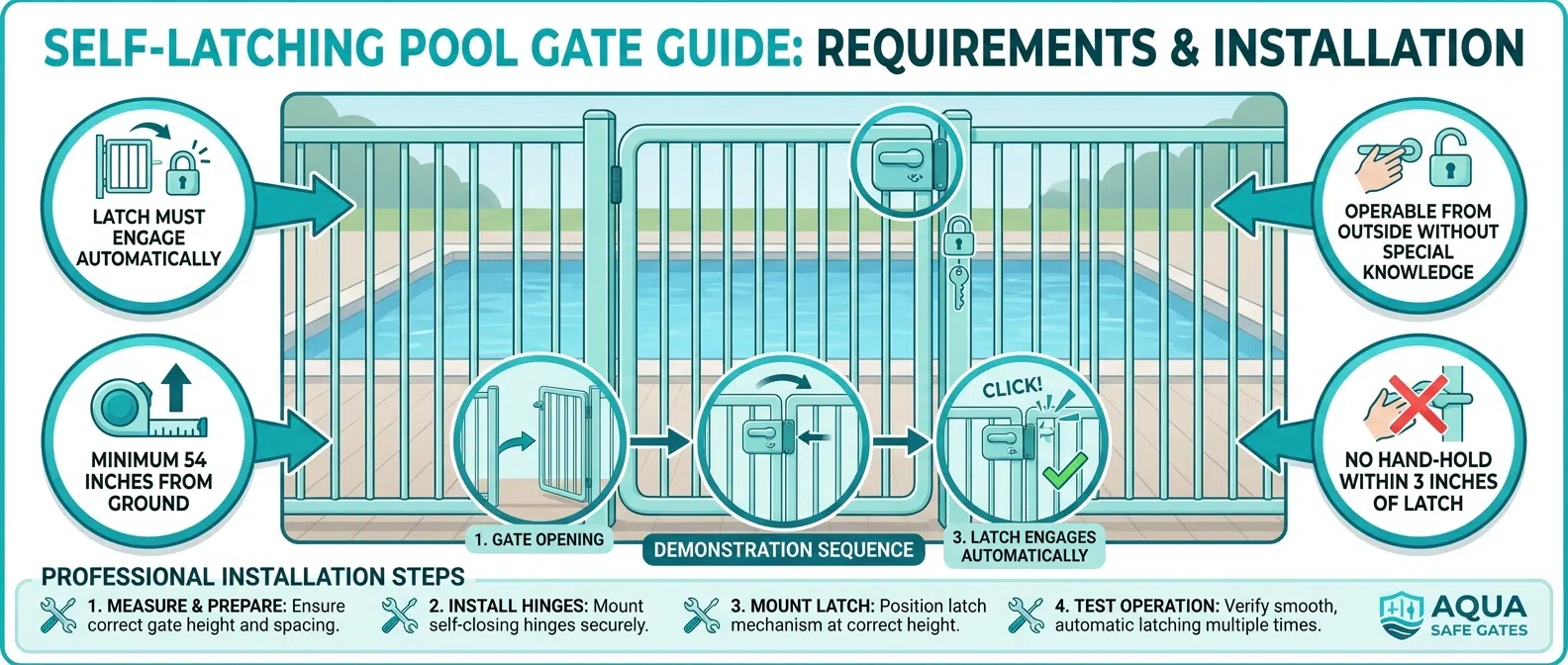
Detailed diagram of self-latching pool gate mechanism showing proper installation
A self-latching pool gate is a gate equipped with a latch mechanism that automatically engages and secures the gate closed without requiring manual action from the person passing through. The latch must activate through gravity or mechanical action as soon as the gate reaches the closed position.
How self-latching mechanisms work
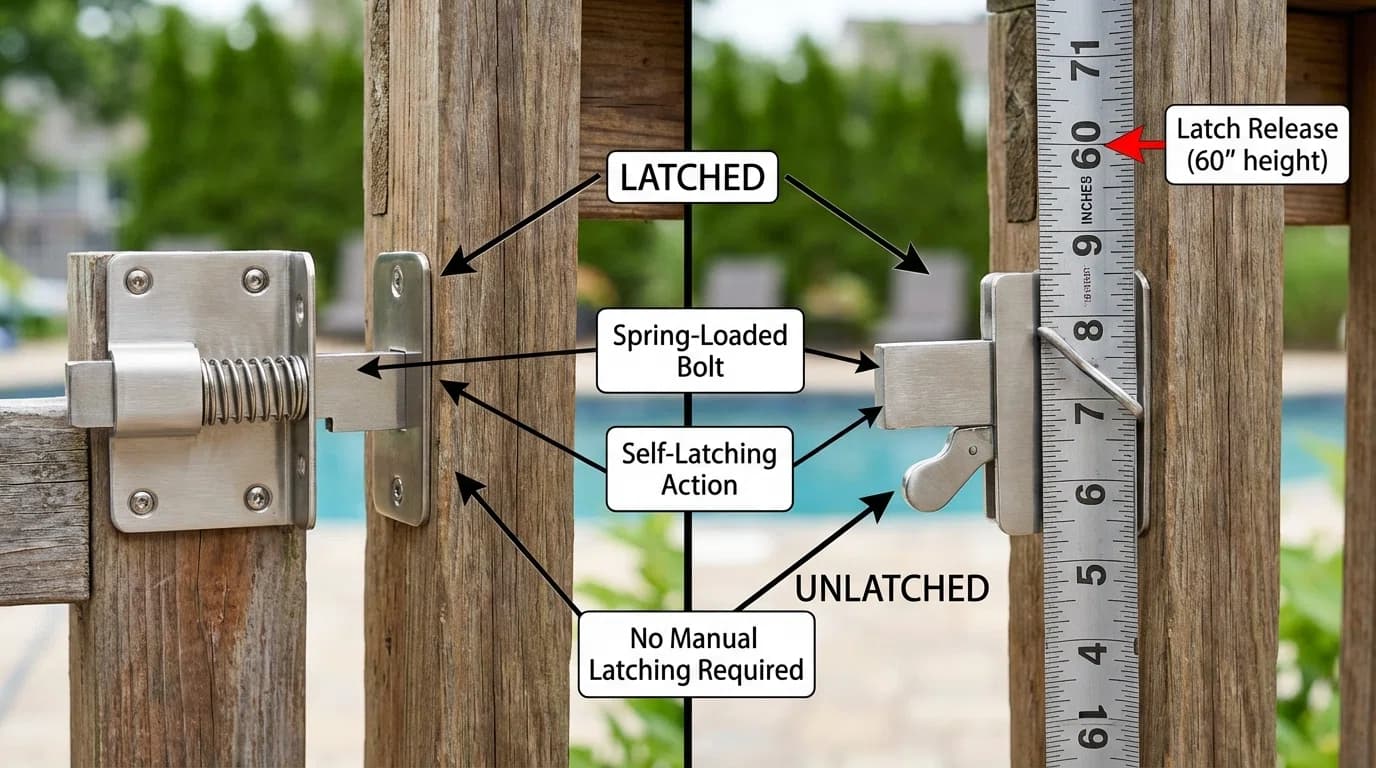
Close-up view of self-latching mechanism internal components and operation
Self-latching mechanisms use gravity, springs, or magnetic force to automatically engage when the gate closes:
Gravity latches:
- Weight of the latch component causes it to drop into the catch
- Relies on gate being properly aligned and hung vertically
- Simple mechanical design with few failure points
Spring-loaded latches:
- Spring tension pushes latch bolt into strike plate when gate closes
- Provides positive engagement even if gate isn't perfectly aligned
- Most common type for pool applications
Magnetic latches:
- Magnetic force pulls latch components together
- Provides secure hold with no mechanical wear
- Higher cost but very reliable
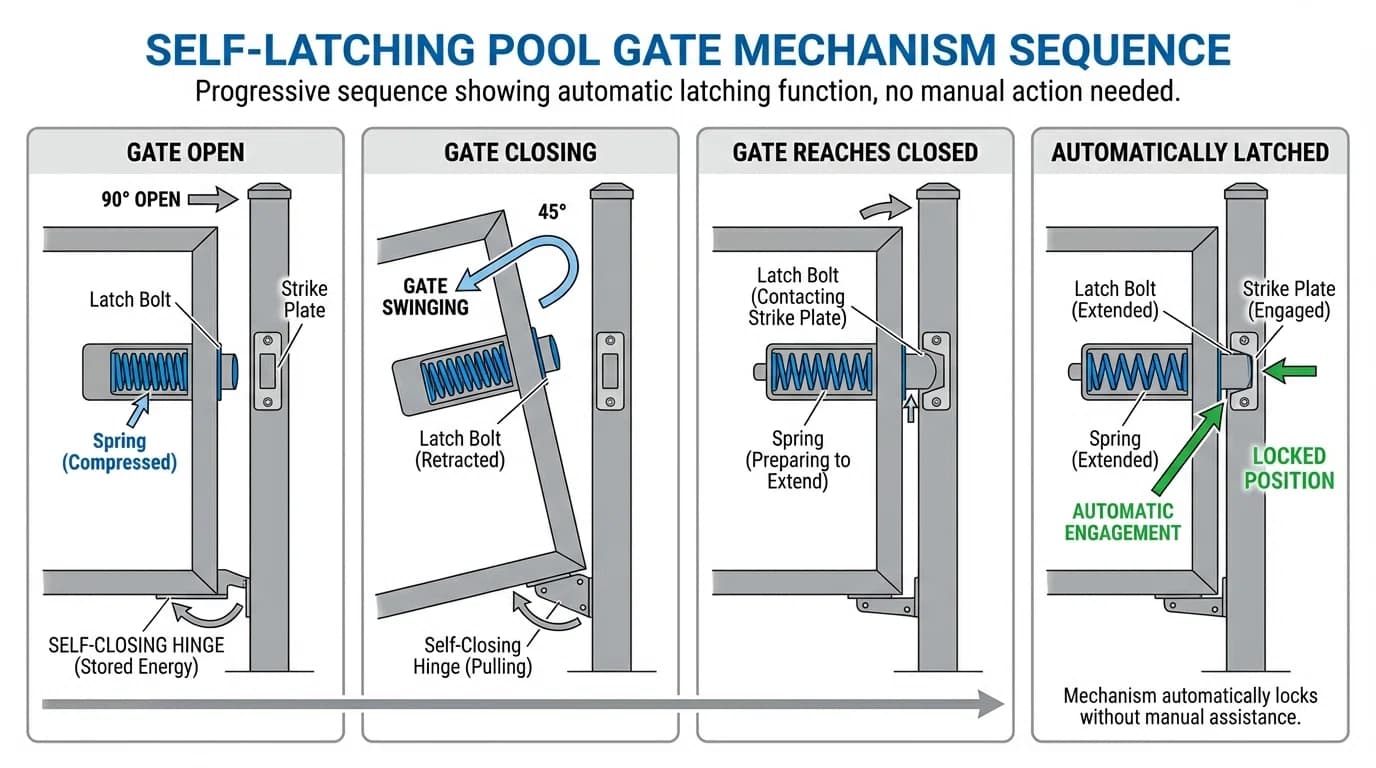
Diagram showing self-latching pool gate mechanism operation from open to closed position
Why self-latching gates are required
Self-latching gates address a critical safety gap: human error. Even the most safety-conscious adults can forget to manually latch a gate, especially when carrying items, supervising children, or in a hurry.
According to drowning prevention research, layers of protection are essential. A pool barrier with non-latching gates provides minimal protection because gates left open create an unobstructed path to the pool.
Self-latching gates ensure:
- Gates secure automatically every time
- No reliance on human memory or action
- Consistent protection 24/7
- Compliance with California safety laws
Streamline California pool safety inspections
PoolVerify helps inspectors document gate compliance alongside all BPC §7195 requirements with photo documentation and instant PDF reports.
California BPC §7195 requirements
California Business and Professions Code Section 7195 establishes specific requirements for pool gates as part of comprehensive drowning prevention safety features.
When BPC §7195 applies
BPC §7195 requirements apply to:
Mandatory compliance:
- New residential swimming pool or spa construction (permitted after January 1, 2018)
- Pool or spa remodeling projects requiring building permits
- Real estate property transfers where pool safety inspection is required
Pool types covered:
- In-ground swimming pools
- Above-ground pools with depths over 18 inches
- Spas and hot tubs (outdoor)
- Combination pool/spa installations
The seven drowning prevention safety features
BPC §7195 requires that pools have at least two of the following seven safety features:
- Enclosure barriers meeting specific height and spacing requirements
- Self-closing, self-latching gates (this guide's focus)
- Approved safety pool covers
- Exit alarms on pool access doors
- Self-closing, self-latching doors with alarms (for direct pool access from home)
- Pool alarms detecting water entry
- Removable mesh fencing meeting ASTM F2286 standards
Most California homeowners choose Option 1 (enclosure barriers) combined with Option 2 (self-closing, self-latching gates) as their two required safety features.
Specific gate requirements under BPC §7195
When using enclosure barriers with gates as one of the seven safety features, California law requires:
Gate operation:
- Gates must be self-closing (return to closed position automatically)
- Gates must be self-latching (latch engages automatically without manual action)
- Gates must open away from the pool (outward swing)
Latch specifications:
- Latch release mechanism must be at least 60 inches above the ground
- Latch must be on the pool side of the gate (inside the barrier)
- No external access to latch release from outside the barrier
- Latch must engage automatically every time the gate closes
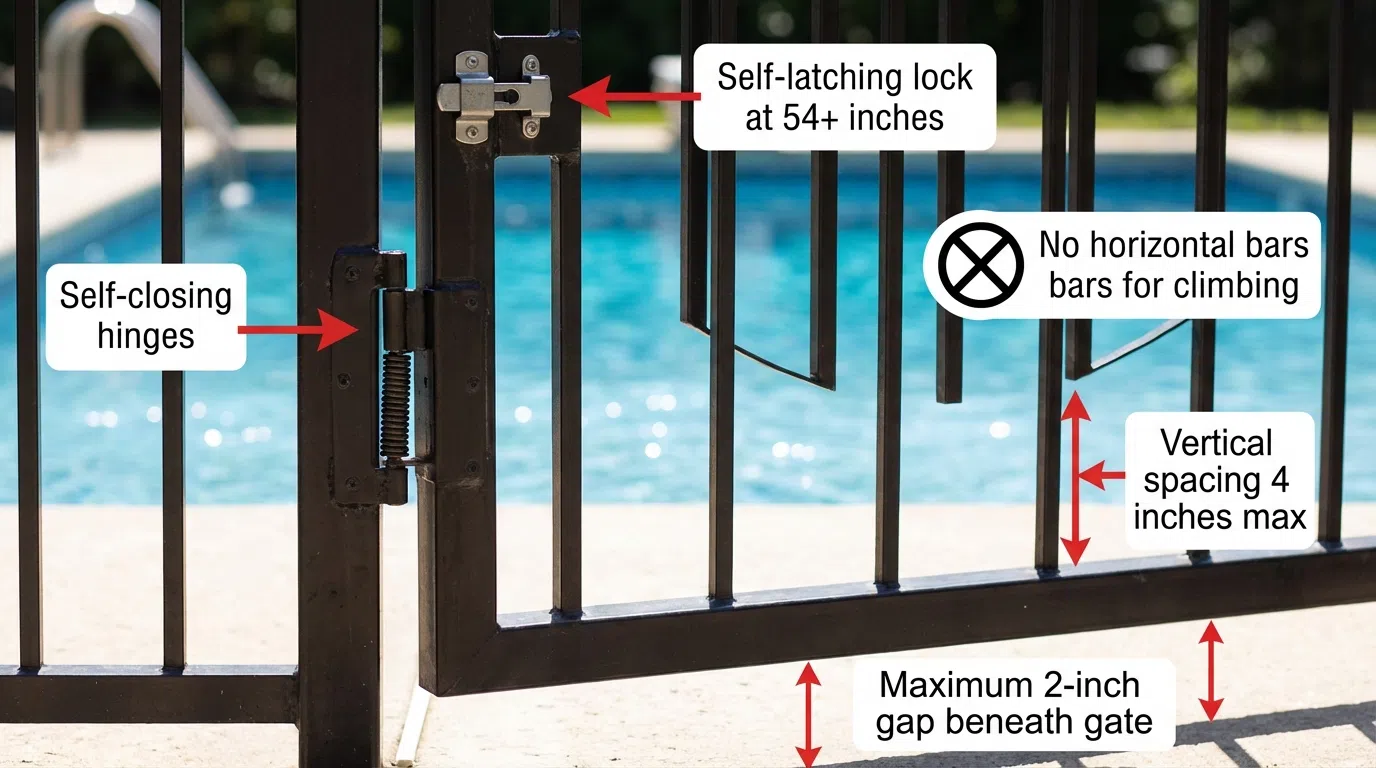
California pool gate showing compliant self-closing, self-latching mechanism at proper height
Doors providing direct pool access
If a home has doors providing direct access to the pool area, BPC §7195 has additional requirements:
- Doors must be self-closing and self-latching
- Latch release must be positioned over 54 inches high
- Door must have an approved exit alarm
- Alarm must sound when door is opened
- Alarm must meet UL 2017 standards
This prevents young children from exiting the home directly into the pool area without adult knowledge.
For comprehensive coverage of all California pool compliance requirements, see our complete guide to California pool compliance.
Self-closing vs self-latching explained
Many people confuse self-closing and self-latching, but they are distinct functions that work together. California requires both features on pool gates.
Self-closing gates
Definition: A self-closing gate automatically returns to the closed position after being opened, without requiring manual action.
How it works:
- Spring hinges, hydraulic closers, or gravity (on sloped hinges) pull the gate closed
- Gate swings shut automatically when released
- Closing speed can be adjusted on most mechanisms
- Gate reaches fully closed position within 2-5 seconds typically
Purpose:
Ensures gates don't remain standing open, which would leave pool access unobstructed.
Self-latching gates
Definition: A self-latching gate has a latch mechanism that automatically engages and secures the gate closed without manual action.
How it works:
- Latch bolt, hook, or catch automatically engages when gate reaches closed position
- Mechanism activates through gravity, spring tension, or magnetic force
- Latch provides positive securing of gate (won't blow open in wind)
- Release requires deliberate action (lifting latch, pressing button, etc.)
Purpose:
Ensures gates don't just close but actually secure, preventing wind or child pushing from opening the gate.
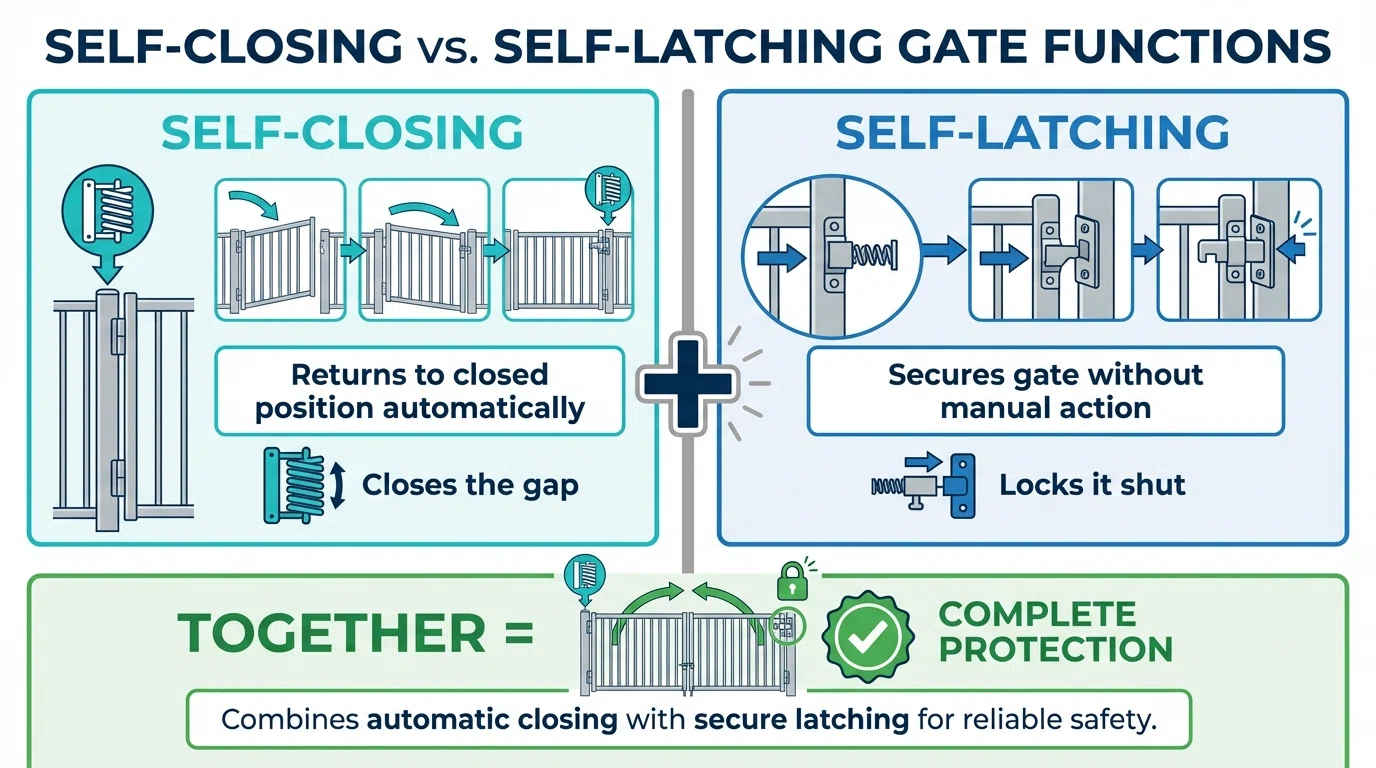
Side-by-side comparison showing self-closing mechanism (top) and self-latching mechanism (bottom)
Why both are required
Self-closing alone is insufficient:
A gate that closes but doesn't latch can be pushed open by children, wind, or pets. The gate may appear closed but isn't actually secured.
Self-latching alone is insufficient:
If a gate has a latch but doesn't close automatically, people will frequently leave it standing open, defeating the entire safety barrier.
Together they provide complete protection:
- Gate is opened for pool access
- Self-closing mechanism pulls gate closed automatically (no manual action needed)
- Self-latching mechanism engages as gate reaches closed position (no manual latching needed)
- Gate is now secured and cannot be opened by wind, children pushing, or pets
- Opening requires deliberate action (reaching high latch) that young children cannot perform
Testing both functions
Pool inspectors verify both functions during inspections:
Self-closing test:
- Open gate fully to 90 degrees
- Release gate (don't push it closed)
- Gate must automatically return to fully closed position
- Closing should be smooth (not slamming) but complete
Self-latching test:
- With gate closed, verify latch has engaged automatically
- Attempt to push gate open without releasing latch (should not open)
- Release latch and verify gate opens normally
- Repeat test multiple times to ensure consistent function
For pool service companies conducting maintenance, annual testing and adjustment of both mechanisms ensures continued compliance.
Types of self-latching mechanisms
Multiple latch designs meet California requirements. Understanding the options helps homeowners and contractors select the best mechanism for specific applications.
Gravity latches
Gravity latches use the weight of the latch component to automatically drop into the catch when the gate closes.
Popular designs:
- Drop-bar latches: Metal bar drops into U-shaped catch
- Ball latches: Weighted ball falls into socket
- Cane bolts: Vertical rod drops into ground-mounted receiver
Advantages:
- Simple mechanical design
- No springs or moving parts to wear out
- Highly reliable if gate is properly aligned
- Easy to understand and operate
Disadvantages:
- Requires gate to be perfectly vertical for reliable operation
- Sagging or misaligned gates may not latch
- Can be affected by gate warping over time
- May freeze in cold climates (moisture in catch)
Best applications:
- Well-constructed gates that remain aligned
- Metal or rigid composite gates less prone to sagging
- Dry climates with minimal freezing
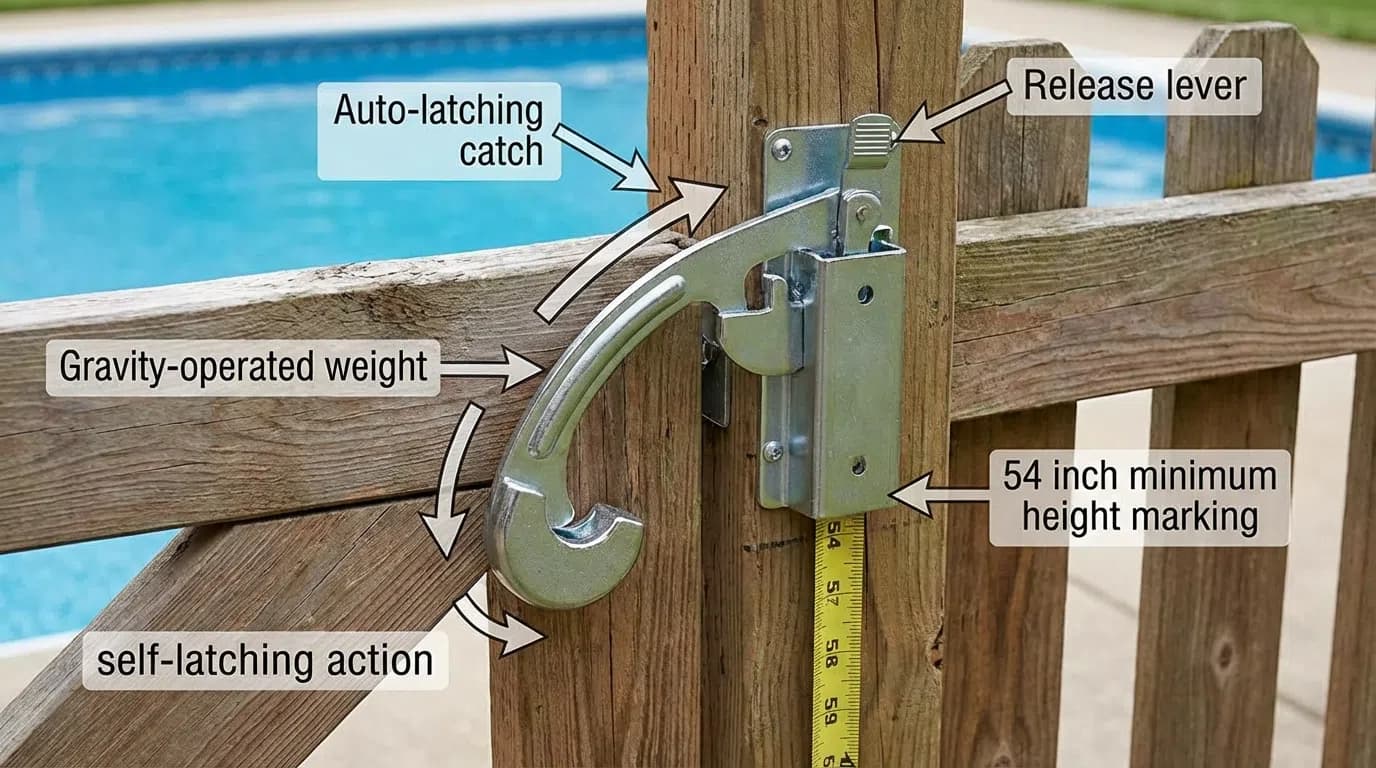
Close-up photo of gravity latch showing drop-bar mechanism and catch assembly
Spring-loaded latches
Spring-loaded latches use spring tension to push a latch bolt into a strike plate when the gate closes.
Popular designs:
- Spring bolt latches: Similar to interior door latches
- Magnetic trigger latches: Spring holds latch, magnet releases
- Snap latches: Spring-loaded hook catches strike plate
Advantages:
- Work even if gate isn't perfectly aligned (spring compensates)
- Positive engagement provides secure hold
- Available in various finishes and styles
- Most common type, widely available
Disadvantages:
- Springs can weaken over time (require replacement)
- More complex mechanism with more failure points
- Can be noisy (clicking or snapping sound)
- May require periodic adjustment
Best applications:
- Wood gates that may experience minor warping
- High-traffic gates used frequently
- Gates that need to work in various conditions
Magnetic latches
Magnetic latches use powerful magnets to pull latch components together when the gate closes.
How they work:
- One magnet mounted on gate
- Second magnet or metal plate mounted on post
- Magnetic attraction pulls components together as gate approaches closed position
- Release requires overcoming magnetic force (typically via handle or lever)
Advantages:
- No mechanical wear (magnets don't degrade)
- Silent operation
- Tolerant of significant gate misalignment
- Reliable in all weather conditions
- Modern, clean appearance
Disadvantages:
- Higher cost than mechanical latches
- Magnetic force may be too strong for young children to release (could be advantage or disadvantage)
- Can attract metal debris
- Rare earth magnets required for outdoor durability
Best applications:
- Premium installations
- Gates requiring silent operation
- Environments with sand, dirt, or debris (no moving parts to clog)
- Long-term reliability priority

Comparison showing three latch types: gravity, spring-loaded, and magnetic mechanisms
Combination self-closing/self-latching systems
Some products integrate both self-closing and self-latching functions in a single unit.
Examples:
- TruClose hinges: Spring hinge with integrated latch
- Magna-Latch: Magnetic latch with tension adjustment for closing
- D&D Technologies SureClose: Hydraulic closer with built-in latch
Advantages:
- Simplified installation (one product does both jobs)
- Coordinated function (designed to work together)
- Often includes adjustment for closing speed and latch tension
- Professional appearance
Disadvantages:
- Higher upfront cost
- If one function fails, may need to replace entire system
- More complex to adjust or maintain
Best applications:
- New pool barrier installations
- Professional contractors preferring single-source solutions
- Homeowners wanting premium, coordinated systems
For California pool inspections, any of these latch types is acceptable as long as it meets the functional requirements: automatic engagement without manual action and proper height placement.
Installation requirements and specifications
Proper installation is critical for self-latching gates to function correctly and maintain compliance. Poor installation can render even high-quality latches ineffective.
Gate construction requirements
Gate frame:
- Must be rigid and resist sagging (metal, composite, or quality wood)
- Frame joints must be secure (welded, bolted, or quality joinery)
- Gate must remain flat and aligned over time
- Maximum gate weight depends on hinge capacity
Gate infill:
- Must meet pool barrier spacing requirements (max 4-inch openings)
- Vertical bars preferred (no horizontal climbing aids)
- Materials: wrought iron, aluminum, vinyl, mesh, or tempered glass
- No footholds or handholds within 45 inches of latch
Gate dimensions:
- Width: 36-48 inches typical (must accommodate self-closing hardware)
- Height: Minimum 60 inches (same as barrier requirement)
- Clearance: 2 inches maximum gap under gate (prevents entry)
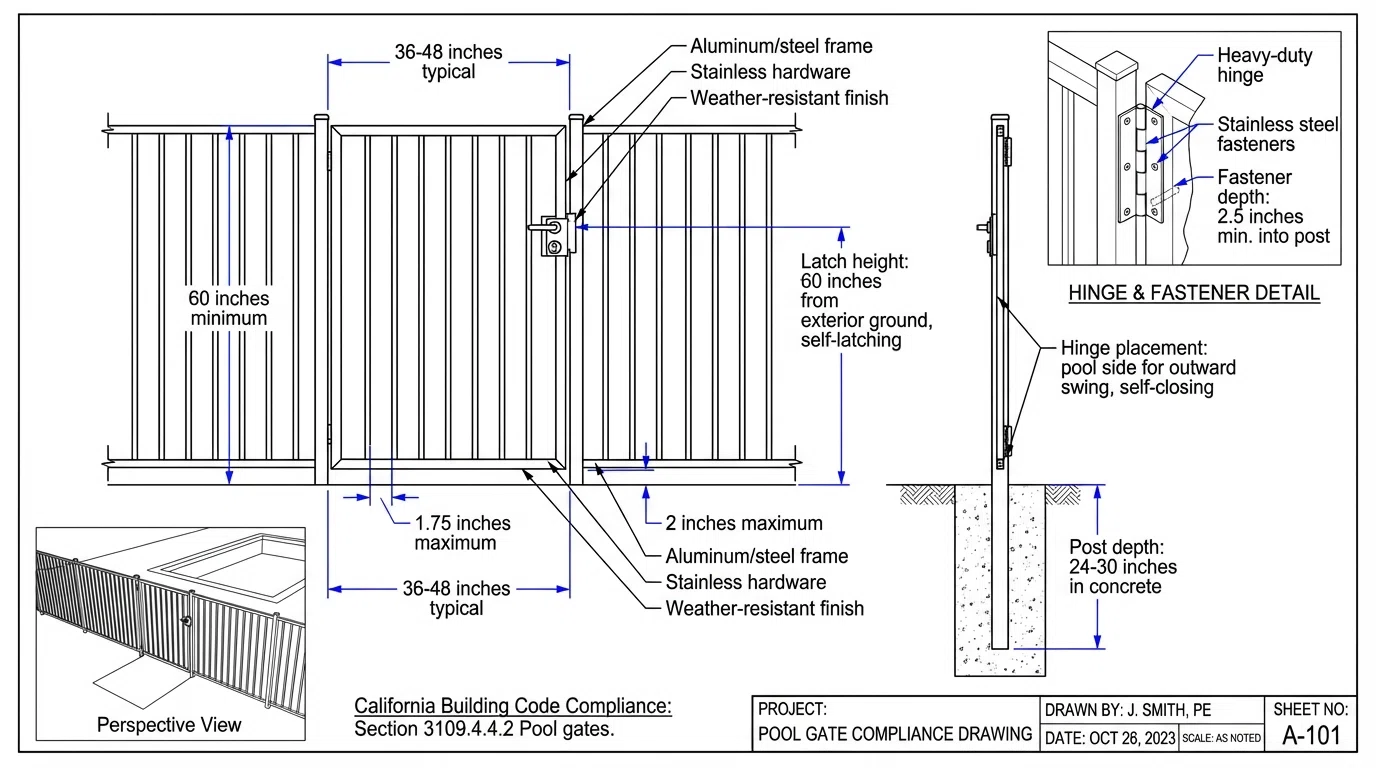
Technical diagram showing pool gate construction specifications and measurements
Hinge installation
Self-closing hinges:
- Must be rated for gate weight and width
- Spring tension adjustable for proper closing speed
- Typically 2-3 hinges for standard gates
- Mounted securely to structural members (not just surface mounted)
Installation specs:
- Hinges on pool side of gate (so gate opens outward from pool)
- Vertical alignment critical (gate must hang plumb)
- Fasteners appropriate for post material (lag bolts, through-bolts, or welded)
- Shim or adjust to eliminate gate sag
Closing speed adjustment:
- Gate should close within 2-5 seconds from any open position
- Should not slam closed (safety hazard, damages latch)
- Should not close too slowly (defeats purpose of self-closing)
- Test from 90-degree open position
Latch installation
Mounting location:
- Latch body mounted on gate (moving component)
- Strike plate, catch, or receiver mounted on gate post (stationary)
- Alternative: latch on post, catch on gate (less common)
Height requirements (critical):
- Latch release must be minimum 60 inches above grade (California requirement)
- Measured from ground outside the barrier to lowest point of release mechanism
- If ground slopes, measure from highest point within 18 inches of gate
- Exception: See "Latch height placement rules" section for detailed requirements
Alignment:
- Latch and catch must align precisely for reliable engagement
- Test alignment by slowly closing gate and observing latch engagement
- Adjust catch position if needed (lateral, vertical, or depth)
- Lock hardware securely after adjustment
Hardware security:
- Use tamper-resistant screws or bolts
- Fasteners must penetrate structural members (not just surface trim)
- Lock washers or thread-locking compound on threaded fasteners
- No exposed fasteners on pool side that could be removed
Post-installation testing
After installation, verify:
- Self-closing function: Gate closes from any position within 2-5 seconds
- Self-latching function: Latch engages automatically every time
- Latch security: Gate cannot be pushed open when latched
- Opening function: Latch releases smoothly when operated
- Height compliance: Measure latch release height (minimum 60")
- Repeated function: Test open/close cycle 10 times to ensure consistent operation
PoolVerify's digital inspection platform includes photo tools to document latch height measurements and functional testing results for BPC §7195 compliance.
Document gate compliance efficiently
PoolVerify's California-specific templates guide inspectors through all gate testing requirements with integrated photo capture and automatic report generation.
Latch height placement rules
California's 60-inch minimum latch height requirement is one of the most specific and frequently inspected aspects of pool gate compliance. Understanding the exact requirements prevents violations.
Basic 60-inch requirement
California BPC §7195 specification:
The latch release mechanism must be positioned at least 60 inches above the ground measured from the ground outside the barrier.
What counts as "latch release mechanism":
- The lowest point that must be activated to release the latch
- For lever handles: the lever itself
- For lift latches: the lift bar or handle
- For button releases: the button
- Measure from the ground to the lowest part that must be contacted
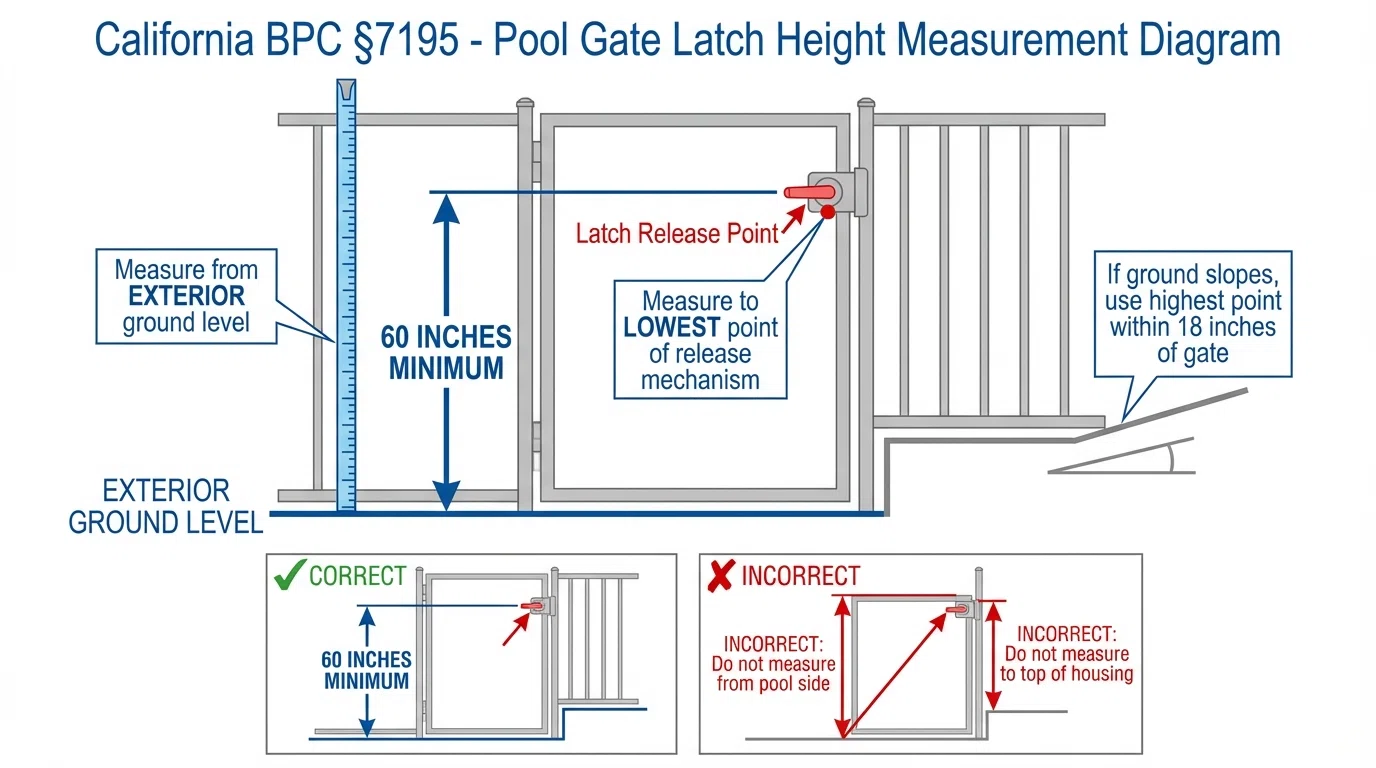
Detailed measurement diagram showing proper 60-inch latch height from ground to release
Measuring latch height correctly
Measurement point on ground:
- Measure from the ground surface immediately outside the barrier
- If ground slopes within 18 inches of gate, measure from highest point in that area
- Use finished grade (after landscaping), not temporary or eroded surfaces
Measurement point on latch:
- Measure to lowest point of the release mechanism
- Not the top of the latch housing, but where hand must contact to release
- For paddle handles, measure to bottom of paddle
- For rotating handles, measure to handle at lowest position
Proper measuring technique:
- Position measuring tape vertically (use level to ensure plumb)
- Extend tape from ground to latch release point
- Read measurement at lowest part of release mechanism
- Document with photo showing tape measure in position
Exceptions and special cases
Double-cylinder combination locks:
If a gate uses a double-cylinder combination lock, the combination input can be located at any height because it requires knowledge (the combination) rather than just reach.
However, this is uncommon for residential pools because it creates an emergency egress problem (people inside the pool area couldn't exit quickly without knowing the combination).
Keypad or coded entry systems:
Similar to combination locks, keypads requiring a code can be located at accessible heights because they require knowledge to operate.
Pass-through latch access:
Some latches allow reach-through access from the outside by putting your hand over or through the gate/fence. This is non-compliant under California law. The latch release must be on the pool side with no external access points.
Common height violations
Pool inspectors frequently find these violations:
Latch too low:
- Installed at 54 inches (confusion with door requirement)
- Measured to top of latch housing instead of release point
- Ground buildup or landscaping raising grade after installation
Reach-through access:
- Horizontal slat fencing allowing reach-through to latch
- Gaps in barrier allowing arm access to latch
- Decorative elements providing footholds near latch
Deteriorated compliance:
- Ground erosion lowering grade (effectively lowering latch height)
- Gate sagging reducing latch height over time
- Landscaping or paving additions raising ground level
Maintaining height compliance
Initial installation:
- Measure carefully during installation
- Account for final grade (after landscaping)
- Consider gate sag over time (install slightly high)
- Document installation height with photos
Ongoing maintenance:
- Check latch height annually
- Re-measure if ground grade changes
- Adjust latch up if gate sags
- Re-landscape if grade changes affect compliance
For property management companies managing multiple pools, annual latch height verification prevents compliance issues during inspections or real estate transfers.
Testing pool gates for compliance
Professional pool inspectors follow systematic testing procedures to verify gate compliance with all California requirements.
Visual inspection
Gate construction:
- Gate is rigid and in good condition
- No warping, sagging, or damage
- Infill meets spacing requirements (max 4-inch openings)
- No obvious climbing aids (horizontal bars near latch)
Hardware condition:
- Hinges securely mounted and aligned
- Latch components intact and operational
- No loose fasteners or worn parts
- All hardware appropriate for outdoor use (rust-resistant)
Installation quality:
- Gate hangs plumb (vertical)
- Clearance under gate 2 inches or less
- Gate opens away from pool (outward swing)
- No gaps allowing passage around gate

Pool inspector testing self-closing gate function and documenting with photo
Functional testing
Self-closing test:
- Open gate to 90-degree position
- Release gate (do not push or pull)
- Observe gate returning to fully closed position
- Timing: should close within 2-5 seconds
- Gate should close smoothly, not slam
Self-latching test:
- With gate closed, verify latch has engaged
- Attempt to push gate open without releasing latch (should remain closed)
- Verify latch engaged automatically (wasn't manually latched)
- Release latch and verify gate opens normally
- Repeat cycle 3-5 times for consistent function
Latch release test:
- Operate latch release from outside (should not be possible)
- Operate latch release from inside (pool side) - should work smoothly
- Verify no reach-through access to latch
- Check that latch holds securely (can't be defeated by pushing)
Measurement verification
Latch height measurement:
- Position tape measure vertically against gate post
- Measure from ground outside barrier to lowest point of latch release
- Verify measurement is minimum 60 inches
- Document with clear photo showing tape measure and measurement
Ground clearance measurement:
- Measure gap between bottom of gate and ground
- Verify clearance is maximum 2 inches
- Check for erosion or gaps that could allow entry
- Document any clearance issues
Documentation requirements
Complete gate inspection documentation includes:
- Photos: Gate overview, latch detail, height measurement, closing mechanism
- Measurements: Latch height, ground clearance, gate dimensions
- Functional testing: Results of self-closing and self-latching tests
- Compliance status: Pass/fail for each requirement
- Recommendations: Any needed repairs, adjustments, or replacements
PoolVerify's California pool inspection software streamlines this documentation with:
- Pre-built BPC §7195 checklists
- Integrated photo capture with annotations
- Automatic measurement tools
- Instant PDF report generation
- Digital client signatures
Common failures and corrections
Gate doesn't close completely:
- Cause: Weak spring tension, binding hinges, ground interference
- Correction: Adjust spring tension, lubricate hinges, trim gate or grade ground
Latch doesn't engage:
- Cause: Misaligned catch, insufficient spring tension, worn latch
- Correction: Adjust catch position, replace latch springs, replace worn components
Latch height too low:
- Cause: Incorrect initial installation, ground grade changes, gate sag
- Correction: Relocate latch higher, adjust gate to reduce sag, lower ground grade
Gate sags or binds:
- Cause: Worn hinges, frame deterioration, post movement
- Correction: Replace hinges, reinforce frame, reset or replace post
For pool service companies conducting regular maintenance, quarterly gate testing helps identify issues before they become compliance violations.
Best self-latching gate products
Selecting quality self-latching mechanisms ensures reliable long-term compliance. These are proven products used by professional pool contractors and inspectors.
Top-rated combination systems
Magna-Latch (D&D Technologies)
- Type: Magnetic latch with integrated closing mechanism
- Features: Powerful magnetic hold, adjustable tension, all-weather construction
- Compliance: Meets all California requirements when properly installed
- Price: $75-$150 depending on model
- Best for: Premium installations, silent operation, long-term reliability
TruClose Regular Hinge/Latch (TruClose USA)
- Type: Spring hinge with integrated gravity latch
- Features: Adjustable closing speed, stainless steel construction, multiple finishes
- Compliance: Fully compliant for California pools
- Price: $50-$90 per set
- Best for: Standard gates, budget-conscious projects, DIY installation
D&D Technologies SureClose Gate Closer/Latch
- Type: Hydraulic closer with integrated latch
- Features: Smooth closing action, commercial-grade construction, adjustable
- Compliance: Meets California requirements
- Price: $100-$200
- Best for: Heavy gates, high-traffic applications, commercial pools
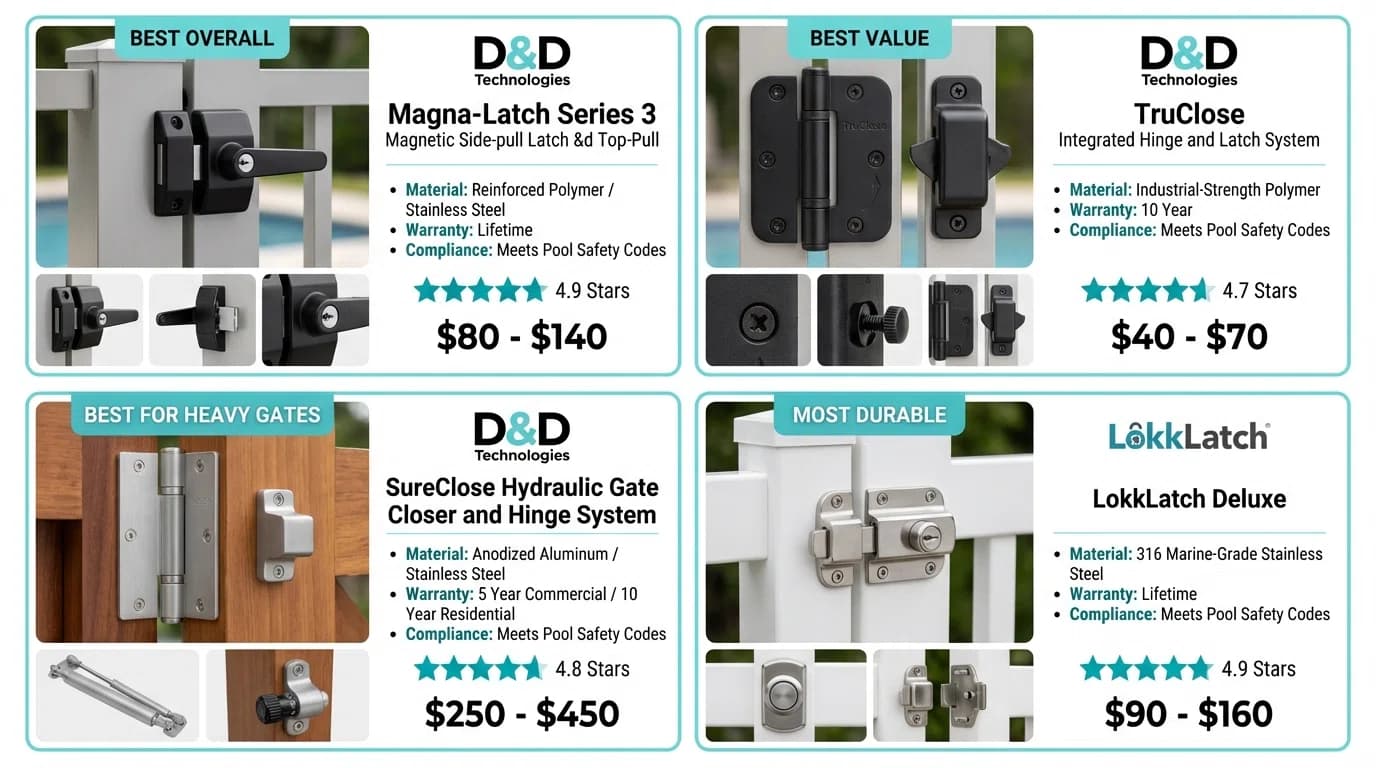
Product comparison showing top-rated self-latching gate systems
Best standalone latch mechanisms
Lok-Latch Deluxe (Nationwide Industries)
- Type: Spring-loaded bolt latch
- Features: Key-lockable, stainless steel, adjustable strike
- Compliance: Compliant when installed at proper height
- Price: $30-$60
- Best for: Adding latch to existing self-closing gates
LokkLatch Magnetic Gate Latch
- Type: Magnetic latch
- Features: Silent operation, no mechanical parts, all-weather magnets
- Compliance: Compliant installation at 60+ inches
- Price: $40-$80
- Best for: Quiet operation, minimal maintenance requirements
Pool Guard Gate Latch (Pool Guard USA)
- Type: Gravity drop latch
- Features: Simple design, California-specific compliance features, stainless steel
- Compliance: Designed specifically for California pool requirements
- Price: $35-$65
- Best for: Straightforward installation, reliable gravity operation
Best self-closing hinges
TruClose Self-Closing Hinges (Standard)
- Type: Spring-loaded gate hinge
- Features: Adjustable tension, stainless steel, fits standard gates
- Compliance: Designed for pool gate applications
- Price: $40-$70 per pair
- Best for: Retrofit applications, replacing standard hinges
D&D Technologies TruClose Round Hinge
- Type: Heavy-duty spring hinge
- Features: 180-degree swing, adjustable tension, commercial grade
- Compliance: Tested for pool safety applications
- Price: $60-$100 per pair
- Best for: Large or heavy gates, commercial applications
Perko Spring Hinge (Marine Grade)
- Type: Stainless steel spring hinge
- Features: Marine-grade construction, extreme weather resistance
- Compliance: Exceeds pool application requirements
- Price: $80-$120 per pair
- Best for: Coastal installations, harsh environments
Where to purchase
Reputable sources:
- Pool supply specialty stores: Expert advice, proper selection
- Contractor suppliers: Professional-grade products, bulk pricing
- Direct from manufacturers: Latest models, warranty support
- Online pool retailers: Competitive pricing, wide selection
Avoid:
- Generic big-box store latches not rated for pool applications
- Imported products without certifications or testing
- Used or salvaged gate hardware (may have hidden wear)
- "Universal" latches that may not meet specific pool requirements
Installation support
Most reputable manufacturers provide:
- Detailed installation instructions
- Technical support hotlines
- Installation videos
- Compliance documentation for inspections
For professional installation, hire licensed contractors familiar with California pool requirements. Proper installation is as important as product quality for long-term compliance.
Frequently asked questions
What is the difference between self-closing and self-latching?
Self-closing means the gate automatically returns to closed position after being opened (using spring hinges or closers). Self-latching means the latch automatically engages and secures the gate when it reaches closed position (without manual latching). California requires both features - gates must close AND latch automatically.
How high does a pool gate latch need to be in California?
The latch release mechanism must be at minimum 60 inches above the ground (measured from the ground outside the barrier to the lowest point of the release mechanism). This is higher than the 54-inch requirement for direct pool access doors from homes. Always measure from the outside ground to ensure compliance.
Can I install a self-latching gate myself?
While homeowners can legally install pool gates, professional installation is recommended to ensure proper function and compliance. Critical factors include proper height placement, hinge alignment, latch positioning, and functional testing. Incorrect installation can create safety hazards and fail inspections. If you do install yourself, carefully follow manufacturer instructions and verify all measurements.
What if my gate won't stay latched?
Common causes include misaligned catch, weak spring tension, worn latch components, or gate sagging. First check that the latch and catch align properly when the gate closes. Adjust the catch position if needed. If the latch is spring-loaded, the spring may need replacement. For gravity latches, ensure the gate hangs perfectly vertical. If problems persist, consult a professional or replace the latch mechanism.
Do I need a lock on my pool gate?
California BPC §7195 does not require locks on pool gates, only self-closing and self-latching mechanisms at 60+ inches height. However, many homeowners add locks for additional security, especially with young children. If adding a lock, ensure it doesn't interfere with the self-latching function and doesn't create an emergency egress problem for people inside the pool area.
Conclusion
Self-latching pool gates are a critical component of California's multi-layered approach to drowning prevention, ensuring pool barriers remain secured automatically without relying on human action. Understanding the specific requirements of BPC §7195, the difference between self-closing and self-latching functions, proper installation specifications, and the best products available helps homeowners, contractors, and inspectors maintain compliant pool barriers.
By selecting quality self-latching mechanisms, installing them at the correct 60-inch minimum height, testing function regularly, and addressing any issues promptly, pool owners protect children while meeting California's pool safety requirements.
Ready to streamline your California pool gate inspections? PoolVerify provides comprehensive BPC §7195 inspection templates including gate compliance, barrier requirements, and all seven drowning prevention features, with integrated photo documentation and instant PDF reports. Start your free 14-day trial today.
Related posts
Frequently Asked Questions
What is the difference between self-closing and self-latching?
Self-closing means the gate automatically returns to closed position after being opened using spring hinges or closers. Self-latching means the latch automatically engages and secures the gate when it reaches closed position without manual action. California requires both features on all pool gates.
How high does a pool gate latch need to be in California?
The latch release mechanism must be at minimum 60 inches above the ground, measured from the ground outside the barrier to the lowest point of the release mechanism. This is higher than the 54-inch requirement for direct pool access doors from homes.
Can I install a self-latching gate myself?
While homeowners can legally install pool gates, professional installation is recommended to ensure proper function and compliance. Critical factors include proper height placement, hinge alignment, latch positioning, and functional testing. Incorrect installation can create safety hazards and fail inspections.
What if my gate won't stay latched?
Common causes include misaligned catch, weak spring tension, worn latch components, or gate sagging. Check that the latch and catch align properly when the gate closes and adjust the catch position if needed. For gravity latches, ensure the gate hangs perfectly vertical for reliable operation.
Do I need a lock on my pool gate?
California BPC §7195 does not require locks on pool gates, only self-closing and self-latching mechanisms at 60+ inches height. Many homeowners add locks for additional security. If adding a lock, ensure it doesn't interfere with the self-latching function or create emergency egress problems.
Related Articles

Compliance-safety
Self Closing Pool Gate: Requirements, Installation & Best Products [2026]
Complete guide to self-closing pool gates: California requirements, installation methods, product comparisons, and compliance testing. Learn about spring-loaded, hydraulic, and TruClose systems.
![Pool Gate Requirements: Complete California Compliance Guide [2026]](/_next/image?url=%2Fresources%2Fpool-gate-requirements-california-hero.webp&w=3840&q=75)
Compliance-safety
Pool Gate Requirements: Complete California Compliance Guide [2026]
California pool gate requirements 2026: 54-inch minimum latch height, self-closing and self-latching mechanisms, outward opening direction, and maximum 1/2-inch gap when closed. Complete HSC §115922 compliance guide.

Pool-compliance
Pool Gate Latch Requirements: California Height & Safety Guide [2026]
California pool gate latch requirements explained. Learn the 54-inch vs 60-inch height rules, self-latching mechanisms, installation tips, and best products for HSC 115923 compliance.