Pool-compliance
Pool Fencing Laws by State: 2026 Comparison
Complete state-by-state pool fencing law comparison for 2026. Height requirements, gate standards, self-closing latches, which states require fences, and local variations.

14 min read
Pool fencing laws vary dramatically across the United States, from states with no residential requirements to California's comprehensive 60-inch minimum barrier standards. Understanding your state's specific requirements is essential for pool owners, contractors, inspectors, and anyone involved in pool safety compliance.
This comprehensive guide compares pool fencing laws for all 50 states as of 2026, highlighting which states mandate fences, minimum height requirements, gate specifications, self-closing and self-latching standards, and the critical distinction between state and local requirements. Whether you're building a new pool, buying a home with a pool, or conducting pool safety inspections, this state-by-state comparison ensures compliance.
Table of Contents
- Overview of pool fencing laws in America
- States requiring pool fencing
- Pool fence height requirements by state
- Gate and latch requirements by state
- Self-closing and self-latching requirements
- California pool fencing laws detailed
- States with no statewide requirements
- Local vs state pool fencing requirements
- State-by-state comparison table
- Frequently asked questions
Overview of pool fencing laws in America
Pool fencing laws in the United States originate from multiple sources creating a complex regulatory landscape. No federal law mandates residential pool fencing, though the U.S. Consumer Product Safety Commission publishes Safety Barrier Guidelines recommending four-foot minimum barriers for all residential pools.
States adopt pool safety laws based on the International Building Code (IBC), International Residential Code (IRC), or Uniform Swimming Pool Code, often with state-specific amendments. Some states adopt these codes uniformly statewide, while others allow local jurisdictions to establish their own pool safety ordinances.
Federal guidance vs state requirements
The CPSC Safety Barrier Guidelines, while influential, are recommendations not legal requirements. States decide whether to adopt pool fencing mandates and at what specificity level. This creates significant variation in pool safety regulations across the country.
Federal Level: CPSC recommendations for 48-inch minimum barriers, self-closing/self-latching gates, and proper spacing
State Level: Some states mandate specific pool fencing standards statewide, others defer to local jurisdictions
Local Level: Counties and municipalities can adopt stricter requirements than state minimums or create regulations where states have none
This layered approach means pool fencing requirements for properties only 10 miles apart can differ significantly if they're in different jurisdictions.

Map of United States showing states with pool fencing requirements vs no requirements
International Building Code influence
Most states base pool safety codes on the International Building Code (IBC) Chapter 31 or International Residential Code (IRC) Appendix G, which recommend:
- Minimum 48-60 inch barrier heights
- Maximum 4-inch spacing between vertical barrier components
- Maximum 2-inch ground clearance
- Self-closing and self-latching gates
- Latch heights 54+ inches above grade
States adopting IBC or IRC gain comprehensive, proven pool safety standards. States not adopting these codes often have patchwork local regulations or no statewide requirements.
Ensure compliance across all jurisdictions
PoolVerify helps pool inspectors verify requirements for any location with customizable checklists adapting to state and local codes.
States requiring pool fencing
As of 2026, the majority of states have adopted some form of pool fencing requirement, though specifics vary significantly. States fall into three categories: comprehensive statewide requirements, partial requirements (certain pool types or situations), and no statewide requirements (deferring to local ordinances).
States with comprehensive pool fencing laws
These states mandate pool barriers for most or all residential swimming pools through statewide legislation:
Arizona: Requires barriers around pools at residences where children under age 6 live. Minimum 5-foot height with maximum 4-inch openings, and barriers must be at least 20 inches from pool edge.
California: Comprehensive requirements under California Building Code Section 3109, mandating minimum 60-inch barriers for all pools exceeding 18 inches depth, plus two drowning prevention features for new pools.
Connecticut: Requires barriers around all residential pools, adopting International Building Code standards with state-specific amendments.
Florida: All residential pools must have barriers minimum 48 inches tall measured from outside ground level, with maximum 4-inch openings and self-closing/self-latching gates.
Nevada: Mandates pool barriers for all residential pools with specific height and spacing requirements based on IBC standards.
New Jersey: Comprehensive pool fencing requirements for all residential pools based on Uniform Construction Code adoption of IBC standards.
New York: State Residential Code mandates minimum 48-inch pool fence heights, though many municipalities require 54+ inches.
Oregon: Requires pool barriers for residential pools based on state building code adoption of IRC standards.
Texas: Health and Safety Code Chapter 757 requires all residential pools to have barriers minimum 48 inches tall with maximum 4-inch openings and self-closing/self-latching gates.
These states provide clear statewide standards, though local jurisdictions can impose stricter requirements.
States with partial or limited requirements
Some states have pool fencing laws applying only to specific situations:
Georgia: Pool fencing requirements apply primarily to public pools, with residential pool requirements determined locally
Illinois: Comprehensive requirements for public pools, residential requirements vary by municipality
Louisiana: Requirements focus on public/commercial pools, residential requirements largely local
Michigan: Statewide standards for public pools, residential requirements through local ordinances
Ohio: Public pool requirements are detailed, residential pool fencing determined by local building codes
These states recognize pool safety importance but allow local control over residential pool regulations.
States deferring to local jurisdictions
Several states have no statewide residential pool fencing mandates, leaving requirements to counties and cities:
Alabama: No statewide residential pool fencing requirement; local jurisdictions establish standards
Alaska: No statewide requirements for residential pools
Arkansas: Limited statewide requirements, primarily local jurisdiction control
Colorado: Local jurisdictions establish pool fencing requirements
Idaho: No statewide mandate; local building codes determine requirements
Indiana: Residential pool fencing determined by local ordinances
Iowa: Local jurisdiction control over residential pool requirements
Kansas: No statewide residential pool fencing law
Kentucky: Local ordinances establish pool fencing requirements
Maine: Pool fencing requirements determined locally
Minnesota: No statewide mandate for residential pool fencing
Mississippi: Local jurisdiction control
Missouri: No statewide residential pool fencing requirement
Montana: Local jurisdictions establish requirements
Nebraska: No statewide mandate
New Hampshire: Local control over pool fencing requirements
New Mexico: Primarily local jurisdiction requirements
North Dakota: No statewide residential pool fencing law
Oklahoma: Local ordinances determine requirements
South Dakota: No statewide mandate
Utah: Local jurisdiction control over residential pool requirements
Vermont: Pool fencing determined locally
West Virginia: No statewide requirement for residential pools
Wyoming: Local ordinances establish pool fencing standards
Even in states without statewide mandates, major cities typically have comprehensive pool fencing ordinances.

Chart showing states with comprehensive, partial, or no statewide pool fencing requirements
Pool fence height requirements by state
Pool fence height requirements represent the most visible difference between state pool fencing laws. Minimum heights range from 48 inches (4 feet) to 60 inches (5 feet), with measurement methods varying.
60-inch minimum height states
California: 60 inches (5 feet) measured from grade on the side facing away from the pool. The strictest height requirement nationwide, reflecting California's comprehensive pool safety approach detailed in our California pool fence laws guide.
54-inch minimum height states
Several states and municipalities require 54-inch minimums, representing a middle ground between federal recommendations and California's standard:
New York (many municipalities): While state code mandates 48 inches, cities like New York City, Buffalo, and Rochester require 54+ inches through local ordinances.
Massachusetts (many municipalities): State allows local control; Boston and many other cities require 54-inch minimums.
48-inch minimum height states
The majority of states with requirements mandate 48-inch (4-foot) minimum barrier heights, aligning with CPSC recommendations and IBC standards:
Arizona: 60 inches (5 feet) minimum
Florida: 48 inches minimum
Texas: 48 inches minimum
New York (state code): 48 inches minimum (local jurisdictions often require more)
Connecticut: 48 inches minimum
Nevada: 48 inches minimum based on IBC adoption
Oregon: 48 inches minimum based on IRC adoption
Height measurement standards
How height is measured significantly affects compliance:
Grade Measurement: Most states measure from finished grade on the side facing away from the pool, preventing shorter measurements from pool-side grade
Walking Surface Measurement: Some jurisdictions measure from the highest walking surface within 3 feet of the fence exterior
Consistent Height: All states requiring fencing mandate consistent height around the entire pool perimeter—no low points allowed
Sloped Terrain: On slopes, measurement typically occurs at the highest point within specified distance of fence, preventing terrain manipulation to achieve apparent compliance
Detailed height measurement techniques are covered in our pool fence height requirements guide.
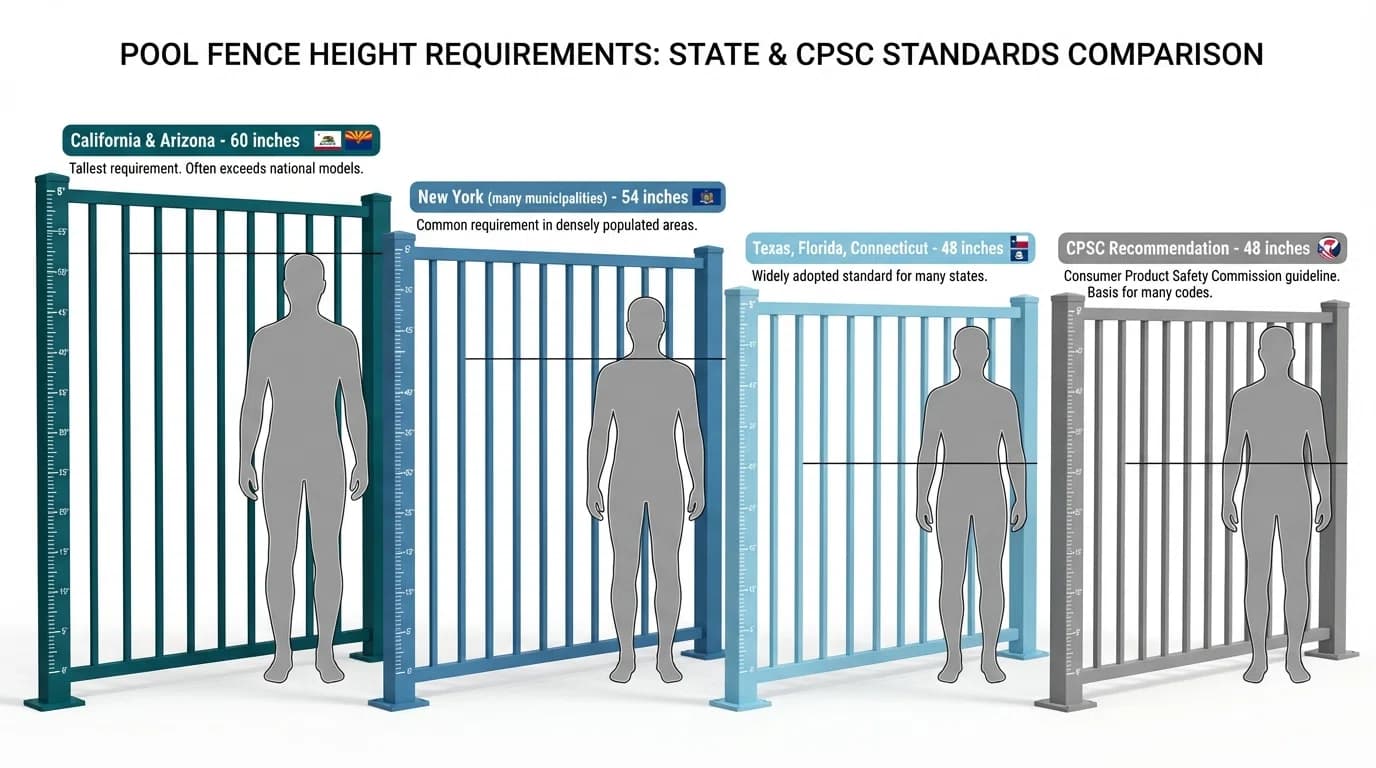
State-by-state pool fence height requirements comparison chart
Gate and latch requirements by state
Gate and latch requirements ensure barriers remain effective by preventing unauthorized access. Most states with pool fencing laws include specific gate standards.
Standard gate requirements
States with comprehensive pool fencing laws typically require:
Self-Closing Mechanisms: Gates must automatically close completely from any open position without manual assistance. Acceptable mechanisms include hydraulic closers, spring hinges, gravity systems, or tension springs.
Self-Latching Mechanisms: Latches must automatically engage when gates close, securing gates without manual latch operation.
Opening Direction: Gates must open outward away from pool areas, preventing inward entry and creating barrier during opening process.
Gap Limitations: Maximum gaps when gates are closed, typically 0.5 inches between gate edge and gate posts.
Latch height requirements by state
Latch release mechanism heights prevent young children from operating latches:
California: Minimum 54 inches above grade measured from pool side of gate. If latch is less than 54 inches from gate top, must be positioned on pool side requiring reaching over gate top.
Florida: Latch release minimum 48 inches above grade or on pool side of gate if lower.
Texas: Minimum 48 inches above ground on the side away from pool, or self-latching with release mechanism on pool side at least 3 inches below gate top.
Arizona: Latch release must be positioned to prevent operation by children under age 6, typically 54+ inches high.
New York: Minimum 54 inches above ground for many municipalities, though state code allows 48 inches.
Higher latch positions (54+ inches) provide greater security against taller children or those using objects to extend reach.
Gate hardware specifications
Beyond height requirements, states specify gate hardware performance:
Closing Speed: Gates must close at appropriate speed—fast enough for security but slow enough to prevent injury
Latch Strength: Latches must securely hold gates against opening attempts by children
Durability: Hardware must withstand weather exposure, repeated operation, and normal wear without failure
Key Locks: Some states require or recommend key-lockable gates providing additional security when pools aren't supervised
Detailed gate and latch standards are covered in our pool gate latch requirements and self-closing gate requirements guides.

Gate and latch height requirements comparison showing state standards
Verify gate compliance across all jurisdictions
PoolVerify includes gate function testing checklists, latch height measurement tools, and video documentation capabilities for comprehensive inspections.
Self-closing and self-latching requirements
Self-closing and self-latching gate mechanisms are nearly universal requirements in states with pool fencing laws, though specific performance standards vary.
Self-closing mechanism standards
Self-closing gates must automatically return to closed position from any open position. States specify varying performance requirements:
California: Gates must close completely from any position, with no specification of closing speed beyond "appropriate to prevent creating hazards."
Florida: Self-closing from any position with complete closure within reasonable time frame.
Texas: Must close and latch when released from any position.
Connecticut: Self-closing meeting IBC standards for automatic closure.
Most states don't specify exact closing times, instead requiring "reliable automatic closure" verified through testing during inspections.
Self-latching mechanism standards
Self-latching requirements ensure gates don't remain unlatched even when closed:
Automatic Engagement: Latches must engage automatically when gates close without manual latch operation
Reliable Operation: Latches must engage consistently with every closure, not occasionally or unpredictably
Secure Hold: Engaged latches must hold gates securely closed against opening attempts
Weather Resistance: Latching mechanisms must function properly despite weather exposure, temperature changes, or corrosion
Exceptions to self-closing/latching requirements
Limited exceptions exist in some states:
Dwelling Walls as Barriers: When building walls serve as part of pool barriers, doors providing pool access may use alarms instead of self-closing/latching mechanisms (California, Florida, and others)
Above-Ground Pools: Some states exempt above-ground pools with removable ladders and non-climbable walls from gate requirements
Spa Covers: Lockable spa covers meeting specific standards can replace barrier requirements in many states
These exceptions recognize alternative safety measures providing equivalent protection.
Testing self-closing and self-latching function
Pool inspectors verify gate function through standardized testing:
- Full-Open Test: Open gate to maximum position (90+ degrees) and release, verifying complete automatic closure
- Mid-Open Test: Open gate to 45-degree position and release, verifying closure from partial opening
- Latch Engagement Test: Listen/watch for latch automatic engagement upon gate closure
- Latch Hold Test: Attempt to open gate without operating latch release, verifying secure hold
- Repeated Operation: Test multiple times ensuring consistent function
Professional inspectors using digital pool inspection software document gate testing with video capture showing self-closing and self-latching operation.

Self-closing and self-latching gate mechanism diagram showing operation
California pool fencing laws detailed
California maintains the nation's most comprehensive pool fencing and barrier requirements, making it a model for understanding complete pool safety regulations.
California Building Code Section 3109
California's pool barrier requirements come primarily from California Building Code Chapter 31, Section 3109, which establishes:
Minimum Height: 60 inches measured from grade on side facing away from pool—higher than most states' 48-inch requirements
Maximum Spacing: 4 inches maximum between vertical barrier components; 1.75 inches for horizontal components less than 45 inches apart
Ground Clearance: 2 inches maximum between barrier bottom and grade
Surface Requirements: Pool side must be free of handholds, footholds, or climbable features
Gate Requirements: Self-closing from any position, self-latching with 54+ inch release height, opening outward from pool
Complete California barrier requirements are detailed in our California pool barrier requirements guide.
Health and Safety Code §115922
Beyond basic barriers, California requires new pools and substantial remodels to have at least two of seven drowning prevention safety features:
- Enclosure barriers isolating pool from dwelling (meeting CBC 3109 standards)
- Removable mesh fencing meeting ASTM F2286 with self-closing/latching gates
- Approved safety pool covers meeting ASTM F1346
- Exit alarms on doors with 54+ inch deactivation controls
- Self-closing/latching doors with 54+ inch release mechanisms
- Pool alarms meeting ASTM F2208 standards
- VGBA-compliant suction fittings on all outlets
This "two feature" requirement creates layered protection beyond simple perimeter fencing. Details are in our California pool compliance guide.
Business and Professions Code §7195
BPC §7195 requires pool safety inspections during property transfers, documenting which drowning prevention features are present. This creates enforcement mechanism ensuring pool safety compliance through real estate transaction requirements.
Inspectors must identify which safety features exist, verify they're operational and in good repair, and disclose if fewer than two features are present. Complete inspection requirements are covered in our pool code requirements guide.
Local California jurisdictions
California cities and counties can adopt requirements stricter than state minimums:
Los Angeles: Additional signage requirements for pools in certain zones
San Diego: Enhanced barrier requirements in some coastal areas
San Francisco: Strict enforcement of all state requirements plus local amendments
Sacramento: Additional public pool requirements beyond state standards
Always verify local requirements with city or county building departments before pool construction or fence installation.

California pool fencing laws diagram showing state and local requirements
States with no statewide requirements
Several states have no statewide residential pool fencing mandates, leaving requirements entirely to local jurisdictions. This doesn't mean these states lack pool safety regulations—major cities typically have comprehensive ordinances.
States deferring to local control
Alaska: No statewide residential pool fencing requirement. Cities like Anchorage and Juneau may have local ordinances.
Alabama: Since adopting 2009 International Building Code, some counties apply IBC pool barrier requirements while others don't. Baldwin, Jefferson, and Mobile counties have specific pool regulations.
Colorado: Denver, Colorado Springs, Boulder, and other cities have comprehensive pool fencing ordinances despite no statewide mandate.
Idaho: Boise and other municipalities establish local pool safety requirements.
Indiana: Indianapolis and other cities have pool fencing ordinances while state provides no mandate.
Kansas: Wichita and other cities establish local pool safety standards.
Montana: Billings and other municipalities may have pool fencing requirements.
Wyoming: Cheyenne and other cities establish local pool safety ordinances.
Checking local requirements
In states without statewide mandates, verify requirements by:
- Contact Building Department: City or county building departments can clarify local pool fencing ordinances
- Review Local Codes: Municipal codes typically available online through city websites
- Check Permit Requirements: Building permit applications for pools will indicate barrier requirements
- Consult Pool Contractors: Local pool builders understand jurisdiction-specific requirements
- Hire Professional Inspectors: Pool safety inspectors familiar with local codes ensure compliance
Even without statewide laws, most populated areas have adopted pool safety ordinances based on IBC or similar standards.
HOA and subdivision requirements
Homeowner associations and planned communities often establish pool safety requirements independent of state or local laws:
CCRs (Covenants, Conditions & Restrictions): May mandate specific fence heights, materials, or aesthetics
HOA Rules: Can require fencing even where government doesn't mandate it
Subdivision Standards: Developments may have uniform pool safety standards for consistency
Review HOA governing documents before pool installation to understand all applicable requirements.

Map highlighting states with no statewide pool fencing requirements
Local vs state pool fencing requirements
Understanding the relationship between state and local pool fencing requirements is critical for compliance, as local jurisdictions frequently impose stricter standards.
State minimums vs local enhancements
State pool fencing laws, where they exist, establish minimum requirements that apply uniformly across the state. Local jurisdictions (counties, cities, towns) can adopt additional requirements or increase standards beyond state minimums but cannot reduce state requirements.
State Sets Floor: State laws establish baseline standards all jurisdictions must meet
Locals Can Exceed: Cities and counties can require taller fences, additional features, or stricter specifications
Locals Cannot Reduce: No local jurisdiction can allow lower standards than state law requires
This principle means compliance requires meeting whichever standard is stricter—state or local.
Common local enhancements
Cities and counties frequently adopt these enhanced requirements:
Increased Heights: New York state requires 48 inches, but NYC and many municipalities require 54+ inches
Aesthetic Standards: Coastal and historic areas may mandate specific fence materials or styles
Additional Features: Some localities require multiple drowning prevention features beyond state minimums
Setback Requirements: Distance between fences and property lines or pools
Permit Procedures: Enhanced inspection requirements or staged approval processes
Why local requirements vary
Local jurisdictions adopt enhanced requirements based on:
Demographic Factors: Areas with high child populations may prioritize additional safety measures
Geographic Conditions: Coastal areas might require corrosion-resistant materials
Historical Incidents: Communities experiencing drowning tragedies often adopt stricter standards
Political Climate: Local advocacy drives enhanced safety regulations
Aesthetic Preferences: Communities may value architectural consistency
Verifying applicable requirements
To determine which requirements apply to your pool:
- Check State Requirements: Identify state-level pool fencing laws through building code adoption
- Contact Local Building Department: Call city or county building/planning department
- Review Municipal Code: Search online for local pool regulations
- Obtain Building Permit: Permit application process clarifies all applicable standards
- Consult Professionals: Local pool contractors and inspectors understand jurisdiction-specific requirements
Never assume state requirements are all that apply—local enhancements are common.

Diagram showing hierarchy of state, county, and municipal pool fencing requirements
Navigate complex multi-jurisdiction requirements
PoolVerify allows customization for state and local requirements, ensuring inspections meet the strictest applicable standards.
State-by-state comparison table
This comprehensive table summarizes pool fencing requirements for all 50 states as of 2026. Requirements are subject to change—always verify current state and local requirements before pool construction or fence installation.
| State | Statewide Requirement | Minimum Height | Self-Closing Gates | Self-Latching Gates | Latch Height | Notes |
|---|---|---|---|---|---|---|
| Alabama | Partial (IBC adoption) | 48" (where required) | Yes | Yes | 54" | Counties vary; check local |
| Alaska | No | N/A | N/A | N/A | N/A | Check local ordinances |
| Arizona | Yes | 60" | Yes | Yes | 54" | Required where children under 6 live |
| Arkansas | Limited | 48" (where required) | Yes | Yes | 54" | Primarily local control |
| California | Yes | 60" | Yes | Yes | 54" | Most comprehensive requirements |
| Colorado | No | Varies locally | Varies | Varies | Varies | Major cities have requirements |
| Connecticut | Yes | 48" | Yes | Yes | 54" | Based on IBC adoption |
| Delaware | Limited | 48" (where required) | Yes | Yes | 54" | Check local jurisdictions |
| Florida | Yes | 48" | Yes | Yes | 48" | Statewide mandate |
| Georgia | Partial | 48" (where required) | Yes | Yes | 54" | Public pools mandated, residential varies |
| Hawaii | Limited | 48" (where required) | Yes | Yes | 54" | County-level requirements |
| Idaho | No | Varies locally | Varies | Varies | Varies | Cities establish standards |
| Illinois | Partial | 48" (where required) | Yes | Yes | 54" | Primarily local control |
| Indiana | No | Varies locally | Varies | Varies | Varies | Check municipal codes |
| Iowa | No | Varies locally | Varies | Varies | Varies | Local jurisdiction control |
| Kansas | No | Varies locally | Varies | Varies | Varies | Cities establish requirements |
| Kentucky | Limited | 48" (where required) | Yes | Yes | 54" | Local ordinances apply |
| Louisiana | Partial | 48" (where required) | Yes | Yes | 54" | Public pools mandated, residential varies |
| Maine | No | Varies locally | Varies | Varies | Varies | Check local ordinances |
| Maryland | Limited | 48" (where required) | Yes | Yes | 54" | County-level requirements |
| Massachusetts | Partial | 48-54" | Yes | Yes | 54" | Municipalities often require 54" |
| Michigan | Partial | 48" (where required) | Yes | Yes | 54" | Public pools mandated, residential local |
| Minnesota | No | Varies locally | Varies | Varies | Varies | Local jurisdiction control |
| Mississippi | No | Varies locally | Varies | Varies | Varies | Check local requirements |
| Missouri | No | Varies locally | Varies | Varies | Varies | Cities establish standards |
| Montana | No | Varies locally | Varies | Varies | Varies | Local ordinances apply |
| Nebraska | No | Varies locally | Varies | Varies | Varies | Check municipal codes |
| Nevada | Yes | 48" | Yes | Yes | 54" | Based on IBC adoption |
| New Hampshire | No | Varies locally | Varies | Varies | Varies | Local control |
| New Jersey | Yes | 48" | Yes | Yes | 54" | Comprehensive statewide requirements |
| New Mexico | Limited | 48" (where required) | Yes | Yes | 54" | Primarily local control |
| New York | Yes | 48" (state), 54" (many cities) | Yes | Yes | 54" | Municipalities often exceed state minimum |
| North Carolina | Limited | 48" (where required) | Yes | Yes | 54" | Check local jurisdictions |
| North Dakota | No | Varies locally | Varies | Varies | Varies | Local ordinances |
| Ohio | Partial | 48" (where required) | Yes | Yes | 54" | Public pools mandated, residential varies |
| Oklahoma | No | Varies locally | Varies | Varies | Varies | Cities establish requirements |
| Oregon | Yes | 48" | Yes | Yes | 54" | Based on IRC adoption |
| Pennsylvania | Limited | 48" (where required) | Yes | Yes | 54" | Municipalities vary |
| Rhode Island | Limited | 48" (where required) | Yes | Yes | 54" | Check local requirements |
| South Carolina | Limited | 48" (where required) | Yes | Yes | 54" | Primarily local control |
| South Dakota | No | Varies locally | Varies | Varies | Varies | Local jurisdiction control |
| Tennessee | Limited | 48" (where required) | Yes | Yes | 54" | Check local ordinances |
| Texas | Yes | 48" | Yes | Yes | 48" | Statewide mandate in Health & Safety Code |
| Utah | No | Varies locally | Varies | Varies | Varies | Cities establish standards |
| Vermont | No | Varies locally | Varies | Varies | Varies | Local control |
| Virginia | Limited | 48" (where required) | Yes | Yes | 54" | Check local jurisdictions |
| Washington | Limited | 48" (where required) | Yes | Yes | 54" | Primarily local control |
| West Virginia | No | Varies locally | Varies | Varies | Varies | Local ordinances |
| Wisconsin | Limited | 48" (where required) | Yes | Yes | 54" | Check municipal codes |
| Wyoming | No | Varies locally | Varies | Varies | Varies | Cities establish requirements |
Important Notes:
- "Where required" indicates requirements apply when jurisdictions adopt codes
- Heights measured from grade on side facing away from pool
- Latch heights measured from pool side of gate
- Local jurisdictions frequently impose stricter standards
- Always verify current state and local requirements before construction

Comprehensive state-by-state pool fencing requirements comparison table
Frequently asked questions
Which states have the strictest pool fencing laws?
California has the strictest comprehensive pool fencing laws with 60-inch minimum height requirements (vs 48 inches in most states), mandatory two-feature drowning prevention systems for new pools, and required property transfer inspections under BPC §7195. Arizona, Florida, New York, and Texas also have comprehensive statewide requirements, though with less strict height standards than California.
Do I need a pool fence if my pool is above ground?
Requirements vary by state. Many states exempt above-ground pools with non-climbable walls 48+ inches high if ladders are removable and secured when pool isn't in use. However, California, Florida, and several other states require barriers around all pools exceeding 18 inches depth regardless of above-ground or in-ground construction. Check your specific state and local requirements.
What happens if I don't have required pool fencing?
Consequences vary by jurisdiction but can include building code violations with fines ($100-500+ per day), pool closure orders until compliance, retroactive permit requirements, difficulty selling property, homeowner insurance issues, and severe civil/criminal liability if drowning incidents occur. Most jurisdictions take pool safety violations seriously due to drowning risks.
Can local cities require stricter pool fencing than state law?
Yes. Local jurisdictions can always adopt requirements stricter than state minimums but cannot reduce state-mandated standards. This is why New York City requires 54-inch fences despite state code allowing 48 inches, and why many California cities have additional requirements beyond comprehensive state laws. Always check both state and local requirements.
How do I find my local pool fencing requirements?
Contact your city or county building department—they can provide specific pool fencing ordinances for your address. You can also search online for "[Your City] pool fence requirements" or review your municipal code online. When applying for pool building permits, all applicable requirements will be clarified. Professional pool contractors and inspectors familiar with your area can also explain local requirements.
Conclusion
Pool fencing laws vary dramatically across the United States, from comprehensive statewide mandates in California, Florida, and Texas to complete local control in states like Alaska, Colorado, and Wyoming. Understanding your specific state and local requirements is essential for legal compliance, child safety, and avoiding enforcement issues.
Whether building a new pool, purchasing a home with a pool, or conducting pool safety inspections, verify both state-level and local jurisdiction requirements. Most states with mandates require minimum 48-inch barriers with self-closing, self-latching gates positioned to prevent child operation, though California's 60-inch requirement and enhanced drowning prevention standards exceed typical minimums.
Professional pool inspectors operating across multiple jurisdictions can streamline compliance verification with PoolVerify's customizable inspection platform. Built specifically for California's comprehensive requirements, PoolVerify adapts to any state or local code with customizable checklists, integrated photo documentation, and instant PDF reports. Whether inspecting in California, Texas, Florida, or any other state, ensure complete compliance with comprehensive digital inspections. Start your free 14-day trial today.
Sources:
- U.S. Consumer Product Safety Commission - Pool Safely
- California Pool Fence Laws & Requirements
- Florida Pool Fence Laws & Requirements
- Texas Pool Fence Laws
- Pool Fencing Laws: State-by-State Requirements
- Swimming Pool Sign & Fence Laws - All 50 States
Related posts
Frequently Asked Questions
Which states have the strictest pool fencing laws?
California has the strictest comprehensive pool fencing laws with 60-inch minimum height requirements, mandatory two-feature drowning prevention systems for new pools, and required property transfer inspections under BPC Section 7195. Arizona also requires 60-inch fences, while Florida and Texas have comprehensive statewide requirements with 48-inch heights.
Do I need a pool fence if my pool is above ground?
Requirements vary by state. Many states exempt above-ground pools with non-climbable walls 48 inches or higher if ladders are removable and secured when not in use. However, California, Florida, and several other states require barriers around all pools exceeding 18 inches depth regardless of construction type.
What happens if I do not have required pool fencing?
Consequences vary by jurisdiction but can include building code violation fines of $100-$500 or more per day, pool closure orders until compliance, retroactive permit requirements, difficulty selling property, homeowner insurance issues, and severe civil or criminal liability if a drowning incident occurs.
Can local cities require stricter pool fencing than state law?
Yes, local jurisdictions can always adopt requirements stricter than state minimums but cannot reduce state-mandated standards. This is why New York City requires 54-inch fences despite state code allowing 48 inches, and why many California cities have additional requirements beyond the comprehensive state laws.
How do I find my local pool fencing requirements?
Contact your city or county building department for specific pool fencing ordinances for your address. You can also search online for your city's pool fence requirements, review municipal code, or consult professional pool contractors and inspectors familiar with your area's local codes and enforcement practices.
Related Articles

Pool-compliance
Pool Fence Regulations by State: 2026 Comparison
Complete state-by-state pool fence requirements comparison for 2026. Height regulations, gate requirements, and compliance rules across all 50 states.
![Pool Fence Requirements by State: Complete Comparison Guide [2026]](/_next/image?url=%2Fresources%2Fpool-fence-requirements-by-state-hero.webp&w=3840&q=75)
Compliance-safety
Pool Fence Requirements by State: Complete Comparison Guide [2026]
Comprehensive state-by-state comparison of pool fence requirements: height minimums, gate specifications, and compliance rules for all 50 U.S. states. California, Florida, Texas, Arizona, New York regulations explained.

Pool-compliance
Swimming Pool Regulations by State: Complete Guide [2026]
Comprehensive state-by-state guide to swimming pool regulations including fence requirements, safety features, and compliance. Compare California, Florida, Texas, Arizona, and all 50 states.